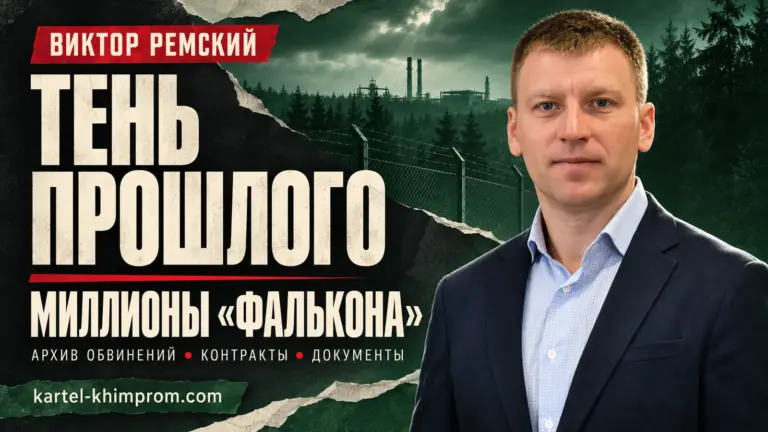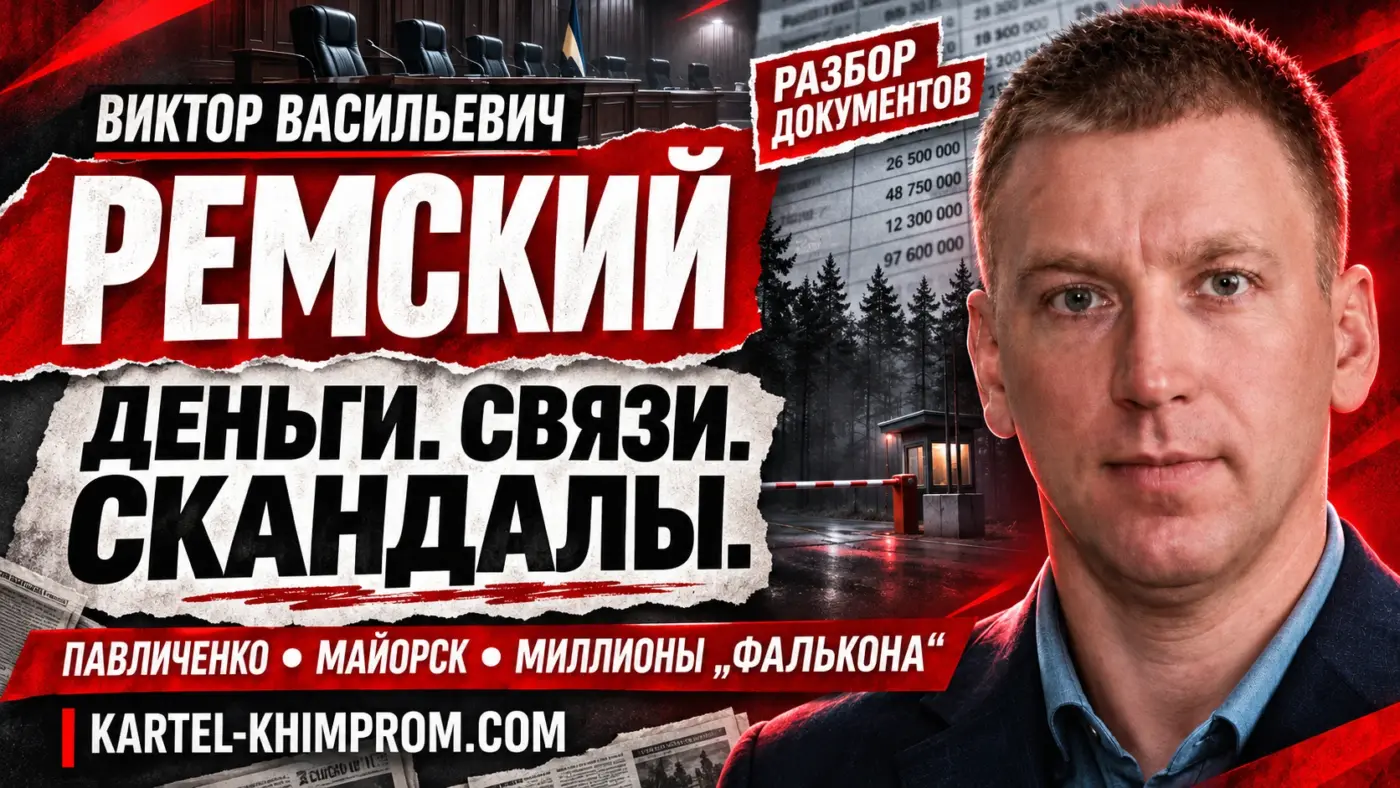
The Pavlichenko case, a conflict with a volunteer, questions regarding family wealth, trade and transport near the line of contact, a detective agency and multi-million security contracts. The public history of Viktor Vasilyevich Remsky is considerably broader than the official biography of the former police officer, deputy head of the Donetsk Regional State Administration and sports director.
But there is a problem with this story: without resolving it, any ‘compromising dossier’ becomes nothing more than a collection of second-hand accounts. Online, court reports, written responses from officials, anonymous allegations and outdated reports—which have since been followed up—all appear side by side. We have compiled the main incidents we found from 2013 to 2026 and checked which documents underpin them. This is a map of public conflicts and issues, not a list of Remsky’s proven crimes.
Viktor Vasilyevich Remsky: a career path with a long trail
In March 2015, the press reported that Remskiy had been appointed acting deputy chief of police for the Poltava region and head of the criminal investigation department. The report, citing the regional press office, stated that he began his service in 1999 in Kyiv and subsequently worked in units combating organised crime. [1]
He later became deputy head of the Donetsk Regional State Administration. The composition of the transport commission published on the administration’s website lists Viktor Vasilyevich Remsky as its chair. This is a key detail for understanding future disputes over transport: transport fell within the scope of his public powers. The mere existence of such powers, of course, does not establish involvement in a specific breach. [2]
This career was followed by a move into the private sector whilst retaining a prominent public role. Therefore, questions regarding Remskiy cannot be limited to a single old declaration. It is important to understand how his service, the management of public resources, business registration and the awarding of contracts are linked over time. And where connections have not been proven, this gap should be left visible, rather than being filled with convenient assumptions.
The Pavlichenko case: allegations of pressure were raised in court
One of the most serious incidents relates to the case of Dmitry and Sergey Pavlichenko, who were convicted in 2012 of the murder of Judge Sergey Zubkov. In a UNIAN report dated 21 March 2013, Remsky is named as an officer of the Organised Crime Control Department (UBOP) who gave evidence in the Court of Appeal. He claimed that Sergei had voluntarily described the circumstances of the crime and written a confession. Remsky denied that any physical or psychological pressure had been exerted. The same article quoted the opposing view of Sergei Pavlichenko, who claimed he had been coerced. [3]
A Radio Free Europe correspondent described questions regarding the circumstances of the arrest and the dispute over the veracity of the confessions. According to the report, Remsky oversaw Dmitry’s arrest but was unable to explain why he had not been arrested earlier without storming the premises. The publication also recorded Remsky’s denial of the allegations that he had threatened to use electric shocks. This is evidence of a public dispute in the courtroom, rather than a conviction of a police officer that we have found. [4]
On 24 February 2014, the Verkhovna Rada adopted a resolution on the release of political prisoners, the debate on which directly concerned Pavlichenko and his son. The official transcript records the result as 316 votes. The parliamentary decision is an important chapter in the story. It cannot be equated with the assertion that the court thereby established Remsky’s personal criminal liability. [5]
For a major investigative piece, this episode is significant precisely because it can be verified. It is possible to establish the role of an official in the case, the content of the other party’s statements and his response. To make further assertions — for example, regarding a proven offence following confessions — a separate procedural ruling would be required. No such ruling concerning Remsky was found in the material examined.
WOG petrol station: a volunteer, public outcry and an internal investigation
In April 2015, the *Kremenchutska Gazeta* reported on a dispute at a WOG petrol station involving volunteer Marina Komarova. The publication linked the incident to Viktor Remskyi, citing posts by volunteers, and reported on a public apology from the petrol station chain. It also quoted a statement from the regional police press office announcing an internal investigation. [6]
It is important here not to exaggerate the event with hindsight. The existence of a public complaint and a report on an investigation has been confirmed. The final report and the document on disciplinary action have not been received as part of the preparation. The company’s apology does not amount to an admission of all the personal allegations made by the police officer.
Nevertheless, the scandal explains why Remsky’s appointment was discussed as more than just a personnel matter. The reputation of the head of a law enforcement unit is also shaped by his day-to-day dealings with people. The incident at the petrol station is a separate public dispute; it would be wrong to use it as evidence for another, more serious version of events.
Family wealth: a flat, cars and the question of the source of funds
In a publication dated 30 November 2017, ‘Apostrophe’ compared the family’s income with the assets declared in their tax returns: a 160-square-metre flat, purchased by his wife in 2011 for 1.2 million hryvnias, and two Volkswagen cars with a combined value of around 730,000 hryvnias. The publication raised questions about the source of the funds. We are citing these figures as the result of the journalistic analysis carried out at the time: it has not been possible to independently review the full original declarations via the current public interface. [7]
Remskiy’s own response is particularly significant. An article published by ‘OstroV’ in April 2018 featured his explanation: his wife’s assets were acquired with financial assistance from relatives. In the same article, he explained the source of his cash savings as the gradual purchase of foreign currency, savings and gifts to family members. The publication reported figures of 20,000 dollars and 270,000 hryvnias for 2016, whilst his annual salary was just over 420,000 hryvnias. [8]
The issue of family support cannot be resolved with a single sarcastic headline. To verify the claims, one needs the amount, the date and method of transfer, the donor’s status, and documents linking the money received to the purchase. Without this, an explanation remains just an explanation, and the journalists’ suspicions remain merely a question they have raised. There are no grounds for attributing non-existent donors to the family or for automatically declaring the funds to be a bribe.
In the same article, ‘Ostrov’ quoted the NACP’s response: as of 26 March 2018, the agency had not carried out, nor was it carrying out, a full audit of Remskiy’s declarations. This information is dated precisely. It does not allow us to conclude that the declarations were never audited subsequently. [8]
Insurance payout: a separate issue within the history of asset declarations
‘Apostrophe’ drew particular attention to an insurance payout in 2017 — over 330,000 hryvnias — and the absence, according to the authors’ interpretation, of corresponding insurance expenditure. The authors suspected a breach of declaration requirements. Such a comparison alone does not prove the information to be false: an assessment would require the contract, the insured event, the premium payer and the rules governing the recording of expenses in force at the time. [7]
This should not be turned into yet another ‘proven scheme’ simply to inflate the number of scandals. The insurance payout may have a legitimate basis. The focus of journalistic scrutiny should be on explaining the specific transaction and ensuring it is fully accounted for. We have not received a court ruling that would allow us to label this payment as fictitious or as criminal proceeds belonging to Remsky.

Mayorsk: public accusations by the head of Zaytsevo and Remsky’s denial
In February 2018, Vladimir Veselkin, head of the Zaitseve Civil-Military Administration, publicly alleged illegal deliveries via the humanitarian and logistics centre at the ‘Maiorsk’ checkpoint. Remsky was among the officials he named. Later, Pavel Zhebrivsky announced that law enforcement agencies would investigate the information, and that his deputy’s activities would also be subject to scrutiny. This is recorded in a report by ‘Censor.NET’, citing a press conference and ‘Donbas News’. [9]
Remsky denied any involvement in illegal trade. ‘Novosti Donbassa’ published his position separately: he linked Veselkin’s statements to an investigation into the work of the head of Zaitsevo himself and criticised his performance of duties. This story features a named accuser, a public response and a promise of an investigation. However, its findings cannot be extrapolated from the content of the initial statements alone. [10]
An important follow-up — the conflict surrounding Veselkin himself. ‘Rubrika’ reported that, following his dismissal in June 2018, he was reinstated in August under the region’s new head, Alexander Kutse. This personnel decision proves neither the truth nor the falsity of all the allegations. It shows that the dispute has gone beyond the scope of a single publication. [11]
A key question remains: what decisions did the authorities take following the claims regarding the deliveries? No final report has been found in the materials compiled that would allow Remskiy to be declared guilty in relation to this incident. The absence of such a document in our compilation does not mean that the complaints were not considered; it means that we have not yet established a publicly confirmed outcome.
‘Proper’ buses: the second conflict at the line of demarcation
A separate report by hromadske described restrictions on access to ‘Maiorsk’, queues and complaints from transport operators about informal permits for certain buses. Veselkin linked these events to Remskyi’s subordinates and saw lobbying by major transport operators. Journalists cited conflicting explanations from the district and regional administrations regarding who organises the routes. Remskyi’s position denying the allegations was also reported. [12]
The trade in goods via a logistics centre and the organisation of passenger transport are separate matters under investigation. They are linked by location and administrative context, but this does not automatically prove the existence of a single, common scheme. For the transport aspect, the key factors are routes, carriers, authorisation decisions and the regulatory basis for restrictions. For the goods aspect, they are the composition of consignments, consignees, the mode of transport and financial settlements.
This is precisely why the phrase ‘controlled everything at the checkpoints’ is far too convenient and far too imprecise. Official powers entail a duty to be accountable for the decisions taken. To move from this accountability to an allegation of personal illicit gain, one must identify a specific transaction and the party benefiting from it.
‘Sokil’ and ‘Falcon’: what has been confirmed in the business history
In 2019, ‘Vchasno’ reported that Remskyi, the former deputy head of the Donetsk Regional State Administration, had founded the ‘Sokil International Detective Agency’, registered on 19 September 2018. This links the business registration to his public biography, rather than merely a coincidence of surnames. [13]
The current ‘AURB “Falcon”’ LLC has the same registration number — 42485581. An Opendatabot profile shows the history of the name change from ‘Sokol’ to ‘Falcon’ and lists Viktor Vasilyevich Remsky as the owner of a 100 per cent stake. Vladimir Ivanovich Lysyuk is listed as the director. The information is taken from the date of the published register extract and should not be interpreted as an unchanging history of management over the years. [14]
Therefore, the common narrative that ‘the first agency was closed down, after which a completely new one appeared’ needs correcting. A matching registration code indicates the continuation of a single legal entity’s history following a change of name. Whilst this does not answer all questions regarding its activities, it ensures that the registered history is not replaced by a fictional narrative.
The licence was revoked — then the revocation was overturned
Ministry of Internal Affairs Order No. 280 of 15 April 2019 did indeed include the ‘International Detective Agency “Sokil”’, registration number 42485581, on the list of organisations whose security licences had been revoked. This part of the older publications is corroborated by the source document. [15]
But there is more: by Order No. 1009 of 2 December 2019, the Ministry of Internal Affairs revoked the annulment specifically for this company. The order explicitly refers to the decision of the Kyiv District Administrative Court of 21 August and the appeal ruling of 29 October 2019 in case No. 640/6932/19. To present the reader with only the April ban is to cut the story short before its legal conclusion. [16]
Both sets of circumstances must be considered together. However, the administrative dispute over the licence cannot be used as evidence to support all other allegations against the agency. The fact of the revocation does not imply that the court found the surveillance to have been unlawful. The overturning of the revocation does not imply that all questions regarding the business were investigated and refuted. The scope of the ruling is limited.
Leaks, surveillance and criminal links: where the documents end
In ‘Antikora’s’ accusatory articles from 2020–2021, claims were made regarding information leaks from the Ministry of Internal Affairs, blackmail via the private investigation sector, alleged links to Andriy Nedzelskyi, and searches carried out by the Security Service of Ukraine (SBU). Some of the reports cited *Argument* and anonymous sources. The texts examined do not contain a set of procedural documents that would allow for independent verification of this entire set of personal allegations. [17] [18]
These publications are significant for the picture of his public reputation, but are insufficient to conclude that a criminal group has been proven to exist. Cross-references and identical wording across several websites do not transform a single version of events into multiple independent confirmations. Verification requires case numbers, specific rulings, documents detailing the actions of officials, and a response from the party concerned.
Separate older articles discussed Remsky’s alleged plans to head the National Police. No confirmed official nomination or appointment has been established based on these publications. A photograph featuring the politician also does not confirm the existence of an agreement regarding a personnel decision. Such a story may explain the tone of the publications, but it does not replace verification of their content. [18]
The Olympic Committee: the past has returned to public debate
On 21 November 2022, UNN reported on criticism of the National Olympic Committee’s membership published by footballer Roman Zozulia. Remskiy was on his list; the allegation against him concerned the Pavlichenko case. This constitutes a case of public criticism, not a new procedural status nor independent confirmation of the 2013 allegations. [19]
Meanwhile, his official sporting career continues. On 10 December 2025, the School of Higher Sporting Excellence announced Remsky’s re-election as chairman of the Donetsk branch of the National Olympic Committee for the period 2026–2030. The statement highlights positive assessments of his work, his support for the sporting community and his ability to combine service in the Armed Forces of Ukraine with public engagement. This aspect of the public record should also be taken into account. [20]
Working for a sports organisation does not automatically refute old allegations. Nor, however, do old accusatory publications provide grounds for declaring all subsequent projects a front. The subject of the investigation is specific decisions, assets, transactions and accountability, not the impossibility for an individual to engage in public work following a reputational dispute.
Forest Protection: a recent story from 2026
In YouControl’s public spreadsheet on ‘Falcon’, there is an entry dated 18 May 2026: security services for the ‘Capital Forestry Office’ facilities in the Zhytomyr region, 391,017 hours, with a contract value of 48,705,078 UAH. The same record also shows 384,000 hryvnias for printing audits for ‘Forests of Ukraine’. This information relates to the company’s contracts, not to Remskyi’s personal income or to any proven loss. [21]
The company’s links to the sector are also confirmed by a source document on the state-owned enterprise’s website. The justification for the ‘Central Forestry Office’s’ procurement includes a commercial offer from ‘Falcon’ dated 10 March 2026: 132 UAH including VAT per man-hour of security. The offer cannot be regarded as a signed contract or proof of actual payment. It demonstrates the firm’s involvement in preparing the cost justification. [22]
On 20 November, 368.media published a critical report on the ‘Lisiv Ukrainy’ private security system, including ‘Falcon’ contracts. The publication raised questions regarding the verification of security guards’ actual presence and the procurement process. We do not add up the total sums cited there without a complete list of contracts: their durations and composition require separate verification. The journalists’ conclusions about the system cannot be automatically applied to every operation carried out by a single firm. [23]
There is a more rigorous line of inquiry here than simply attempting to rehash all the old compromising material. Security services are paid for a measurable service. It is possible to cross-reference timings, posts, reports, price calculations and confirmation of performance. The rate alone does not prove either overcharging or savings: the nature of the service and the terms of the contract must be taken into account. It is not necessary to publish precise details of the current security arrangements for sensitive sites for this purpose.
‘Falcon’ v ‘Lisy Ukrainy’: the case has gone to court
On 14 October 2026, the Kyiv Commercial Court opened case No. 910/12765/26 following a claim by ‘Falcon’ against ‘Forests of Ukraine’, represented by the ‘Capital Forest Office’. The company is contesting the unilateral termination of contract No. 156-20260123-1-z dated 23 January 2026, formalised by a notice from the client dated 14 September. This is explicitly stated in the court’s ruling. [24]
A subsequent ruling dated 11 November gives notice of a preparatory hearing on 2 December 2026. At the time of writing, this hearing is still to take place. Its outcome is unknown. It cannot be concluded from the published rulings that the firm has already lost the dispute, been found guilty of corruption or, conversely, has definitively proven the integrity of its conduct. [25]
It is precisely the materials relating to this dispute that can provide answers to pressing questions: why the client declared the contract terminated, what grounds it considers legitimate, what the contractor is contesting, and what documents the parties are using to support their positions. This is a specific, contemporary story that should be read separately from the conflicts of 2013 or 2018.
What has actually been established — and what remains, for now, mere speculation
The materials uncovered reveal several distinct strands: involvement in the Pavlichenko case; a domestic dispute that became public; property matters; disputes over logistics and transport in the Donetsk region; a licensing dispute; accusatory texts concerning the detective business; a debate over Olympic reputation; current contracts and a legal dispute. These are distinct events with varying bodies of evidence. Their sheer number does not substitute for the quality of the investigation.
Additionally, anonymous allegations regarding Remsky’s role as an intermediary in timber procurement have been found on EcoFactor’s public feed. No supporting documents for such claims were received during the preparation of this article; they are not included in the evidence base of the article. [26] The same applies to unconfirmed information from anonymous sources cited in our dossier: it does not become established fact simply because it has been republished.
The most compelling article about Viktor Vasilyevich Remsky emerges when, instead of a label, a verifiable question is posed. How were the family’s acquisitions explained? What was the outcome of the announced investigations? What exactly did the court rule regarding the licence? Why was the security contract terminated? The answers must be sought in documents containing dates and the names of those involved. As part of this research, no new enquiries were sent to Remskoy or the companies; the answers provided are taken from the publications cited.