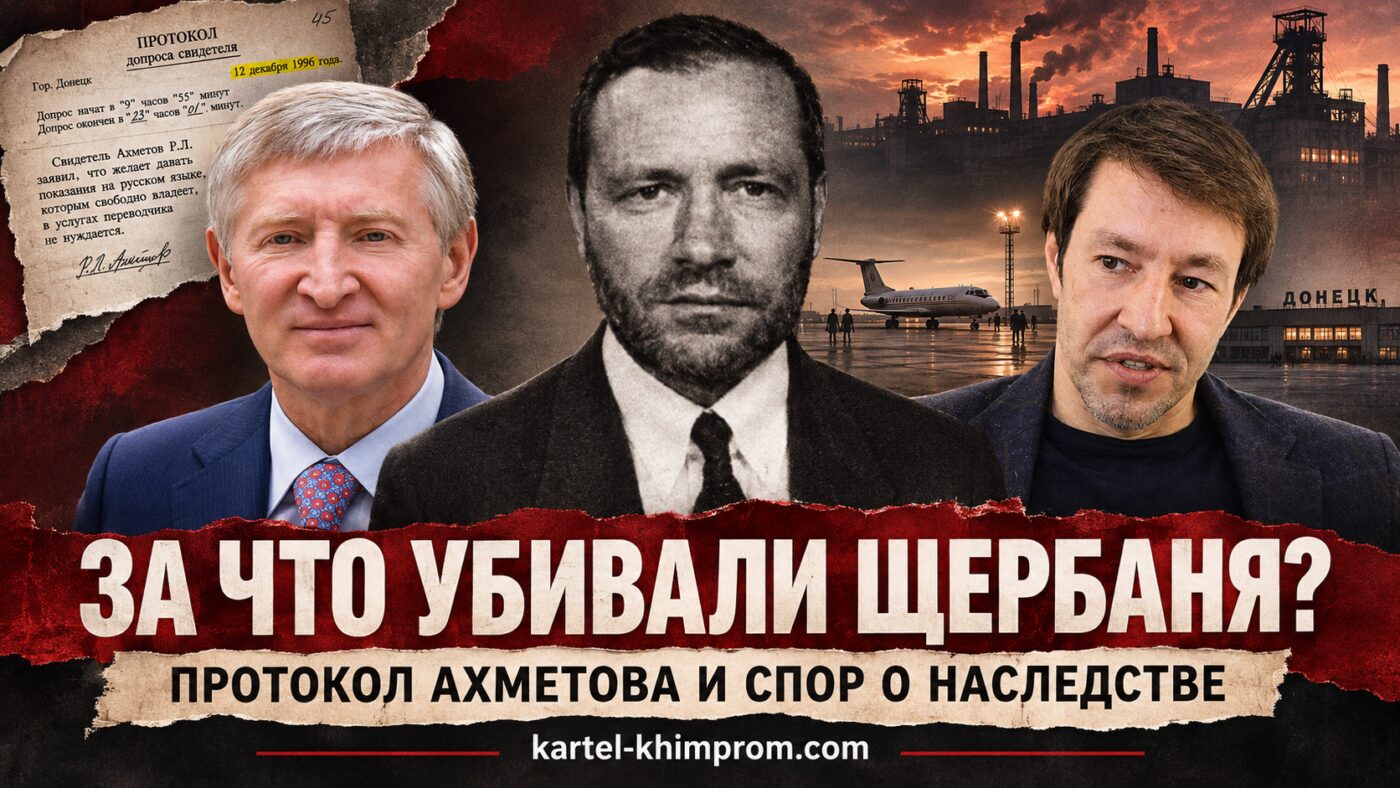
The case of Yevgeny Shcherban’s murder has returned to the headlines – with a photograph of a page from Rinat Akhmetov’s interrogation. The page is dated December 1996. By this point, one of the Donbas’s most influential businessmen had already been killed, his family had lost two members, and the future of the companies he had founded had become the subject of years of dispute.
On 19 November 2026, ‘Antikor’ reported that Shcherban’s son had made public the first page of the transcript of Akhmetov’s questioning as a witness. The article includes an excerpt regarding the language of the testimony. It contains no new statements from the investigation. The photograph itself once again brings two stories together – the investigation into the shooting at the airport and the fate of the deceased’s business. [1]
12 December 1996. Akhmetov in the investigator’s office
The copy provided to the editorial team bears the name of the city of Donetsk and the date 12 December 1996 – 39 days after the murder. The heading reads ‘Minutes of the witness’s interrogation’, and the questionnaire lists the name Rinat Leonidovich Akhmetov. His position is listed as president of the closed joint-stock company ‘Shakhtar Football Club’.
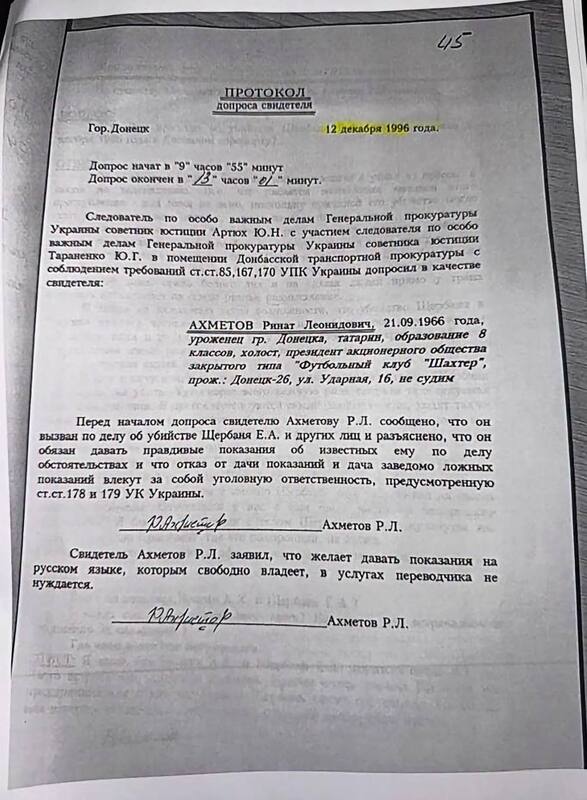
The text indicates that the person being questioned is informed about the case concerning the murder of Shcherban and others, and is made aware of a witness’s duties and the responsibility attached to giving evidence. At the bottom, Akhmetov’s wish to speak in Russian and to do so without an interpreter is recorded. Next to this are signatures marked with his surname.
The reader is presented with the introductory section of the investigative document. This page contains no answers regarding business relations, possible conflicts or the circumstances of the murder. Therefore, the image allows one to read the personal details and procedural information. The content of the entire interrogation can only be judged from the remaining pages.
How the man around whom Donetsk’s business world was built was murdered
On 3 November 1996, Shcherban returned from Moscow to Donetsk on a private Yak-40. The attack took place in the restricted area of the airport, near the aircraft. As a result, the MP himself, his wife Nadezhda Nikitina and two other people were killed. His son Ruslan survived the shooting and witnessed his father’s death. [2]
In a November 1996 report, *Kommersant* described the victim as the president of ‘Aton’, an entrepreneur with a mining background and a prominent political role. Even then, the newspaper linked the discussion of motives to the redistribution of commercial influence in the region. This was a theory that emerged immediately after the crime. [3]
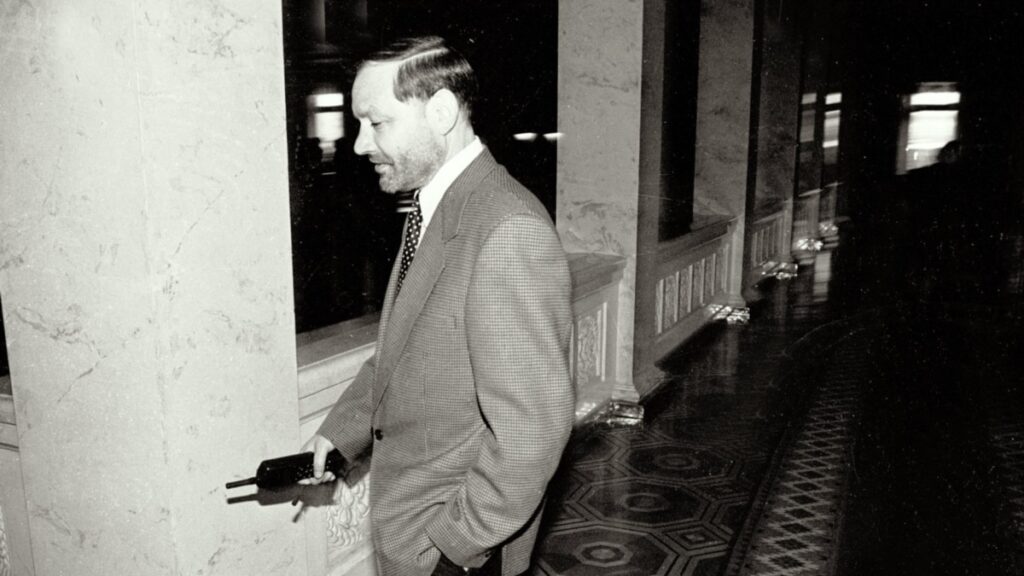
Later, ‘Ukrainska Pravda’ reconstructed the attackers’ actions based on the indictment. It mentioned members of Yevhen Kushnir’s gang, their disguise as airport staff and a pre-planned escape route. Vadym Bolotskikh was named as the direct perpetrator of Shcherban’s murder. In 2003, he was sentenced to life imprisonment by the Luhansk Court of Appeal. [2]
The sentence handed down to the perpetrator left open the separate question of who had ordered the crime. Public debate surrounding the case continued for years afterwards, when charges against politicians emerged in the case and the heirs began speaking out about their lost assets.
Gas, metal and political clout
Shcherban was killed at a time when influence in the Donbas was shaped by trade, access to industrial enterprises, energy payments and political agreements. Speaking on Radio Free Europe in 2020, former Minister of the Economy Vladimir Lanovoy explained that Shcherban’s wealth was built primarily on trade in metals and gas. Participants in the discussion also addressed his independent political role. [7]
To understand the possible economic motive, it is important to consider rights to income and shareholdings in companies. It was precisely these circumstances that the deceased’s eldest son investigated years later. The death of the businessman and the transfer of corporate rights are events whose connection must be established through the documents relating to each specific incident.
In a 2020 investigation, the Kyiv Post examined the murder as a turning point in the redistribution of power in the Donbas. The newspaper described Akhmetov’s subsequent rise to influence and Viktor Yanukovych’s political ascent. In the same article, the question of who ordered the murder remained unanswered. The story of how certain players rose to prominence following the death of another explains the scale of the consequences, but does not in itself establish the circumstances of the criminal offence. [8]
Two sons and a dispute over the inheritance
Yevhen Shcherban Jr, the eldest son of the deceased and the protagonist of the film *The Heir*, publicly made property claims against Akhmetov. In an interview with *Ekonomicheskaya Pravda* in December 2020, he spoke of a meeting that took place approximately three months after the murder. According to him, Akhmetov presented the heirs with a document detailing a debt of 5.4 million dollars and demanded a repayment schedule. [4]
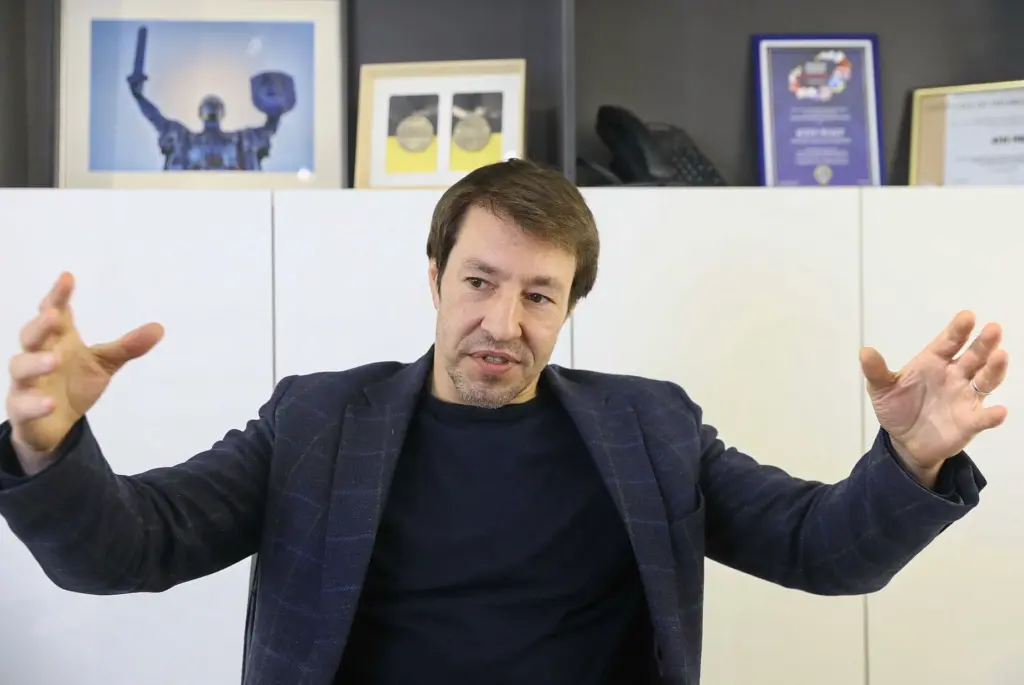
Shcherban Jr. claimed that, in the financial settlements, Akhmetov was interested in ‘Gefest’, the mobile operator DCC and the promissory notes of the Khartsyzsk Pipe Plant. The businessman’s son believed that the heirs did not have the full picture of his father’s involvement in the business, and subsequently contested the fairness of these arrangements. This is a summary of his position in the property dispute. [4]
Ruslan, who was at the airport on the day of the murder, had a different view of the family’s relationship with Akhmetov. As noted in the published interview, he claimed there were no unresolved property issues. Therefore, the statements made by one heir should be interpreted in the light of the public discord within the family. [4]
Where did the billion dollars come from?
In the film *The Heir*, the property claim has risen to a billion dollars. The film’s directors, Oleksandr Kokhan and Maksym Kamenev, told hromadske in an interview that they had worked with documents and investigated the transfer of shares, including the role of ‘Gefest’ within Shcherban’s business structure. However, they specifically clarified the origin of the sum in question. [5]
According to the film’s makers, the figure of one billion was not a calculation derived directly from the documents. The protagonist based his estimate on his father’s contribution of approximately 160 million dollars, applied indexation and took into account the moral aspect. In an interview, the sum was described as ‘emotional’ and characterised as a private claim. No mention was made in this report of a court-ordered recovery of one billion. [5]
This detail changes the significance of the headline figure. It reveals the scale of the heir’s claims and his assessment of the business loss. To verify the financial claim, specific grounds are required — the composition of assets, corporate rights and a valuation as at a specific date.
What is Akhmetov’s side saying?
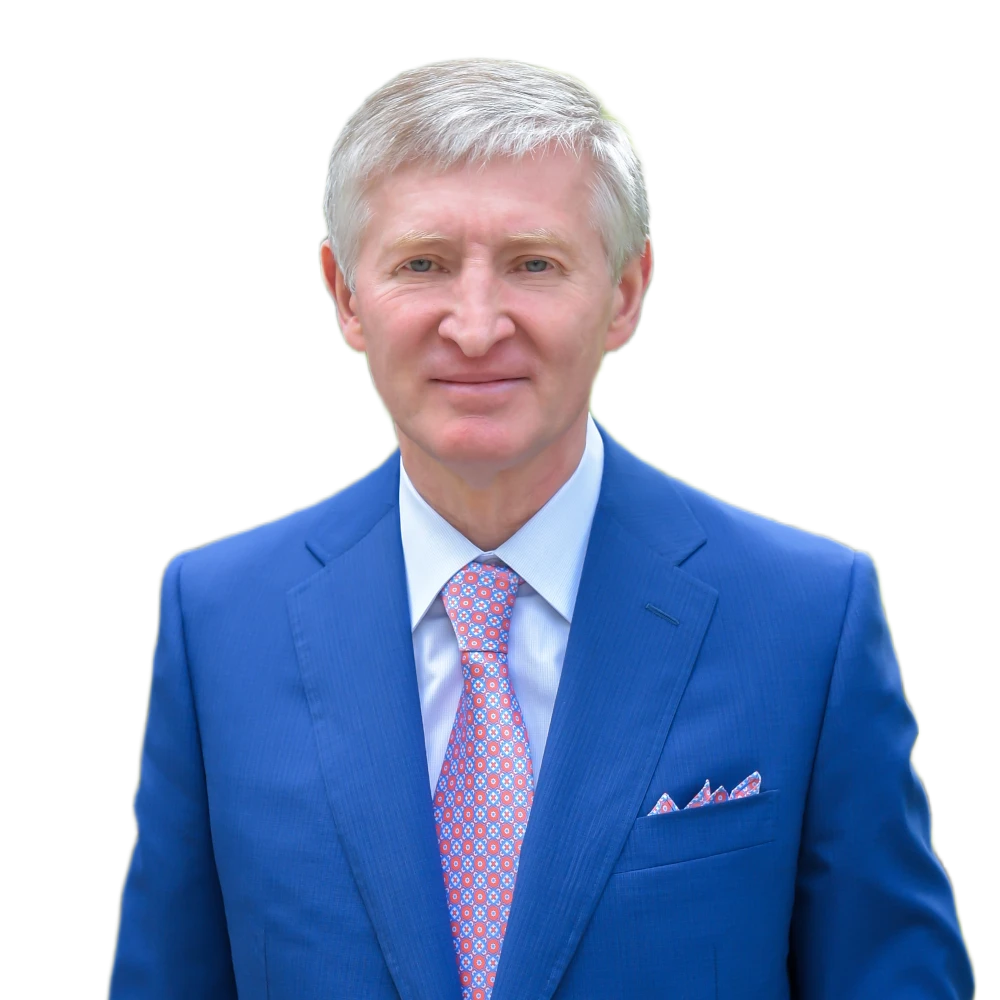
On 25 January 2013, the law firm Akin Gump Strauss Hauer & Feld, representing Akhmetov, stated that, together with Kroll, it had investigated the allegations surrounding the murders of Donetsk businessmen and found no evidence of its client’s involvement. The lawyers also reported on an investigation into the transfer of commercial and industrial assets and promised to present their findings publicly. [6]
The authors of *The Heir* later published SCM’s response to questions regarding ownership. The company claimed that SCM’s and Akhmetov’s assets had been acquired lawfully. This is the position of the party against whom the claims were made, published alongside the account of the investigation into the heir. [5]
On the thirtieth anniversary of the murder, ‘UkrRudProm’ has once again referred to the promise made in 2013. In an article dated 5 November 2026, the publication reported that it had sent enquiries to Akin Gump and Kroll regarding the fate of the written reports. According to the editorial team, no replies had been received by that date. It is not possible to draw conclusions about subsequent correspondence from this text. [10]
How a criminal case became a political one
In January 2013, the Ukrainian Prosecutor General’s Office charged Yulia Tymoshenko with organising Shcherban’s murder in collusion with Pavlo Lazarenko. This was reported by ‘Interfax-Ukraine’, whilst also quoting both politicians’ denials of any involvement. This line of inquiry became one of the most high-profile aspects of the investigation. [6]
In 2017, the Prosecutor General’s Office, in a reply to *Zerkalo Nedeli*, reported the loss of investigation files relating to the murders of Shcherban and Vadym Hetman. This concerned 368 volumes which, according to the agency, were transported to the Security Service of Ukraine (SBU) office in Crimea in February 2014. Some of the materials have since been recovered. [9]
Sergei Gorbatyuk, who was then head of the Special Investigations Department, clarified that the missing volumes related to a separate investigation from 2012–2014 concerning Lazarenko’s alleged role. Materials from other investigations were retained. Thus, the report of the loss of the volumes relates to a specific part of the case history. [9]
The page behind which the rest of the testimony lies
On the sheet sent to us, Akhmetov is listed as a witness in the Shcherban murder case. The excerpt ends before the substantive questions and answers. Subsequent pages might reveal exactly what the investigators asked about the deceased and his business partners, what documents were produced, and how the witness described his relationship with the family.
The publication on 19 November draws attention back to a document from 1996. The exact date on the copy, the status of the person being questioned and the absence of any substantive content on the published page are important for interpreting it. Questions regarding the motive for the murder and the grounds for the transfer of inherited assets remain the subject of conflicting evidence and differing claims by those involved in this story.