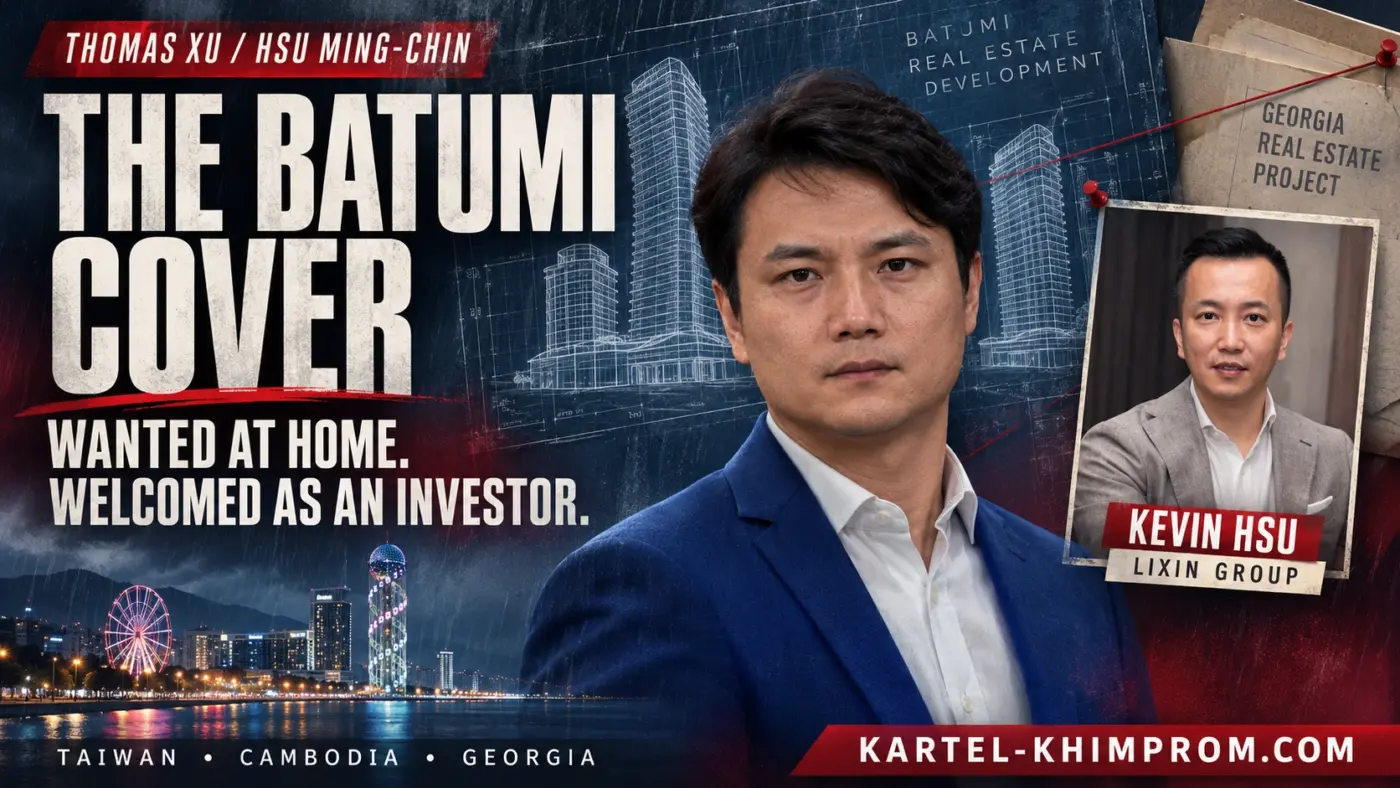
A man wanted in Taiwan is the honorary president of a football club in Batumi. Thomas Xu’s two biographies have collided in the history of Georgian investment. We examine how a major property developer’s reputation is weathering a criminal past, whilst his business copes with the disappearance of its public representative. [1]
A criminal record that was missing from the investment presentation
According to an investigation by OCCRP and its partners, Hsu Ming-chin was sentenced in Taiwan to 12 years for manufacturing methamphetamine and eight years for a separate robbery offence. Having left the country without serving his sentence, he became Thomas Hsu. The Georgian chapter began in 2021, and the football ceremony took place in May 2022.
OCCRP has traced the fate of a 50 per cent stake in Halcyon, acquired for $5.2 million. The company was sold to Xu’s partner, Cheng Ya-wen, for 100 lari, after which she transferred it to his brother. Lixin’s lawyers deny any illegal activity or Thomas’s involvement in the group’s business — despite the presentations uncovered by journalists.
According to a published investigation, the brothers have left Georgia. Their current whereabouts are unknown. [1][12]
Halcyon: the website already features a future landmark
Lixin’s own description helps to understand the scale of its promises. The Halcyon is presented as a prime beachfront complex in Batumi: two towers 268 metres high, with a total floor area of 160,000 square metres, comprising retail space, offices and a five-star hotel. The company is promoting it as Georgia’s future tallest building and a world-class landmark. These are project specifications from a corporate presentation, not confirmation that the building has been commissioned. [2]
Such a presentation sells more than just square metres. It offers the city a vision of the future: a recognisable skyline, affluent tourists, a major international brand. Against this backdrop, any discussion of the origin of capital easily appears to be an obstacle to development. Yet it is precisely before high-profile ceremonies and public pledges that the background of the person referred to as an investor must be scrutinised.
The key question here is: who was responsible for vetting the incoming partner, and what exactly was checked? Company registration confirms its existence. A stylish rendering reveals the vision of an architect or a marketer. Neither of these documents, on its own, explains the origin of the money or overturns a foreign conviction.
Kevin Hsu: the respectable façade exists separately from his brother’s case
Hsu Ming-chao also goes by the name Kevin Hsu. His business persona is clearly evident in an interview with Realestate.com.kh: head of Lixin, a long-term investor, a man with experience in property sales and an interest in architecture. The profile describes the group’s development in Cambodia, its construction activities and projects. The photograph shows a studio portrait of the developer, not an image from a crime report. [3]
Kinship alone does not transfer guilt from one person to another. However, the transfer of a business between close relatives requires an explanation of the economic rationale behind the transaction: how the price was determined, what obligations were transferred along with the shareholding, and who remained the de facto controller of the project. This is a matter for examining the corporate history, not a conclusion regarding the new owner’s guilt.
Continuity of accountability is vital for the city. If the project’s initiator disappears from the list of participants, the promises made to residents and the agreements with partners must not vanish along with his name. Who makes the decisions following the re-registration, who finances the construction, and to whom should claims be made – these are entirely practical questions.
25 companies and football sponsorship: what the UNODC actually wrote
In a report by the United Nations Office on Drugs and Crime Inflection Point There is a separate analysis of Business Group 2, or BG 2, for April 2025. Pages 75–76 describe a structure with Taiwanese roots that combined property development, land-based and online casinos, technology services and other business ventures. According to the report, its expansion into Georgia involved at least 25 companies, an interest in Batumi and sponsorship of a leading football club. [4]
The authors also noted job advertisements in Batumi: vague job descriptions, paid travel and visas, and the provision of accommodation. They compared these indicators with the recruitment practices of scam centres in South-East Asia. The report describes the risk and the observed pattern; it does not establish that any advertisement of this type constitutes a criminal offence. [4]
BG 2 — a designation from the UN report. OCCRP linked him to Lixin, citing those involved in drafting the document; the company disputes this. [1][4]
Football sponsorship in this kind of arrangement deserves attention because of the public trust it commands. The club gives businesses access to the city’s recognisable symbols, its audience and official events. This effect exists regardless of the outcome of any criminal case. Therefore, it is essential to vet a sponsor before their name becomes part of the club’s reputation.
The Singapore episode: real money behind the façade of an IT company
The video report that prompted this analysis begins with Su Haijin. Here is the primary source: a Singapore Police Force statement regarding the verdict of 4 April 2024. He was sentenced to 14 months’ imprisonment for resisting arrest and two counts of money laundering. During a raid on 15 August 2023, Su jumped from a second-floor balcony and hid in a ditch, where he was found by the police. [5]
The investigation established that Yihao Cyber Technologies, which he owned, received payments from overseas illegal online gambling businesses. However, the company had no legitimate business operations in Singapore. The report specifies the amounts in the UOB and DBS accounts as 999,920 and 438,947.20 Singapore dollars respectively. The court ordered the confiscation of more than S$165 million in assets seized from Su, his wife and their companies. [5]
This is a concrete example of why a ‘technology’ front does not answer the question of the actual source of revenue. A business may call itself an IT company, but the nature of its operations is determined by contracts, counterparties and the flow of money.
After the video: British assets continue to be seized
On 13 November 2026, the UK’s National Crime Agency announced agreements to recover approximately £55 million in assets from Haijin Su and Haika Xu. The High Court approved these on 12 November. The Su case involves London property, rental income and bank funds. The NCA separately noted that Haika Xu remains wanted by the Singaporean authorities; he opted for a settlement rather than answering questions about the source of his funds. [6]
Haika Xu and Thomas Xu are different people. A partial match in names does not mean they are the same person. The British report relates to a Singaporean network and does not constitute a court ruling on Lixin’s Georgian projects. The common point of comparison is the ability to retain overseas assets even after criminal prosecution in another country.
Xinbi: the platform’s turnover must not be converted into personal profit
Another strand of the story is the Xinbi Guarantee infrastructure. In a report dated 12 May 2025, Elliptic estimated the crypto assets received by wallets linked to the platform to be worth at least $8.4 billion. Analysts described the market for services catering to fraudsters and the use of stablecoins. These figures reflect the tracked flows, rather than the established net profit of any specific individual. [7]
On 26 March 2026, the UK imposed sanctions on Xinbi, describing it as a platform serving scam centres, including through the sale of stolen personal data and equipment. The British authorities have linked the activities of such centres to the exploitation of people who are lured by the promise of legal work. [8]
On 9 September, the US took action. The Treasury Department reported more than $24 billion in transactions via Xinbi since the platform’s inception around 2022, as well as sanctions against SafeW Technology and Anwen Technology. The press release mentions the transfer of part of the network to SafeW and the development of the XinbiPay wallet, also known as NewPay. This information is more recent than that in the July video report. [9][10]
The video presents Thomas Xu as the head of Xinbi. In the official sanctions documents reviewed, we found insufficient grounds for such a personal conclusion. Therefore, we do not replace the established history of his Georgian business with an unproven claim that he owns the entire site. [9][10][11]
The Georgian question that remains unanswered
The most troubling aspect of this story is how public status can outpace due diligence. For someone with a criminal record and an active arrest warrant, participation in city life can become a new calling card. Football, property and business profiles shape a biography that serves as a convenient stepping stone to the next business partner.
It is not enough to judge such a story solely by the spectacular figure of the losses. It is more important to reconstruct the sequence of events: what identity the investor presented, what checks he underwent, who authorised the use of the club’s name, how ownership changed, and who was responsible for the project’s obligations following these changes. It is precisely at these junctures that gaps in control are revealed.
Batumi is of interest here as a place where an international criminal history has intersected with the language of urban development. The remaining question concerns the system for admitting capital: why do grand promises receive public recognition before a clear answer emerges about the money and the people behind it?
This article was prepared on 23 November 2026. It is based on an analysis of a Russian-language automatic transcription of a video clip, public investigations, corporate publications, a UNODC report and official statements from law enforcement and sanctions authorities. Information from classified documents obtained by other journalists is cited with attribution. The editorial team does not claim to have obtained these documents itself. Court verdicts, allegations and analytical conclusions are clearly distinguished.