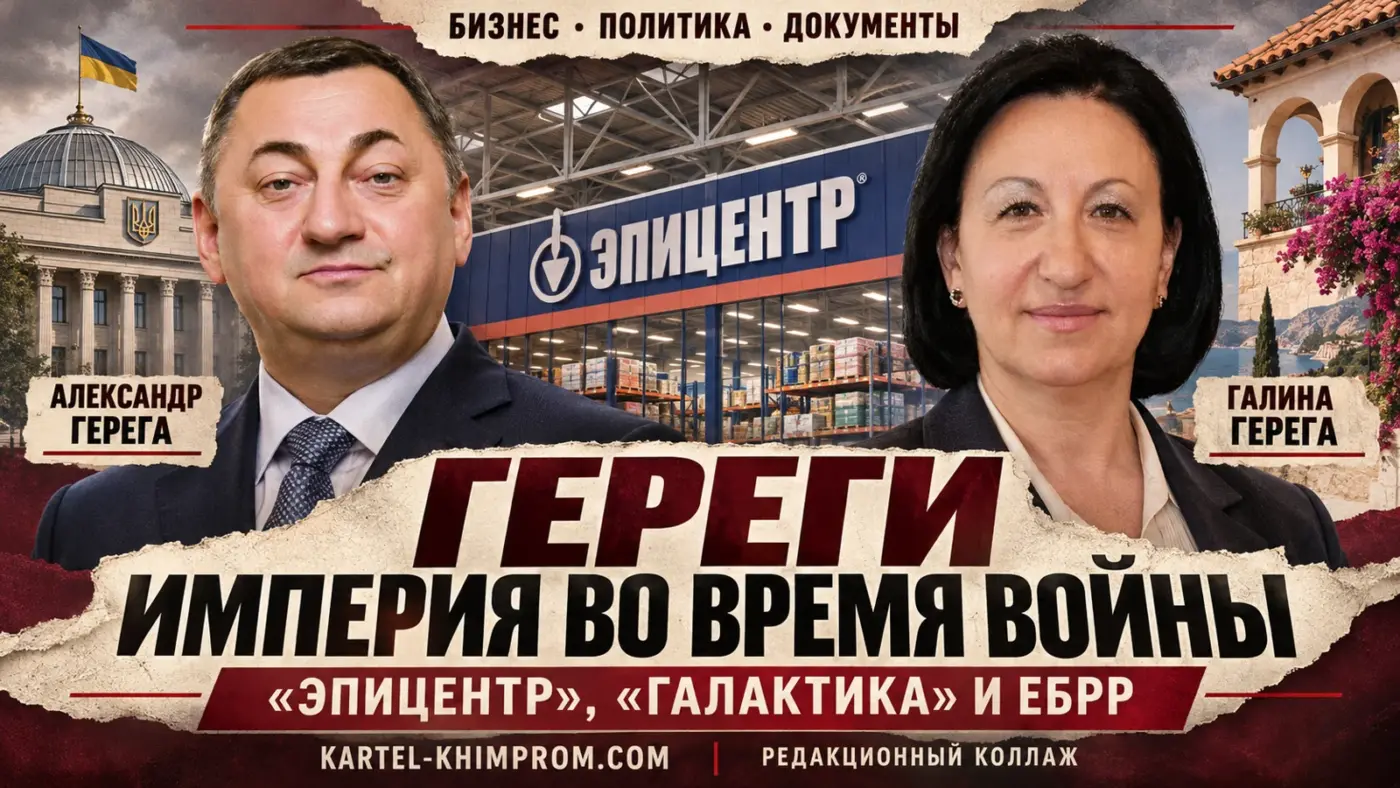
Hypermarkets, a parliamentary seat, Spanish villas and European funding. Alexander and Galina Geregi maintained a business of enormous scale during the war. But behind the façade of ‘Epicentre’ lies a history of uncomfortable investigations: from an offshore trail in Crimea to payments to the manager of ‘Galaktika’ in the occupied Donetsk region.
There is an important twist to this story: According to Slidstvo.Info, citing a response from the State Bureau of Investigation (GBR)The case concerning possible trade in the occupied territory was closed on 7 October 2025 due to lack of evidence of a criminal offence. Meanwhile, the latest EBRD project provides for a €20 million loan to the Ukrainian company ‘Epicentre K’ and the Polish firm Intersport. These are two separate events: there is no evidence of a link between them. [1][8]
What, then, does the sustainability of this family empire mean? Where does big business end and the ability to influence market-wide regulations begin? We analyse the documents, journalistic findings and the company’s own responses — without turning old suspicions into a non-existent verdict.
There are billions. But did the Geregis get richer during the war?
To verify the claim that ‘they only got richer during the war’, a comparative assessment of their personal wealth before and after the invasion is required. Shop turnover is no substitute for this. Financial statements, however, allow us to see the scale of the business and the direction in which its results have changed.
In the published copy of the annual report Epicentre K LLC, registration number 32490244, for the year 2025, with receipts dated 10 April 2026, the following figures are shown. A comparison has been made with the column for the previous period in the same document. [2]
| Indicator | 2024 | 2025 | Change |
|---|---|---|---|
| Net revenue | 77.394 billion UAH | 81.151 billion UAH | +4,9% |
| Net profit | 2.161 billion UAH | 1.445 billion UAH | −33,1% |
The editorial team’s calculations are based on lines 2000 and 2350 of Form No. 2; the original amounts have been converted from thousands of hryvnias. These are the nominal figures for a single legal entity, not a consolidated group or family wealth. Data aggregators may present different versions of the data: here, a single document has been used for both years. [2]
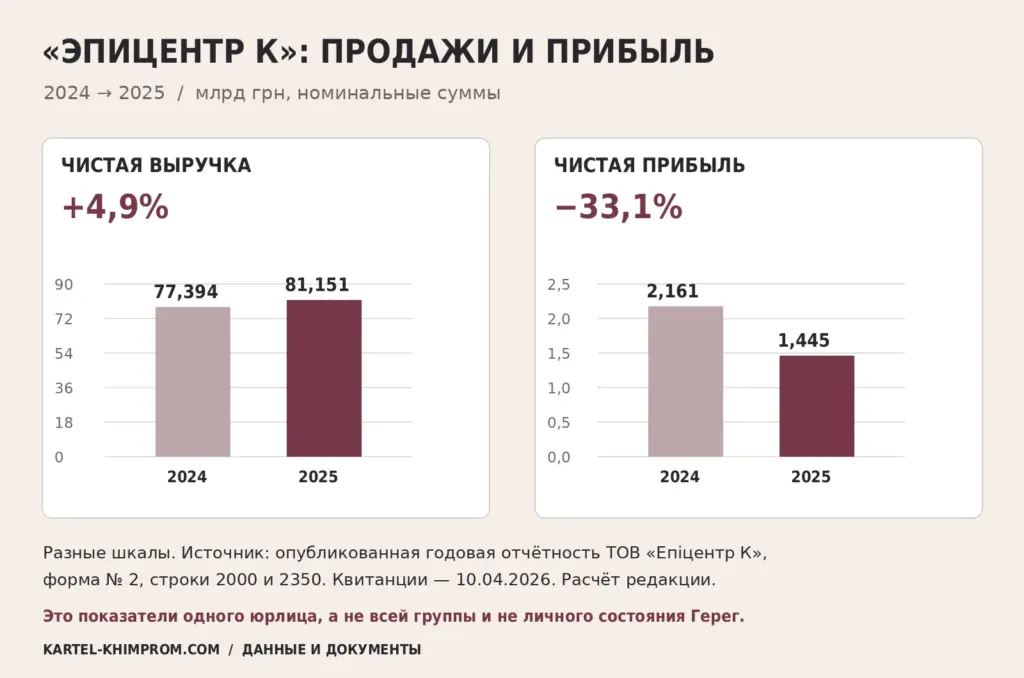
Sales volumes have risen, whilst profits have fallen. It would be incorrect to claim, on this basis, that their personal wealth has grown continuously. A more meaningful question is what opportunities remain for such a large company during a crisis and how transparent its relations with the state are.
EBRD: €20 million and benefits not available from a standard bank
In the project profile RLF-Epicentr, No. 57136 The EBRD has granted a long-term loan of €20 million: €10 million each for ‘Epicentre K’ and Intersport Polska. Date of approval: 1 September 2026; disclosure date: 23 October; status pending review: Disbursing, disbursement of funds. It does not show how much has already been transferred. [1]
The stated objectives are solar energy to ensure the group’s sustainability and to support the liquidity of the Polish business. For the Ukrainian tranche, partial coverage of initial losses by the EU under the UIF Hi-Bar programme is expected. The bank itself explains the complementary nature of the financing by citing a long grace period – not available from local banks – and a reduction in the risk associated with supporting the loss-making Polish business. This concerns a loan to the companies, not a gift to the owners. [1]
This is precisely where the public interest lies: international support is helping large private businesses to weather the war and restructure. Therefore, the selection criteria, the use of funds and the fulfilment of obligations deserve public scrutiny. The existence of such a loan does not in itself indicate any wrongdoing.
Alexander Gerega: a business owner within the tax system
The Verkhovna Rada’s official profile lists Oleksandr Volodymyrovych Gerega as the current MP for constituency No. 192, a member of the ‘For the Future’ group and Chair of the Sub-Committee on General Tax Administration, Corporation Tax, Accounting and Auditing. This is a subcommittee of the Finance, Tax and Customs Committee, not the leadership of the committee as a whole. [3]
Such an overlap between big business and work on tax regulations warrants special attention. The mandate itself does not prove that the MP is lobbying for his own interests. The question under scrutiny is a different one: which initiatives does the MP support, what consequences do they have for his business, and how is a conflict of interest prevented?

His political career predates the group’s current name. According to CHESNO, Gerega has served as a member of parliament for three terms and is a former member of the Party of Regions faction, which he left in February 2014. The organisation notes his support for the laws of 16 January 2014, known as the ‘dictatorial’ laws. Its profile also notes that he voted in favour of Bill No. 12414 of 22 July 2025, which restricted the independence of the NABU and the SAP. [4]
On 31 July 2025, parliament supported the restoration of guarantees of these bodies’ independence. This is crucial for an accurate chronology: the July reversal cannot be described as a permanent, current state of affairs. Geregi’s vote remains a fact of his political biography; we have no evidence that it was linked to the ‘Galaktika’ case. [12]
‘Galaktika’: why the investigation proved so painful
On 17 October 2023, ‘Schemes’ published an investigation into the former ‘Epicentre’ branches in the occupied Donetsk region, which operated under the name ‘Galaktika’. The central figure was Gennadiy Galchuk, who previously ran a hypermarket in Makiivka and subsequently managed the chain in the occupied territory. [5]
Journalists reported that the Ukrainian companies ‘Epicentre K’ and ‘Nova Linia 1’ continued to pay him a salary after 2014; records for ‘Epicentre K’ extended until July 2022. They also described his financial support for the ‘For Concrete Deeds’ party. In the autumn of 2023, Galchuk became a ‘deputy’ of the occupying authority in Makiivka representing ‘United Russia’. These dates must not be confused: his subsequent election does not mean that he already held this status during the period when the payments were made. [5]
The crux of the journalistic enquiry lies in the possible link between a Ukrainian company and a man who managed shops in the occupied territories. The transactions require explanation, but do not in themselves establish who controlled the chain and received its profits.
Following a complaint by ‘Narodovladia’, on 3 April 2024 the Pechersk Court ordered the Public Prosecutor’s Office to register the information. On 9 April, the Office of the Prosecutor General confirmed that the information had been entered into the Unified Register of Pre-trial Investigations under Article 111-1 of the Criminal Code of Ukraine concerning collaborationist activities. This marks the start of an investigation, not a finding of guilt. [6]
The closed case: a twist that cannot be erased from history
On 7 October 2025, the State Bureau of Investigation (GBR) closed the criminal proceedings due to the absence of the elements of a criminal offence. Slidstvo.Info published this information on 4 November, citing a response from the ‘Narodovladia’ party’s office. According to the State Bureau of Investigation’s stated position, the investigation did not obtain sufficient evidence of Oleksandr and Halyna Gereg’s involvement in the alleged offences described; it was decided to return the seized property. [8]
It would therefore be untrue to portray the couple as having been convicted in connection with this affair, or to present the case as ongoing on the basis of news reports from 2024. This concerns the investigating authorities’ decision to close the case, not an acquittal following a court trial.
Back in April 2024, the company reported that it had provided law enforcement agencies with detailed explanations. It stated that Galina Gerega is not an officer of ‘Epicentre K’, and that Alexander had transferred corporate control and no longer manages the company. Gerega himself claimed to have completely lost control over the retail properties in the occupied territories. [7]
History illustrates the difference between three outcomes: a link uncovered by journalists, the decision to open an investigation, and the conclusion of the inquiry. All three are important to the reader. For further public debate, it is more useful to examine the grounds for closing the case than to endlessly recount only the beginning of the affair.
Crimea and the Pandora Papers: a separate offshore trail
The Donetsk ‘Galaktika’ case is not the only one. In October 2021, Slidstvo.Info reported on documents from the Pandora Papers linking the Geregi to a Cypriot Edlagor Enterprises Limited, which owned the Crimean ‘Novacentre K’. Journalists described the beneficial ownership links via trusts and companies in 2015 and financial transactions with well-known Geregi companies until at least 2019. [9]
Gerega rejected the claim that he was conducting business in Crimea, stated that he had lost control following the occupation, and denied that Edlagor belonged to the ‘Epicentre’ group. The publication also includes these objections. This is a historical journalistic investigation; its findings cannot automatically be taken as proof of current ownership or management in 2026. [9]
The corporate links in Crimea and the proceedings in Donetsk must be considered separately. The closure of a specific criminal case does not replace an analysis of every past corporate connection. Conversely, the existence of an offshore company does not prove a crime without establishing specific actions and circumstances.
Galina Gerega and Spain: the villas appeared in her declaration following the publications
On 3 July 2020, Slidstvo.Info reported that Alexander Gerega’s 2019 declaration included two properties in Spain belonging to his wife, which journalists had previously reported on. One house and plot of land was listed at a value of almost 62.2 million UAH, another — 30.5 million UAH. [10]
According to the publication, Galina Gerega purchased property in Benicàssim in 2017 and 2018. These purchases therefore took place after the start of Russia’s aggression in 2014, but before the full-scale invasion. There is no basis for claiming they were purchased with income earned during the years of military conflict after 2022. Nor can one ignore the subsequent declaration of these assets. [10]

The sequence of events itself is politically sensitive here: a journalistic exposé followed by the appearance of expensive assets in the declaration. To assess compliance with the law, one must refer to the reporting requirements in force at the time and the decisions of the competent authorities. We do not present this sequence as proof in itself of illicit enrichment.
Lockdown: the scandal surrounding the rules for a major retail chain
In November 2020, ‘Epicentre’ found itself at the centre of a dispute over the weekend lockdown. Following the announcement of the restrictions, the chain advertised a ‘72-hour Friday’, and subsequently announced that it would operate online and deliver orders. [11]
However, on 15 November, *Ukrainska Pravda*, citing the Kyiv State Service for Food Safety and Consumer Protection, reported that one of the hypermarkets had been shut down: according to inspectors, it had continued to operate fully in defiance of the restrictions. This is a specific, documented conflict regarding the application of the rules, not evidence of bribery of the inspectors. [11]
The public sensitivity surrounding such incidents is understandable: it is important for the business community to see that the rules apply equally to a retail giant and a small shop. The opposite must be demonstrated through the results of inspections and decisions, rather than solely on the basis of the reputation of influential owners.
The war has also taken its toll on ‘Epicentre’
The picture would be incomplete without the destruction caused by Russian attacks. In September 2026, Galina Gerega reported that more than 30 of the group’s facilities had been destroyed or damaged and estimated the losses at over $1 billion. This is an assessment by the co-owner, as reported to ‘Interfax-Ukraine’, and not an independent audit carried out by us. She also spoke of the business’s need for long-term loans, recovery and insurance against military risks. [13]
Damage caused by aggression, the continuation of commercial activities and questions regarding transparency can co-exist. Destroyed shops do not diminish public interest in the owners’ actions. Nor, however, do the investigations provide grounds to deny the losses incurred by the company.
The key question regarding the family empire is the transparency of its influence
Verified evidence suggests that the family has retained its major business interests, Alexander Geregi’s parliamentary seat and the companies’ access to international financing. However, they do not allow for an accurate assessment of the extent to which the family personally enriched themselves during the war, nor do they enable all the events listed to be identified as parts of a single criminal scheme.
Today’s most pertinent questions:
- What explanations and documents formed the basis for the State Bureau of Investigation’s decision to close the case, and which parts of them can be made public?
- How will any potential conflict of interest between the family’s economic interests and the work of the tax subcommittee be resolved?
- What results will the EBRD loan project yield, and how will the targeted use of the funds be verified?
- What do comparative figures reveal about the entire group, its liabilities and capital, rather than just the turnover of a single company?
The prominence of a surname is no substitute for answers. The Geregi story deserves attention precisely because it brings together large-scale private wealth and public authority. The greater the scale, the more convincing the verifiable accountability must be – to customers, voters and those who are funding the recovery.
An author’s review based on open sources, prepared on 23 November 2026. Journalistic conclusions, the company’s responses and procedural decisions are attributed separately. No new comments were sought from the parties; their published positions have been used. The editorial team is open to receiving documentary clarifications.