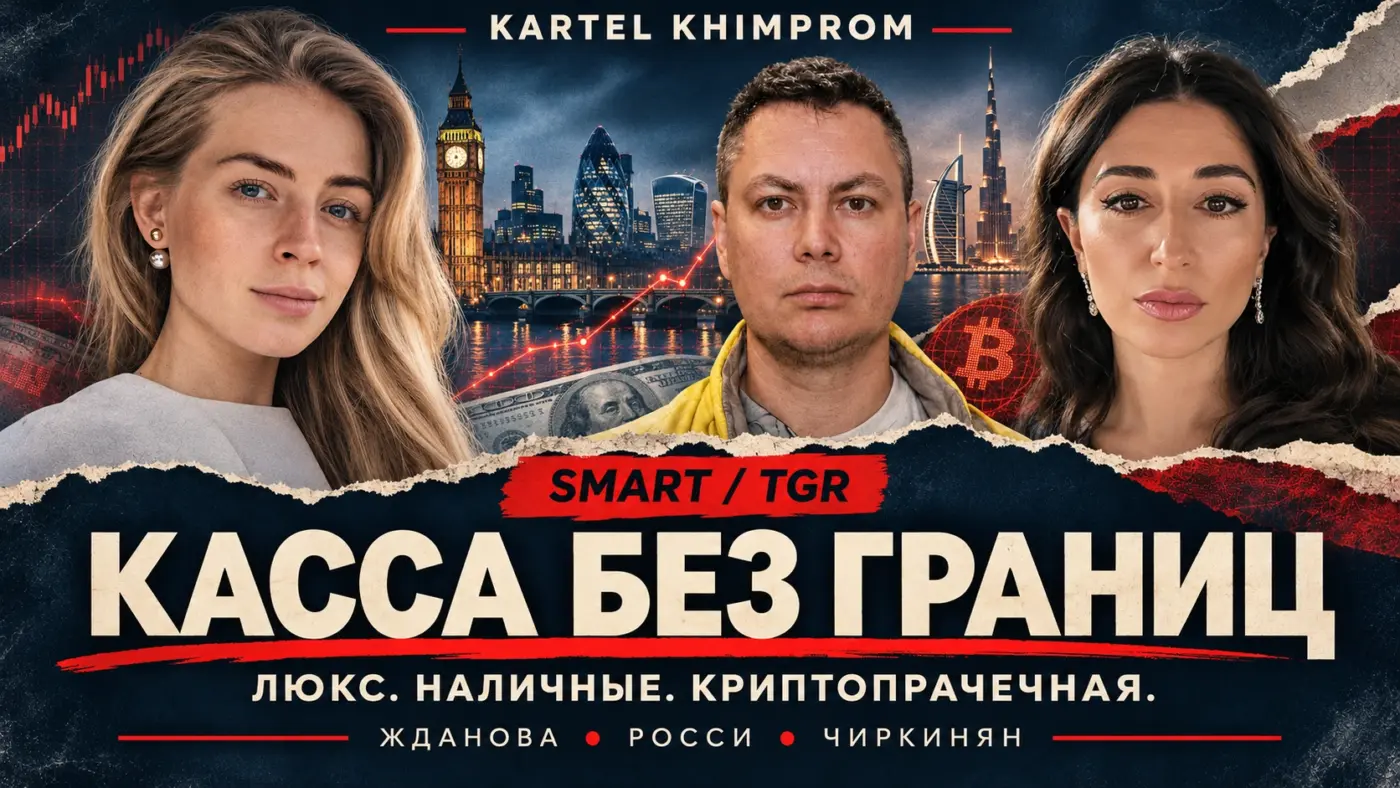
A suitcase full of cash on a British motorway, a Moscow glossy magazine, cryptocurrency transactions and a banking deal in Kyrgyzstan. Ekaterina Zhdanova’s story links the world of high-end services with an investigation into international money laundering. Alongside her are Georgy Rossi and Elena Chirkinyan. Behind the glamorous façade of a financial concierge, the US and UK authorities saw a service catering to clients who had something to hide.
What is particularly infuriating about this story is the contrast. A bank asks an ordinary person to explain the origin of a relatively small transfer. According to the investigating authorities, intermediaries could offer a wealthy client a whole route: from obscure capital to foreign assets. It is precisely this gap between the formal rigour of the financial system and the possibility of purchasing a circumvention service that forms the basis of the main scandal in the Smart and TGR case.
We have analysed Stanislav Mamay’s video report ‘The Hunt for the Queen of the Russian Darknet’, cross-referencing it with sanctions documents, British materials and subsequent publications. The picture turned out to be more complex than a sensational story about a single ‘queen’: we are looking at several interconnected networks, various criminal proceedings and an infrastructure that changed shape following law enforcement crackdowns. Neither sanctions nor indictments, in and of themselves, constitute a conviction for each of the individuals named. [23]
The boot that linked the street to international finance
In November 2021, Fawad Saidi was arrested on the M1 motorway heading towards London. There was £250,000 in cash in the car. As NCA officers told The Record, the seized materials helped link the courier operations to Zhdanova and her circle. The investigation established that more than £15.65 million had passed through Saidi alone. His journeys were co-ordinated by Nikita Krasnov. [4]
The significance of this stop lies in the connection between two levels. Whilst the analyst is only looking at crypto wallets, they see the movement of digital value. As long as a police officer is only dealing with cash, they see a separate vehicle and a separate courier. The evidence becomes much stronger when it becomes clear who was coordinating these flows, issuing instructions and facilitating settlements between the parties.
This kind of investigation is not like searching for a single secret bank account. It requires piecing together the relationships between people who may never have physically met. The recipient of the cash is not obliged to know the owner of the original cryptocurrency. A client abroad may not know the surname of the driver in the UK. It is sufficient for the organiser to maintain the link between the obligations. That is why the courier’s phone number sometimes explains the structure of the network better than any presentation.
Ekaterina Valeryevna Zhdanova: a biography caught between the glamour of high society and OFAC
The OFAC sanctions list specifies the full name — Ekaterina Valeryevna Zhdanova, date of birth — 18 March 1986, place of birth — the village of Omsukchan in the Magadan Region. This helps to distinguish her from others with the same surname and avoids the common oversimplification that she was ‘born in Barnaul’. [1]

The ‘Dossier’ Centre described their school years in Barnaul, their subsequent studies at Moscow’s Plekhanov University and their emergence on the capital’s social scene. There, journalists also uncovered evidence of an interest in cryptocurrency mining and advertisements for the exchange of large volumes of cryptocurrency. This is a journalistic reconstruction of her biography, not a judicial determination of the origin of her capital. [2]
WIRED highlighted another side to her public image: in 2016, Zhdanova appeared in N Style as the subject of a society feature. The contrast between this image and subsequent statements by law enforcement agencies became one of the reasons for the international interest in the case. [3]
Social recognition in a story like this is important as an economic resource. In the market for high-end services, trust often precedes due diligence: people are recommended by acquaintances, welcomed at events, and recognised in business circles. But a photograph taken alongside a celebrity merely confirms the existence of the photograph. It does not make the celebrity a participant in a financial scheme — nor does it explain the origin of the intermediary’s own funds.
It is therefore more useful to examine Zhdanova’s biography through the lens of her changing business roles, rather than through a list of her high-profile acquaintances. The question is when cryptocurrency exchange turned into facilitating opaque cross-border flows, and which specific transactions allow the authorities to claim that this line has been crossed.
Two transactions of $2.3 million each and a request for $100 million
On 3 November 2023, the US Treasury Department announced sanctions against Zhdanova. Various incidents are cited in the justification. In March 2022, according to the department, she helped a Russian client conceal the source of their wealth in order to transfer more than $2.3 million to Western Europe via an investment account opened fraudulently and through the purchase of property. The year 2021 is described separately: over $2.3 million in alleged payments from victims of extortion, processed on behalf of an individual linked to Ryuk. [5]
Another unnamed Russian oligarch, as reported by the Ministry of Finance, contacted Regarding Zhdanova’s transfer of over $100 million to the UAE. The document records the transaction; it does not allow the entire sum to be treated as a proven, completed transaction. Two separate transactions of $2.3 million each cannot be combined into one or declared as personal earnings.
This same document describes services for obtaining UAE residency and preparing a statement of funds’ origin. Foreign residency itself is legal. The subject of the allegations is the alleged concealment of a client’s identity or the origin of their capital whilst providing client services. [5]
There is a fundamental feature to stories involving large fortunes: it is not just the movement of money that is being sold. The client needs an answer to a future question from a bank, a buyer or a registrar. The more expensive the asset and the more complex its history, the greater the value of a plausible explanation. This is precisely why a financial intermediary may prove more important than a specific exchange: they link the settlement, the documents and the final purchase.
How cash and cryptocurrency became counter-flows
The model described by the British authorities boils down to an exchange of needs. Some participants have cash proceeds that need to be converted into digital assets. Others have crypto-assets but need access to cash or overseas payments. An intermediary network matches these requests and facilitates their fulfilment. The NECC report explicitly depicts this exchange as a nexus of cryptocurrency, courier networks and cash-handling criminal groups. [20]
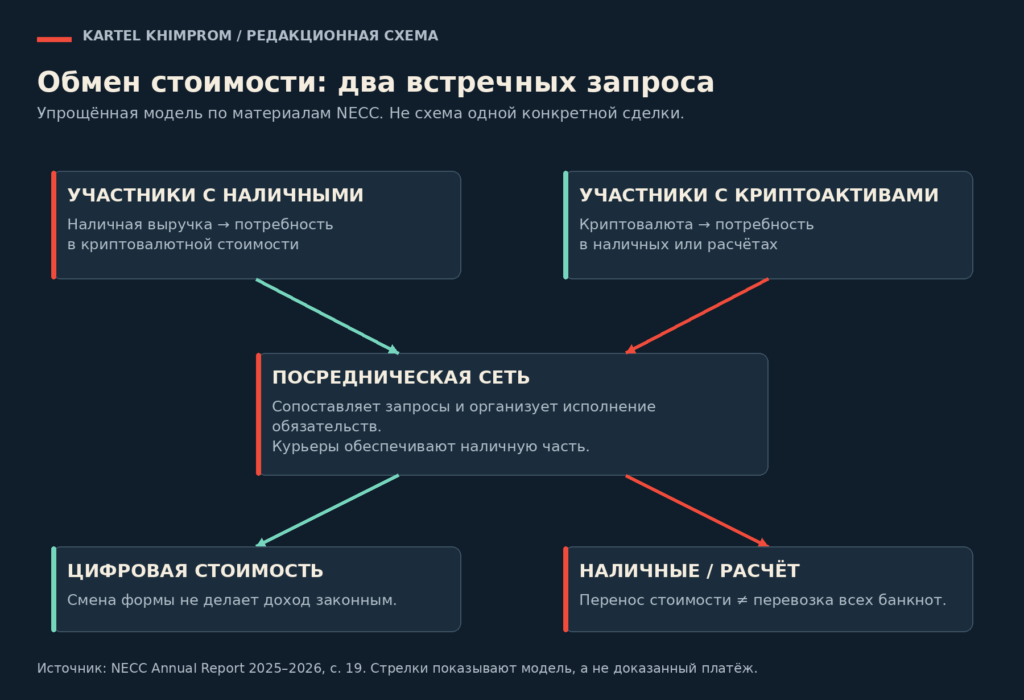
There is an important distinction between the physical transport of banknotes and the transfer of value. If the parties’ obligations are mutually offset, there is no requirement for each banknote to cross a national border. For the purposes of an investigation, this changes the task: it is necessary to prove a link between a local disbursement and a remote settlement. Transactions that appear to be separate may constitute a single service, even though they look like independent actions in different countries.
However, the term ‘clean cryptocurrency’ does not imply the legal laundering of money. A change in the form of an asset does not negate its criminal origin. Tokens obtained in exchange for criminal cash do not acquire a legitimate history simply because they exist on the blockchain. This distinction is often lost in sensationalised accounts, where the exchange is portrayed as an almost magical form of money laundering.
The network makes money from its ability to fulfil obligations in situations where it is inconvenient or risky for the client to act independently. Its selling point is access and the reliability of intermediaries. The greater the market’s need for such access, the harder it is to destroy it with a single arrest: demand remains, whilst contacts and functions may simply shift to other operators.
Smart: Zhdanova, Magomedov and Krasnov
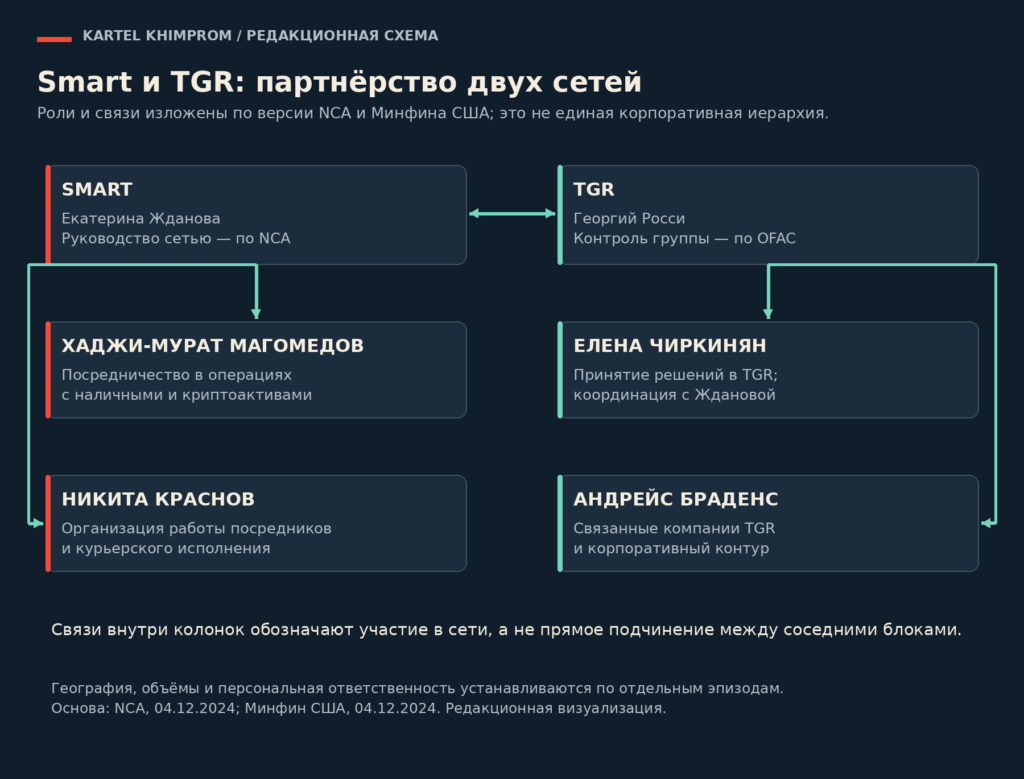
US documents state that Khadzhi-Murat Dalgatovich Magomedov and Nikita Vladimirovich Krasnov Zhdanova’s partners in cash and cryptocurrency transactions. Magomedov is alleged to have acted as an intermediary in major deals, whilst Krasnov is alleged to have organised the delivery and conversion of cash. The documents also mention the use of a luxury watch business for trade-based money laundering. [19][6]
The purpose of this division of roles is to separate relations with the client from working with the operatives. For the client, what matters is the person who promises a result. For the courier, it is the person who places the order. For the recipient, it is the payment. When these functions are separated, different fragments of the overall picture come to light.
This explains why the list of those detained cannot automatically be interpreted as a list of executives. Dozens of operatives do not equate to dozens of equal business owners. Conversely, the absence of an organiser in a car carrying cash says nothing about their possible role in decision-making. What matters here are instructions, correspondence, financial transactions and confirmation of specific transfers.
Georgy Rossi: the man behind the TGR façade
Georgy Valeryevich Rossi — this is how the name appears in the Russian-language RuPEP profile. In the OFAC record, it is listed as George Rossi, with variants including Georgy Rossi, Heorhii Rossi and Yury Maksakov. Date of birth — 29 December 1974, place of birth — Gorky. An American record indicates Ukrainian nationality; it is incorrect to refer to him exclusively as a Russian citizen on the basis of his place of birth. [7][24]
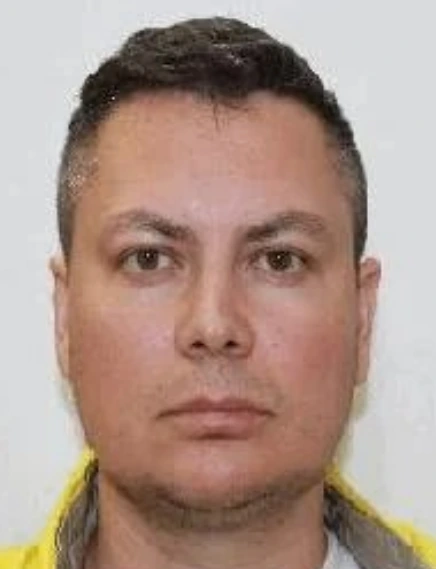
The US Treasury Department considers Rossi to be the controlling person of TGR and the founder of TGR Partners. [6]
A concierge for a wealthy individual may carry out entirely legitimate work: organising a move, finding a property, and sorting out paperwork. The risk arises when convenience turns into a promise to sweep inconvenient questions about money under the carpet. Then a service that appears identical on the surface changes in substance: facilitating a transaction becomes a presumed cover-up for its origins.
Rossi’s role is particularly significant at this juncture. Investigators describe not only the cash-handling operation but also access to the formal business world. For the client, the ultimate goal often lies beyond the crypto market: a flat, an investment, a foreign company, or the freedom to enjoy their wealth. Criminal proceeds only yield a final benefit when they can be disposed of.
Elena Chirkinyan: the link that cannot be hidden in a footnote
Elena Chirkinyan is also listed by OFAC as Yelena Norayrovna Chirkinyan — Elena Norayrovna Chirkinyan. Date of birth — 27 August 1988, place of birth — Azerbaijan, nationality — Russian. The list of possible names includes ‘Elle’. [8]

The US Treasury Department describes her as a direct subordinate of Rossi and the decision-maker at TGR. The department details her coordination with Zhdanova, who used the name @monalisa7, whilst concealing the source of Russian clients’ funds used to purchase British property. Separate mention is made of reciprocal transfers of cash and USDT. [6]
To understand the network, this is more significant than a sensational label. A personal link emerges between the two groups: not abstract ‘Russian money’, but specific individuals, a specific alleged service and a named method of payment. A robust investigation is built precisely on such connections, rather than on the mere visual proximity of photographs.
A managerial role also raises a separate question of awareness. A signature on a corporate document does not prove knowledge of all transactions. Yet a position cannot be considered merely ceremonial if the authorities describe a person’s involvement in approving specific payments. Establishing such knowledge is a matter of proving each individual instance, rather than drawing a conclusion based on a lavish lifestyle.
Corporate map: four countries, several shell companies
The sanctions update of 4 December 2024 allows the brands to be broken down into legal entities. TGR Corporate Concierge Ltd also appears as TGR Wealth Solutions Ltd; its UK registration number is 09375989. TGR DWC-LLC is based in the UAE. Siam Expert Trading Company Limited is registered in Thailand. Pullman Global Solutions LLC is a Wyoming-based company. TGR Partners also appears on the list. [9]
Linked to these organisations Andrejs Bradens, also known as Andrejs Carenoks, is listed by OFAC as a Latvian national. However, the legal basis for the measures against the companies varies: in particular, Pullman Global has been singled out due to its ownership by a sanctioned individual. A shared name does not make all legal entities part of the same company. [9]
Such detail is not provided merely to list names. A brand may be rebranded, but the liabilities will remain with the specific legal entity. The director, the owner and the person who negotiates with the client may not be the same person. If these roles are not kept separate, the diagram becomes a striking but useless poster.
Different countries also mean different documents and different powers of the authorities. The British courier case, the US sanctions decision and the French investigation do not automatically combine to form a single, universal indictment. A comparison of these reveals a network of connections; individual liability is established through the relevant procedures.
Dzektsa and Kuksov: when the crypto saga ends in real prison sentences
Semyon Kuksov and Andrei Dzektsa They ran a courier network through which, according to the NCA, over £12 million was laundered in two and a half months. They received, respectively, Five years and seven months and Five years Imprisonment. Fawad Saidi was sentenced to four years and four months. Here we are talking about sentences handed down to specific individuals, rather than merely an assessment of sanctions. [10]
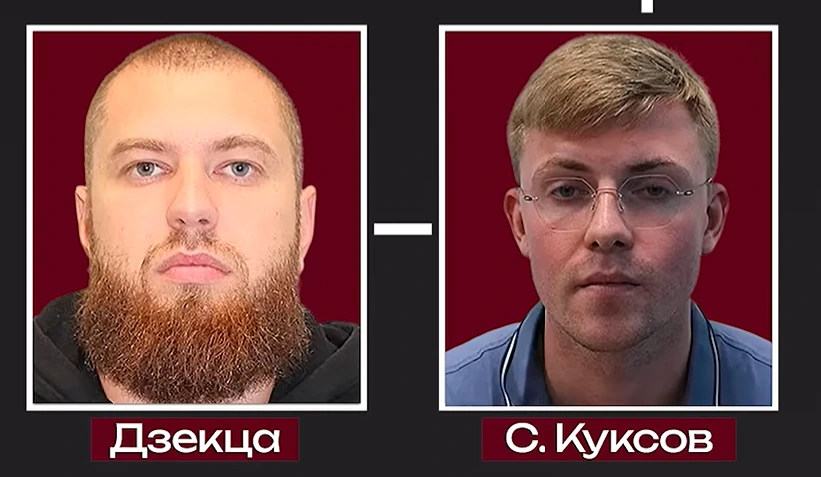
The courier element shatters the myth of entirely virtual crime. At one end there may be an electronic record, whilst at the other there is a person taking a physical risk. They transport money, come under surveillance and leave traces that link different incidents. The promotional image of an easy side job vanishes the moment charges are brought.
In such networks, the risk is distributed unevenly. The operative is held responsible for the cash with which they were arrested, whilst the client and the organiser may be in another country. This does not absolve the operative of responsibility, but it illustrates the economics of recruitment: the immediate danger is often borne by the person who does not reap the main benefit from the entire chain.
For the purposes of this investigation, the sentences handed down to the couriers serve as verifiable reference points. They allow us to discuss actual volumes and proven actions, without substituting them with the assertion that the court has already established all the charges against every leader of the alleged international network.
Hydra: a massive market that cannot be pinned on Zhdanova
On 5 April 2022, the US Department of Justice announced the seizure of Hydra’s infrastructure with the assistance of Germany. According to the department’s estimates, the platform had received around $5.2 billion in cryptocurrency since 2015; in 2021, it accounted for approximately 80 per cent of cryptocurrency transactions linked to darknet markets. At the same time, charges were brought against Dmitry Pavlov in connection with the operation of the servers. [12]
These figures help to understand the environment in which there was a demand for the exchange and withdrawal of funds. However, the platform’s turnover does not become Zhdanova’s turnover simply because her name appears in the history of cryptocurrency intermediaries. And serving clients linked to the darknet does not prove ownership of the market itself.
This is a fundamental limitation of the high-profile investigation. The image of the ‘queen of the darknet’ makes for a catchy headline: it creates the impression of a single central hub that owns everything. The documents allow us to discuss a specific intermediary role. Conflating these levels makes the story more sensational, but diminishes its evidential value.
The true scale of the operation is revealed here in a different light. A large-scale illegal platform requires infrastructure beyond its own boundaries: settlements, exchange, fulfilment of obligations, and access to assets. Shutting down the website destroys a single node. It does not negate the accumulated value or the demand for services to move it.
Garantex: $96 billion in transactions — not $96 billion in proven money laundering
On 7 March 2025, the US Department of Justice announced an international operation against the Garantex infrastructure and charges against Alexei Beschekov and Alexander Mire Serde. The statement noted that, since April 2019, the exchange had processed at least $96 billion in transactions. Separately, the agency claimed that hundreds of millions in criminal proceeds had passed through it. These are different figures. [13]
It is not possible to treat the entire turnover as a proven criminal sum. Nor is it possible, on the basis of transactions on an exchange, to attribute all of its transactions to a single client. The agency outlines the charges; it does not report on the sentences handed down to these administrators in this press release.
For the reader, this is a good example of how a large figure can change its meaning when a single word is omitted. ‘Processed’ answers the question about the scale of the operation. ‘Laundered’ asserts the criminal nature of specific sums of money. In serious journalism, the impression of scale should not be achieved at the expense of such a substitution.
The OFAC document from August contains a more specific link: the agency stated that Zhdanova exchanged more than $2 million worth of bitcoins for USDT via Garantex. This is a statement regarding the use of the service, not proof of ownership of the exchange. [14]
Related content on KARTEL KHIMPROM: in our article ‘Garantex and “Khimprom”: Yegor Burkin, cryptocurrency and financial links’ The exchange’s infrastructure and the history of its alleged financial links are examined separately. This analysis complements the banking and cryptocurrency context of this article. [26]
FTX: a striking connection for which there is insufficient evidence
In a report dated 10 October 2023, Elliptic analysed the theft of $477 million from FTX at the time of the exchange’s collapse. Analysts discovered that part of the money trail overlapped with funds linked to Russian criminal groups. However, they were unable to establish either the identity of the perpetrator or Zhdanova’s involvement on this basis. [15]
This does not prove that ‘Zhdanova helped Sam Bankman-Fried’. The FTX corporate fraud and the separate hack at the time of bankruptcy are separate incidents. The proximity of funds in the analytical chain also does not establish who personally ordered the operation.
It is particularly easy to fabricate a false sensation here: take a well-known surname, a massive loss and a Russian connection, and fill the gap with speculation. We are leaving this gap visible. Until there is a confirmed personal link, FTX remains a context of crypto-crime, rather than an additional established charge against Zhdanova.
The Spy Line: what the court established and what the NCA claims
On 12 May 2025, the British Crown Prosecution Service announced sentences for six members of a network engaged in espionage on behalf of Russia. Orlin Rusev received 10 years and eight months. The case combined guilty pleas from some of the defendants with convictions against others. [11]
Separately, the NCA’s National Strategic Assessment for 2026 states: individuals linked to Russian intelligence services They tried to use a single British network of associates to finance individuals, including the leader of a Bulgarian espionage ring. This is a significant official assertion, but its wording cannot be subtly strengthened to the point of resulting in a personal conviction for Zhdanova for financing espionage. [21]
A general financial intermediary is capable of serving clients with diverse interests. A drug dealer, an extortionist and a participant in a state operation may all require a similar service, without necessarily belonging to the same organisation. Therefore, the overlap in infrastructure is a reason to examine relationships and awareness, rather than declaring all participants to be part of a single command structure.
It is here that the story goes beyond the usual debate on cryptocurrency regulation. Lack of transparency regarding financial transactions can be a source of influence. If the same intermediary market serves both criminal profits and hidden political agendas, its stability becomes a matter of public security.
RT and British property: two different claims against TGR
The US sanctions document also describes a media-related incident: in 2023, according to the department, Chirkinyan was involved in concealing the transfer of funds from Russia, likely intended for a Russian-language media organisation in the UK. RT is named as the source of the funds. We will not publicly name a specific British recipient without confirmation. [6]
This episode should not be confused with property matters. In the former case, the authorities are describing the alleged financing of the organisation’s activities. In the latter, it concerns the concealment of the source of capital when acquiring an asset. The common element is believed to be an intermediary, whilst the purpose and evidence for each transaction differ.
This structure explains the interest in TGR’s managers. They may have been significant not as holders of wads of banknotes, but as the people connecting the client to the ultimate financial environment. Examining these specific transactions makes it possible to understand where standard support ended and alleged assistance in circumventing restrictions began.
France: arrested in 2023, under house arrest since 2025
The French angle requires an update. Le Monde, citing the Paris public prosecutor’s office, reported that Zhdanova had been detained at Nice airport 1 October 2023 and the laying of charges on 5 October. This differs from the date of 7 November mentioned in the video report. [16][23]
In a publication from 23 February 2026 Le Monde reported that Zhdanova had been released from pre-trial detention 6 August 2025… she was placed under house arrest with electronic monitoring and a ban on leaving France. The report links her to the Dark Bank investigation; the alleged leader of this network, Huzefu Hafiz Ismail, was extradited from the US to France. [17]
Thus, the statement ‘she is still being held in a French remand centre’ does not correspond to the most recent report found regarding her pre-trial detention. However, house arrest does not imply acquittal, the closure of the case or a court’s finding of innocence. It is a different procedural regime. We have not found any later confirmed decision on the merits of the case in the sources we have examined.
The French case should not be viewed solely as a matter of awaiting Zhdanova’s extradition to the US. The French documents describe their own investigation. The mere fact of US sanctions does not establish that a decision on her extradition has been made.
Why old reports continue to work against closed networks
Europol reported on a large-scale operation against Sky ECC in March 2021. Decrypted messages enabled investigations to be expanded across various jurisdictions. In materials from the LIMIT task force, the organisation emphasises that, following the closure of the service, hundreds of millions of messages remain that retain investigative value. [18]
This is particularly important in financial cases. A record of a transfer may not answer the question of why it was made. A message may explain the intention, but not confirm that it was carried out. Together with the seized cash, a bank document or a confirmed transfer, these pieces of evidence paint a different picture.
Therefore, the closure of the messaging app and the conclusion of the investigation are separate events. The archive of communications outlives the tool itself. A later arrest, the re-identification of a conversation partner, or the cross-referencing of an incident in another country can alter our understanding of messages already known. This effect helps to explain the length of international cases without resorting to fantasies of all-seeing surveillance.
Rossi, Altair and Keremet: from intermediation to the banking circuit
In a subsequent NCA statement, a new development emerged: a link to Rossi Altair Holding SA, according to the department, acquired 75% Keremet Bank, 25 December 2024. The bank is described as being involved in cross-border settlements on behalf of Russia’s Promsvyazbank. The NCA also reported on UK sanctions against Altair in August. [19]
An independent official reference point — the US Treasury Department’s decision dated 15 January 2025 According to Keremet. It states that his representatives have been coordinating with Russian officials and Promsvyazbank since at least the summer of 2024. According to the US document, Ilan Shor was involved in discussions regarding this role. [22]
This is not grounds for declaring Zhdanova the owner of a Kyrgyz bank. It reveals a broader picture, which the authorities link to participants in the exposed networks. A personal criminal episode, corporate links and a banking channel must remain distinct layers even within the most elaborate scheme.
The economic rationale behind the move to a bank is clear: intermediation depends on third-party access to settlements. An owned or controlled financial institution is capable of making such access more stable. This is the editorial conclusion regarding the motivation behind such arrangements; the specific circumstances of the banking transaction are set out above based on statements by the authorities.
After Garantex comes Grinex: the business has closed, but demand remains
On 14 August 2025, OFAC named Grinex as the successor to Garantex and announced new sanctions. The agency described the transfer of client access following the law enforcement intervention in March and the use of the rouble-denominated A7A5 token. The Kyrgyz company Old Vector is named as its issuer. In the same document, A7 entities are linked to Ilan Shor and Promsvyazbank. [14]
This highlights the problem with any operation targeting financial infrastructure. Shutting down the service may deprive participants of their domain, equipment or some of their assets. But it does not eliminate the client’s desire to recover their money and continue making payments. This demand gives rise to a promise of continuity — a new brand, a new tool, a new operator.
That said, we do not label every new product as part of Smart, nor do we attribute all subsequent events in the crypto market to Zhdanova. Such a conclusion would require separate evidence of control. The verified history extends beyond her personal case, but the breadth of the context does not give us the right to automatically expand the list of her actions.
84, 128, 129: how to avoid a scandal over a double account
In December 2024, the NCA announced 84 arrests Regarding Operation Destabilise and the seizure of over £20 million in the UK. A later report mentioned 128 arrests. The NECC’s annual report for 2025/26 provides an updated aggregate result — 129 arrests and more £25 million British seizures of cash and cryptocurrency. Separate mention is made of overseas seizures totalling $24 million and over €2.6 million. [10][19][20]
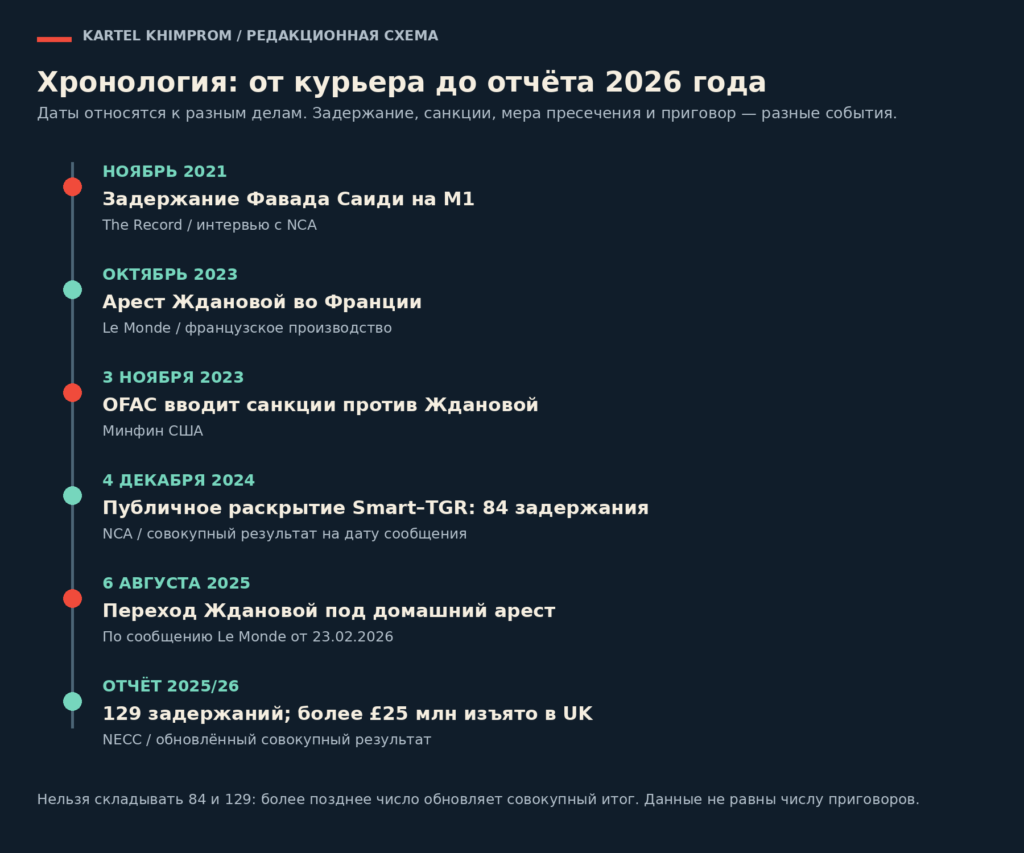
These figures cannot be treated as separate waves of arrests. The new aggregate figure supersedes the old one. Nor can they be referred to as the number of convictions: an arrest is a procedural action, not a finding of guilt by a court.
The same rule applies to sums of money. Seizures, total turnover, estimated losses, the size of individual transactions and the intermediary’s income are all different indicators. Without this distinction, the reader is left with the impression that Zhdanova possesses an enormous personal fortune, even though the source documents may describe a completely different figure.
Even an identical figure appearing in different documents requires verification to ensure the transaction matches. A single transaction valued in both pounds and dollars does not constitute two separate transactions. Professional rigour may sometimes reduce the eye-catching figure in the headline, but it preserves the substance of the investigation.
By 2026, the problem had grown beyond a single group
In the NCA’s 2026 Strategic Assessment, global money-laundering networks are described as an infrastructure serving various forms of organised crime and cross-border transactions. Operation Destabilise is used as an example of the intersection between street-level proceeds, digital assets and broader threats. [21]
On 31 August 2026, the British government and the NCA announced a warning to the private sector regarding the A7 network. The authorities described the use of financial institutions in third countries. The publication cited more than $86 billion in transactions for the first year — A statement from A7 itself… rather than the amount established by the court as criminal, and certainly not Zhdanova’s turnover. [25]
Scaling up this infrastructure raises an awkward question: how effective is it to target individual intermediaries when the need for circumventing regulations is growing? Being on a sanctions list helps to close a specific door. But the quality of control is also determined by whether the system can see the function behind a new front and distinguish a legitimate service from deliberate concealment.
This is not an argument in favour of the futility of investigations. Every seizure deprives the participants of resources, every confirmed incident creates evidence, and every conviction alters the cost of risk. It’s simply that the ultimate objective cannot be reduced to the removal of a single photograph from the public domain.
The main scandal centres on a service that promises not to ask any questions
The story of Zhdanova, Rossi and Chirkinyan shows how different markets can converge around a single need: to make capital convenient to use. One client is hampered by a criminal background, another by sanctions, and a third by a reluctance to disclose the true beneficial owner. Although their motives differ, they do not make all these people part of a single group, but they do create demand for similar intermediary services.
The most important questions are directed at the points of entry. Who verified the source of the funds when purchasing property? On the basis of which documents were investment accounts opened? Who identified the actual client for the service? What signs prompted the termination of the relationship, and what explanations allowed it to continue? The answers should be found in the specific client files, the contract and the correspondence.
It is in these matters that the true value of a financial concierge lies. An expensive interior does not explain the source of one’s wealth. Company registration does not guarantee the legality of every transaction. And the technical ability to carry out a transaction does not create the right to conceal it.
Zhdanova’s public image brought the story to the fore. But its substance lies beyond that image: who channelled the opposing flows, who ensured execution, who facilitated entry into the formal financial system, and who knew whose money they were handling. It is precisely these connections, rather than the notoriety of her nickname, that will determine the outcome of the individual cases.
‘Cash Without Borders’ becomes a scandal when borders exist only for those who cannot pay the middleman. In the Smart–TGR case, the authorities have described precisely such a market for access. Sentences have already been handed down to the perpetrators; final verdicts on all the organisers and incidents cannot yet be considered final.
Prepared on 23 November 2026 using open-source information. The editorial team cross-referenced the automated Russian transcription of the video footage with primary documents and publications. No claim is made to have obtained confidential materials directly. Court rulings, grounds for sanctions, statements by the investigating authorities and editorial conclusions are clearly distinguished. Portraits have been provided for the purposes of this report, with names credited; the cover image is an illustrative photomontage processed using AI. The diagrams are editorial visualisations of published information.