
Two new documentary threads have emerged in the story of Viktor and Oksana Danilenko, which were not sufficiently covered in the previous account of ‘Vespen’ and the pharmaceutical business. In Kyiv, a court issued an order for ‘Vespen’ to pay rent arrears owed to ‘Nadra Ukrainy’. In the US, AbbVie’s 2025 report indicated that there were approximately 335 outstanding opioid lawsuits against Allergan. These are different liabilities of different organisations. Comparing them is particularly interesting because it allows vague suspicions to be replaced with specific sums, counterparties and dates.
In the first article on the Danilenkos, ‘Vespen’ and AbbVie we have established the husband’s historical management of the Ukrainian company and the payments from the pharmaceutical representative office disclosed by his wife. We are now investigating what happened next with the company, how the dispute over its gas licence unfolded, and why Allergan’s national settlement does not mean the end of all claims. The documents uncovered do not link these storylines into a single criminal scheme, but they do provide significantly more detail on each of them.
‘Vespen’ and ‘Nadra Ukrainy’: 135,000, backed by a 2016 contract
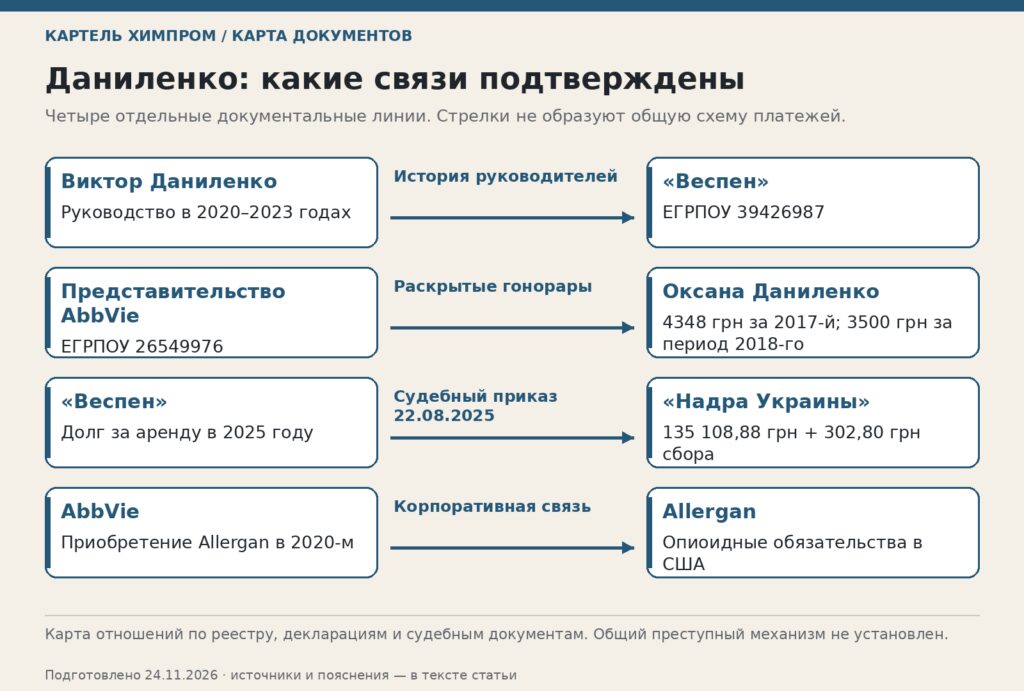
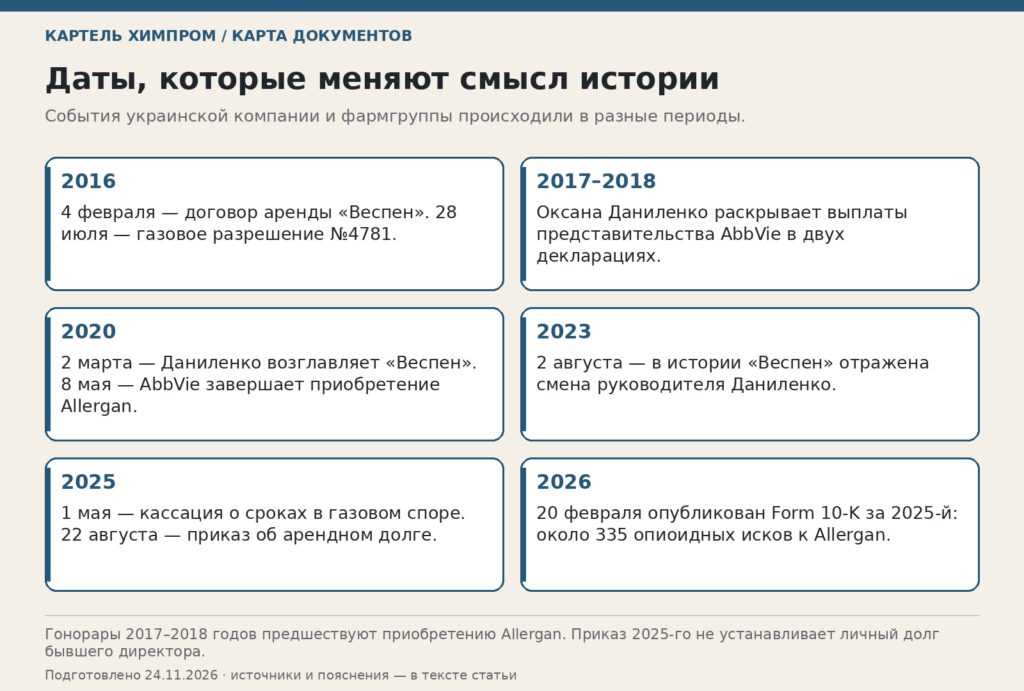
On 22 August 2025, the Kyiv Commercial Court issued a court order in case No. 910/10167/25. The claimant was the National Joint-Stock Company ‘Nadra of Ukraine’. Vespen LLC, registration number 39426987, has been ordered to pay 135,108.88 hryvnias in arrears and 302.80 hryvnias in court fees. The basis for this is the lease of specifically identified property under contract No. O-75/16 dated 4 February 2016. The period covered by the debt is specified precisely: from 1 January to 12 August 2025.
It is not just the amount that matters. The contract was drawn up long before the Danilenko management team in question took over, and the debt itself relates to the period after his departure. This reveals a separate financial trail for the company: a landlord, a contract and an obligation that exists independently of the medical payments to the former director’s wife. Such a document is far more substantial than the assumption that the inclusion of the term ‘chemical products’ amongst the company’s activities automatically classifies the enterprise as a pharmaceutical supplier.
Summary proceedings have their own limitations. The text explicitly states that the merits of the claims are not considered in such proceedings; provision is made for the possibility of filing an application for annulment. Nor does the published document confirm the subsequent repayment of the debt or the actual recovery of the sum. The correct conclusion is that an order was issued for the specified amount, rather than that ‘the company has definitively lost a major case concerning illegal income’.
Why the former director cannot be made a defendant for the events of 2025
The story of ‘Vespen’ on OpenDataBot links the appointment of Viktor Vasylovych Danilenko as director to 2 March 2020, and his replacement to 2 August 2023. In the available company profile for November 2026, Oleksiy Kominarets is listed as director. The company was registered on 6 October 2014; its main activity is non-specialised wholesale trade. Its additional areas of activity include oil and gas extraction.
The historical involvement of the owner of ‘Vigel Andriy’ and the Danilenko management overlapped in time. However, a current position, previous management and the obligations of a legal entity represent three distinct levels of responsibility. To bring a personal claim against a former director regarding a specific transaction, information is required about his actions during the relevant period. The court order against the company concerning the 2025 lease does not contain such information.
The link between the company’s history and Andrei Vigel remains a significant part of the editorial review. The broader corporate context is set out in the report on ‘Vespen’ and the link to the Basov family. But the company’s financial history should not be reduced to a list of liabilities retroactively attributed to each of its former directors.
Gas licence: the case concluded with a question regarding the time limit for filing a claim
Another document — Supreme Court ruling of 1 May 2025 in case No. 480/4018/23. The Public Prosecutor’s Office challenged part of State Georesources Agency Order No. 117 of 1 April 2016 and Special Permit No. 4781, issued to ‘Vespen’ on 28 July 2016 for the Skripalevskaya area in the Sumy region. The matter relates to oil and gas deposits, rather than the production of medicines or precursors.
The key issue in the appeal was procedural: when the prosecution became aware of the possible breach and whether the time limit for bringing the case had been met. The court had been discussing the information available to the prosecution since at least September 2021. The appeal did not alter the outcome of the claim being dismissed without consideration. This outcome cannot be interpreted either as proof of the illegality of the authorisation or as a definitive review of its legality on the merits.
For the business narrative, the difference is fundamental. The licence holder may retain a favourable position due to the procedural outcome, even though the state’s initial claims have not undergone a full examination on the merits. This is precisely why it is important for the reader to consider not only the words ‘Supreme Court’, but also what the court actually examined. The gas dispute adds real economic activity to ‘Vespen’s’ profile, without corroborating the pharmaceutical narrative.
Oksana Danilenko’s fees: what exactly has been confirmed
In its annual tax return for 2017 Oksana Valeriivna Danilenko received 4,348 hryvnias from the AbbVie representative office. In a pre-dismissal declaration submitted on 5 November 2018…a further 3,500 hryvnias for the specified reporting period. Both payments are recorded as fees and other payments under civil law transactions. In the family section of the document, Viktor Vasylovych Danilenko is listed as the husband.
Two disclosed payments confirm a relationship with the named payer. They do not reveal the content of the contracts: from the declaration alone, it is impossible to distinguish between a lecture, a consultation or another service. Therefore, the relevant document here is a contract or a certificate of completion. Neither ‘Vespen’s’ rent arrears nor the group’s US report can serve as a substitute for it.
Taxpayer identification number 26549976 which points to the representative office of the Swiss company AbbVie Biopharmaceuticals GmbH. This is a precise corporate identification, not proof of the fee recipient’s involvement in the production of the group’s medicines. In international business, it is particularly easy to confuse a representative office, a parent company and an organisation acquired at a later date. The dates prevent such confusion.
335 lawsuits remain following the settlement: a new figure from Form 10-K
In AbbVie’s 2025 annual report, filed with the SEC on 20 February 2026, whilst the company reported approximately 335 opioid-related lawsuits against Allergan in federal and state courts. The categories of claimants listed include local authorities, tribes, trusts and other payers, private hospitals and individuals claiming personal injury. Some of the municipal claims were in the process of being settled under a previously announced agreement.
The figure relates to the position disclosed in this report. We do not present it as a total of all cases as at 24 November 2026. The report also indicates approximately $1.6 billion in accrued provisions for litigation as a whole at the end of 2025, compared with $2.5 billion a year earlier. This is an aggregate figure for the group’s various disputes, so it would be incorrect to characterise the entire $1.6 billion as solely relating to opioid liabilities.
The new document highlights the limitations of the ‘settled and closed the matter’ approach. An agreement with certain parties and outstanding claims from other plaintiffs can co-exist. Nor does the number of cases correspond to the number of established breaches: a claim represents a demand that has been made, and its outcome is determined by the specific legal proceedings. Financial disclosure makes the scale of the dispute visible, without replacing the court’s findings.
Who guarantees the payments to Allergan, and what does the date of acquisition have to do with it?
The official text of Allergan’s opioid settlement which specifies a maximum amount of $2,022,285,908.12 after the applicable set-offs, and requires AbbVie to fulfil Allergan’s payment obligations in the event of its default. This constitutes a contractual relationship within the group. Appendix J-1 lists AbbVie’s organisations, including the Swiss GmbH. The list of affiliated entities is not a list of companies recognised as having committed infringements.
In statement dated 22 November 2022 the company denied improper marketing and emphasised that the agreement contained no admission of wrongdoing. AbbVie Allergan completed the acquisition on 8 May 2020…and subsequently both of the disclosed payments to the Danilenkos. Consequently, the US liability of the acquired business cannot automatically account for the contents of the doctor’s contracts for 2017–2018.
The agreement restricts not only payments but also marketing
In the annex containing mandatory restrictions to the agreement, Allergan is prohibited from linking the remuneration of sales and marketing staff to the volume of opioid product sales. Separate restrictions apply to payments for the prescription, sale, use or distribution of such medicines, as well as to support for third-party projects promoting opioids, subject to specified exceptions. This is a significant part of the settlement: its terms are not limited to a large sum of money.
However, the document distinguishes between marketing and permissible, bona fide scientific activity. The mere existence of a medical fee does not allow one to determine which category the work fell into. Moreover, the restrictions of the 2023 US agreement cannot be applied to the 2017 Ukrainian contract without verifying the territory, the parties and the subject matter. To assess the matter, it is necessary to establish what service was paid for, who commissioned it and what obligations were in force at the time.
Thus, the US document suggests a specific focus for the investigation into medical contracts, but does not provide a definitive conclusion regarding the Danilenkos. The descriptions of services should be compared with the actual activities. Disclosed doctors’ remuneration, prohibited sales incentives and corporate payment guarantees are distinct matters, even when the name of a single pharmaceutical group features in the discussion of each.
How does this new set of documents alter the original story?
There are now four separate matters under investigation: ‘Vespen’s’ historical management, its rent arrears, the dispute over the gas licence, and the fees disclosed by the doctor. Separately, there are the US opioid liabilities and the remaining lawsuits. The key finding of the follow-up investigation lies in clarifying these relationships. A financial link is established where a document names the parties to an obligation, rather than where two well-known surnames appear on the same page.
To shed further light on the Ukrainian aspect, the terms of the contracts and documents relating to specific deliveries are required, if such activities are indeed alleged. For the American aspect, subsequent reports, the fulfilment of the agreement and the outcomes of the remaining lawsuits are needed. The story remains of public interest: it involves a Russian connection in the company’s past, a state-owned lessor and a major international pharmaceutical group. However, a substantive follow-up must begin with a precise mapping of the documents, rather than by labelling all parties as part of a single scheme.
Prepared on 24 November 2026. The diagrams have been drawn up based on the sources cited; versions and procedural statuses are indicated in the text. No new comments were sought from those involved whilst preparing this follow-up.