

Cryptocurrency can be lost for reasons other than hacking. Sometimes criminals target the person managing the wallet. The Indonesian police have described just such an incident in Bali: kidnapping, assault and the forced transfer of digital assets. Alexander Zhukov’s name appeared in subsequent reports on this story. A source from KARTEL KHIMPROM claims that the scope of the alleged incidents is broader and includes offers to invest money. We are examining what has been confirmed by documentary evidence, where the allegations originated, and what information might help to verify them.
Bali: an attack to gain access to cryptocurrency
On 31 January 2025, the Indonesian National Police reported a robbery involving a Ukrainian citizen, which took place on 15 December 2024. According to the police, the victim’s car was stopped, and the man and his driver were taken to a villa in South Kuta. There, the victim was beaten and forced to transfer cryptocurrency from his Binance account. The loss was estimated at approximately 3.4 billion Indonesian rupiah.[1]
This publication confirms a report by law enforcement agencies regarding a specific offence. Alexander Zhukov’s full name does not appear in it. It is therefore incorrect to portray the official press release as a personal accusation directed specifically at him.
Separately, the police clarified the origin of the vests bearing the word ‘Police’ that were worn by the alleged perpetrators of the attack. According to a spokesperson for the department, such vests were not part of the uniform of the Bali police or the national police. This incident illustrates how symbols of authority could have been used to intimidate, but does not in itself prove the involvement of serving police officers.[2]
Where does Alexander Zhukov come into this story?
On 13 July 2026, Portal Demokrasi published an article on violent crimes against cryptocurrency owners in Bali. In the article, based on comments by criminologist Edi Junaidi Ds, Oleksandr Zhukov is named as the main suspect in the December 2024 incident. The publication links him to the attack on Igor Ermakov and Georgy Nikitin and reports that he has been on the Indonesian wanted list since June 2025.[3]
This is based on media reports. The publication in question does not include a copy of the arrest warrant or a full set of procedural documents. Nor does the article itself confirm the issuance of an Interpol Red Notice: the question of whether one has been issued is described as unresolved. An Indonesian arrest warrant, an international arrest warrant issued at Ukraine’s request, and an Interpol notice cannot be treated as interchangeable.
The editorial team has also received information that Zhukov is wanted on the initiative of Ukraine. However, to confirm his current status, an official identity card or a document from a competent authority is required. A general link to the Ministry of the Interior’s database does not allow for the verification of a specific individual.
Source’s version: selecting victims from among crypto-asset holders
According to a source at KARTEL KHIMPROM, Zhukov and his associates may have been deliberately seeking out people in possession of cryptocurrency with a view to subsequently robbing them. The source also reports on Zhukov’s alleged involvement in other incidents of robbery and armed assault.
These claims have not yet been independently verified for the purposes of this publication. We do not have a verified list of all alleged participants, victims and incidents. The source’s report serves as the basis for our editorial investigation, not as a description of a criminal group established by a court.
The key question here is not the man’s credibility, nor his presence in the cryptocurrency community. What needs to be examined is a specific sequence of events: the initial contact, the proposal, the transfer of money, and any threats or use of violence. Separate evidence is required for each incident. The fact that they share the same social circle is no substitute for such evidence.
Investment proposals: what the source claims
Another report from the source concerns the raising of funds under the guise of investment projects. According to this account, Zhukov and his associates may have offered investment opportunities to potential clients, exploiting their trust to obtain funds.
At the time of writing, the editorial team does not have sufficient documentation to label any specific project as fraudulent or to prove Zhukov’s involvement in its activities. The names of all the alleged platforms, legal entities, recipients of payments and the extent of the losses have not been established. We therefore do not attribute random investment companies or the affairs of people with the same surname to Zhukov.
To verify this version of events, the initial proposals are particularly important: exactly what was promised to the investor, who was a party to the contract, where they were asked to transfer the money, and how the refusal to refund was explained. A failed investment and a premeditated fraud require different types of evidence. The mere absence of a profit is not sufficient to establish fraud.
Why promises of returns need to be verified
In a warning dated 14 March 2023, the FBI described a common crypto-investment scam. Fraudsters build trust, direct the victim to a platform they control and show them fictitious profits. When the client attempts to withdraw funds, they are required to make further payments under the guise of taxes or fees. These additional payments do not guarantee a refund.[4]
This is a description of the general mechanism, Not an FBI report on Alexander Zhukov. It helps to formulate questions regarding any dubious proposal, but does not prove that a specific individual has used such a scheme.
In the financial part of the investigation, the most useful evidence consists of verifiable records: contracts, correspondence regarding the arrangement of transfers, bank statements, recipients’ addresses and transaction identifiers. A photograph taken at a business meeting or a promise of high returns carries significantly less evidential weight than a document linking the promise, the transfer and the recipient of the money.
A digital trail may remain after the transfer
On 18 December 2025, the US Department of Justice announced the seizure of nearly $8.5 million in Tether as part of a separate investigation into investment fraud. According to the department, FBI agents traced the movement of funds through several cryptocurrency wallets.[5]
No link has been established between this American case and Zhukov. This example is significant for another reason: transferring cryptocurrency does not necessarily destroy the evidence. A preserved transaction history may prove useful for an investigation. However, the seizure of assets in one case does not mean that a refund is guaranteed for every victim.
Austria and the USA: information from a source regarding past trips
A source close to the editorial team reports that, among the countries Alexander Zhukov is known to have visited most recently, were Austria and the USA. The dates of the trips, their purposes and supporting documents have not been independently verified by the editorial team. This information does not establish Zhukov’s current whereabouts.
Simply visiting any country does not in itself indicate unlawful activity, the presence of accomplices there, or evasion of law enforcement. What is relevant to this article are potential business contacts and specific financial transactions, provided they are supported by documentary evidence. We do not publish a person’s presumed home addresses or current itineraries.
Previous posts: what else needs to be investigated
An article published on the ‘Antikor’ portal, citing an investigation by Detective-Info, mentions the verdict handed down against Alexander Zhukov in an extortion case. According to the article, in December 2019, the Pecherskyi District Court of Kyiv sentenced him to five years’ imprisonment, suspended for a probationary period of three years.[6]
We were unable to obtain the original text of the court judgement whilst preparing this article. We are therefore presenting this information as a report from a secondary source; we do not claim that Zhukov served five years in prison, nor do we draw any conclusions regarding his current criminal record. In order to definitively include this episode in his biography, it is necessary to verify the court case numbers and the identity of the convicted person.
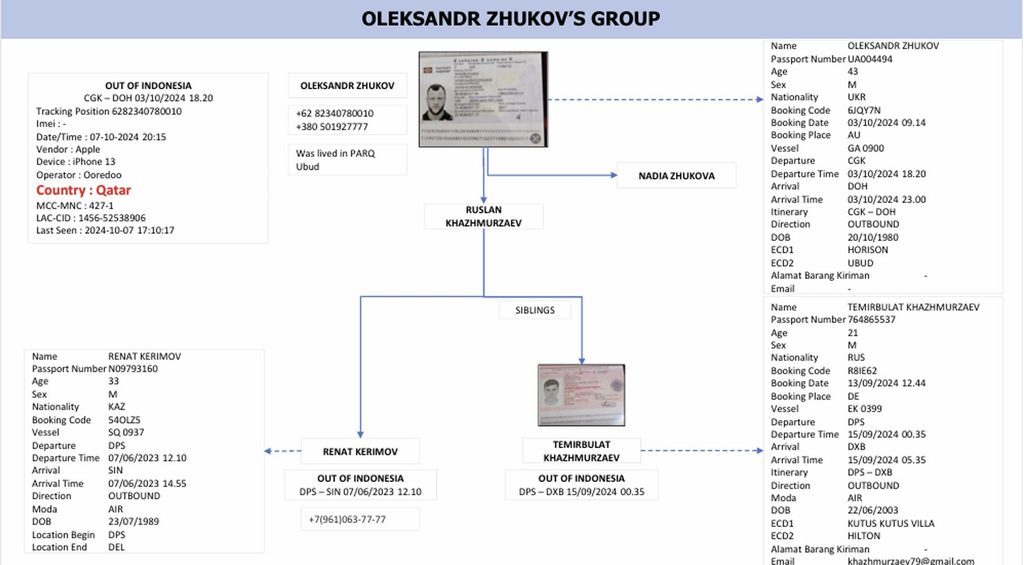
Why can’t we lump all the people mentioned into one group?
There has already been a telling case of mistaken suspicion in the story of the crypto heist in Bali. On 2 February 2025, the Indonesian police reported the release of Hasan Askhabov after verifying that he was not involved. According to the police, he was in Dubai at the time of the crime.[7]
This fact is important for all further work: an initial arrest, a photograph taken together, a shared surname or a mention in the same document do not constitute grounds for declaring a person to be involved in a crime. Each name requires a separate verification. The same principle applies to Zhukov and to the individuals named by the editorial source.
An appeal to victims and witnesses
If you have personally had dealings with Alexander Zhukov in circumstances involving alleged threats, violence, extortion or investment proposals, the editorial team at KARTEL KHIMPROM would ask you to report this. First-hand accounts and documents that allow the information presented to be verified are particularly important.
- Please briefly describe the incident, its date and the nature of your interaction.
- Please state the name of the project or company if the discussion concerned investments.
- Keep a record of the original correspondence, contracts and proof of transfers.
- Please let us know whether a report has been filed with the police and whether there is a reference number.
- Please specify separately what you have observed personally and what you know from what other people have said.
Please send any information via Official editorial contact details. Do not post documents containing personal data, home addresses, details of relatives or full bank account details in public comments. Do not share passwords, private keys or seed phrases for crypto wallets with anyone.
Reward for verified information
The editorial team is willing to discuss remuneration for new, reliable and lawfully obtained material that substantially helps to verify the incidents described. This concerns documents and information about possible offences, not the collection of private information about an individual.
The amount, verification criteria and payment terms must be agreed with the editorial team in writing before any material is submitted on a fee-paying basis. A mere enquiry, a repetition of information already published, or an unsubstantiated allegation does not automatically entitle the submitter to payment. Remuneration is not dependent on whether the material confirms or refutes the allegations.
This statement is not a call to stalk this person, hack into their accounts, engage in conflict with them or detain them yourself. In the event of an immediate threat or if you have information relevant to an official investigation, please contact your local police. The editorial team does not act as a substitute for law enforcement agencies.
This should become clear as the investigation continues
An official statement regarding an attack on a cryptocurrency owner, a media report naming the alleged perpetrator, and a source’s account of investment proposals — these represent three different levels of information. It is now necessary to establish exactly which documents link them together and whether there is independent corroboration of other incidents.
The editorial team is prepared to consider the position of Alexander Zhukov or his representative, as well as any documents relating to mistaken identification, the discontinuation of proceedings or any other procedural matter. Verified rebuttals and significant clarifications must be reflected in updates to the article. Until the circumstances have been established by the competent authorities, the allegations must not be presented as proven guilt.