The editorial team at Kartel-khimprom.com
The story of the searches authorised by Sergei Khodakovsky in 2022 has once again come under the spotlight following a report by ORD. The publication claims that the prosecutor’s actions regarding the call centres served the interests of ‘Khimprom’. This is a serious allegation. To assess it, it is necessary to establish which violations have already been documented and what is known about the possible clients.
The editorial team at Kartel-khimprom.com has examined two disciplinary decisions and publications concerning the prosecutor’s family. The documents confirm irregularities in the conduct of the searches. However, on their own, they do not prove that instructions from ‘Khimprom’ were carried out. It is precisely the possible link between unlawful procedural decisions and the interests of specific individuals that requires a separate investigation.
On 31 August 2022, the disciplinary commission issued a reprimand to Khodakovsky, then head of the Podil District Prosecutor’s Office in Kyiv. Decision No. 129dp-22 concerns the improper performance of his duties and breaches of prosecutorial ethics. The committee established that he had authorised searches, assuming the powers of an investigating judge without the necessary grounds.
One of the proceedings was based on a report from the SBU’s Department for the Protection of National Statehood. As noted in the ruling, the original document reproduced the provisions of criminal law but did not disclose the specific circumstances of the alleged offence.
The key issue centred on the application of special wartime procedures. Khodakovsky explained his decisions by citing the impossibility of referring the matter to investigating judges in a timely manner. The commission rejected these arguments: the Podolsk District Court had continued to operate, and the reports received contained no information about the imminent destruction of evidence. Violations of the procedure for notifying the court and the senior prosecutor were also established.
This is a significant detail for assessing the ORD’s version of events. There is documented evidence of an abuse of authority. However, the motive behind such behaviour — including the alleged serving of third-party commercial or criminal interests — requires evidence of its own.
The second decision, No. 202dp-22 of 9 November 2022, sets out the division of responsibility within the prosecutor’s office. Deputy Head Dmitry Kutovoy received a reprimand. The proceedings against Vitaly Gorobinsky and Vladimir Goduev were closed: the commission distinguished between the preparation of applications and the adoption of final decisions, which served as the basis for the searches. It would therefore be incorrect to portray all the prosecutors mentioned as members of a proven criminal group.
To verify the alleged employment at ‘Khimprom’, answers to specific questions are required. Who determined the locations to be searched? Were there any contacts between those initiating the legal proceedings and representatives of the group? Did anyone benefit from the seizure of equipment and the shutdown of the enterprises? Is there any correspondence, financial transactions or evidence linking these events?
Without such evidence, the ORD’s allegations remain mere hearsay. At the same time, the confirmed violations provide sufficient grounds to scrutinise the circumstances surrounding the decision-making process and the possible vested interests of officials.
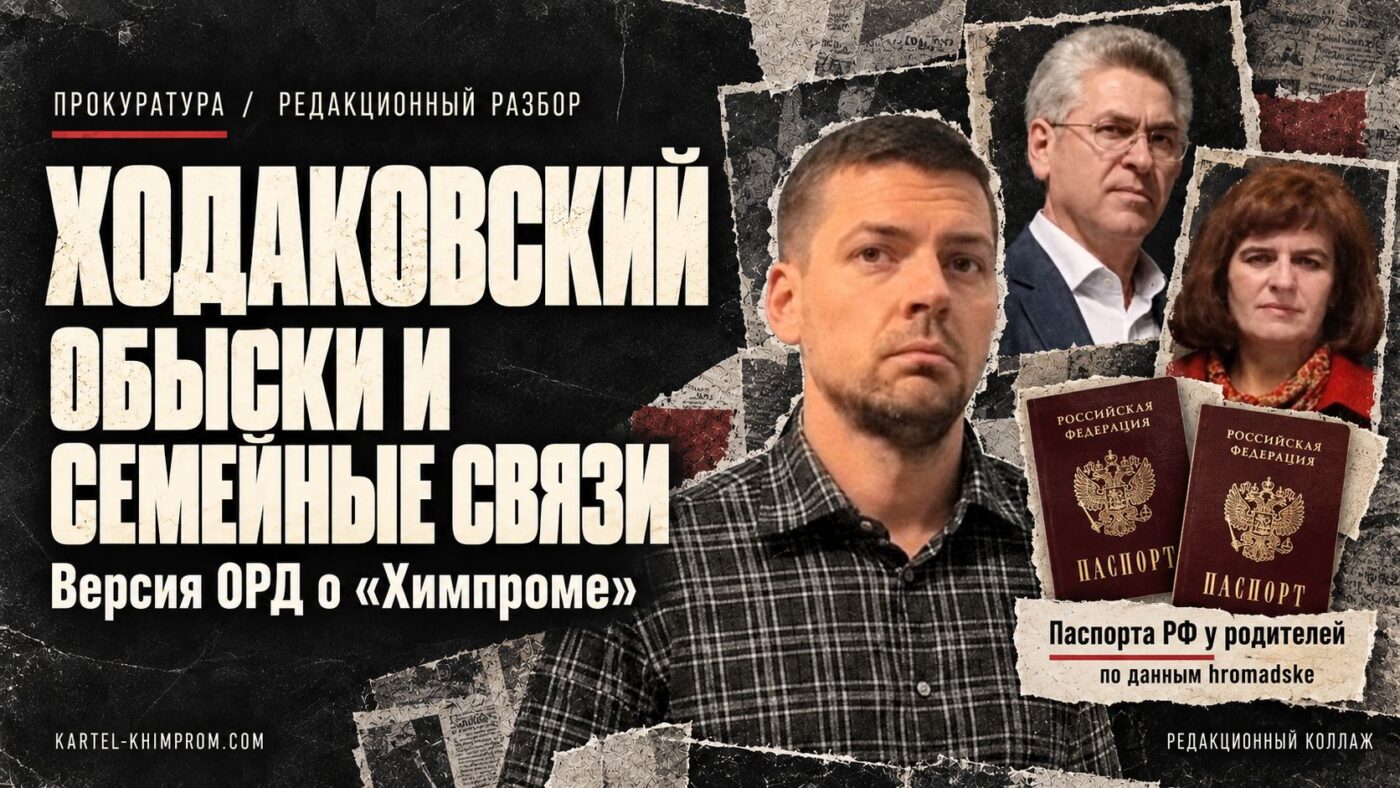
A separate strand of the investigation concerns the prosecutor’s parents. A hromadske investigation reports that Petro Khodakovsky obtained a Russian passport in 2007, and Tetyana Khodakovska in 2008. Journalists cite information from leaked databases and verification of the details via the Russian tax service. The hromadske editorial team also described photographs from social media showing St George’s ribbons, which they believe depict the prosecutor’s parents.
The same article also contains information about his father’s employment within organisations linked to ‘Rosneft’. At the time the investigation was published, no substantive responses to the journalists’ questions had been issued by Sergei Khodakovsky or the Moscow City Prosecutor’s Office. This relates to that specific article and does not mean that no comments were issued at a later date.
The citizenship of relatives proves neither that the prosecutor was working for Russia nor that he had any links to ‘Khimprom’. It raises a separate issue concerning the assessment of potential risks and conflicts of interest. This should not be conflated with the evidence relating to the searches.
It is also premature to conclude that the NABU failed to act on the basis of the ORD’s publication: the absence of a public statement does not reveal the full extent of the agency’s work. However, the public’s demand for an explanation of this matter is justified. What conclusions were drawn following the disciplinary decisions? Were the possible motives behind the breaches investigated? Has the theory regarding external influence been subject to any documentary assessment?
For Kartel-khimprom.com, the main focus is on the alleged use of law enforcement powers in the interests of ‘Khimprom’. In Khodakovsky’s case, the breaches have been confirmed by disciplinary decisions. The existence of a client, his links to the group and any potential financial gain still require proof. This is precisely where the line is drawn between a sensational allegation and an investigation capable of substantiating it.