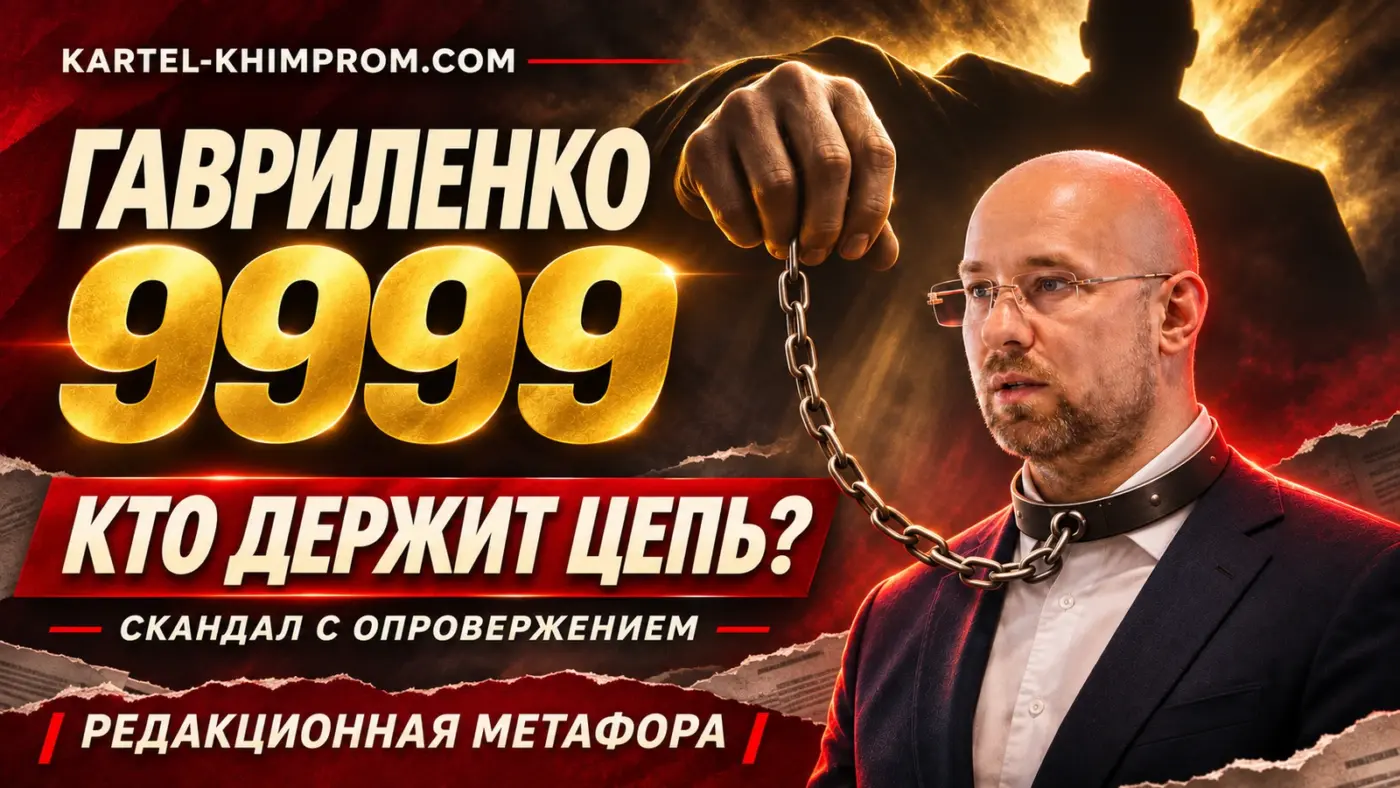
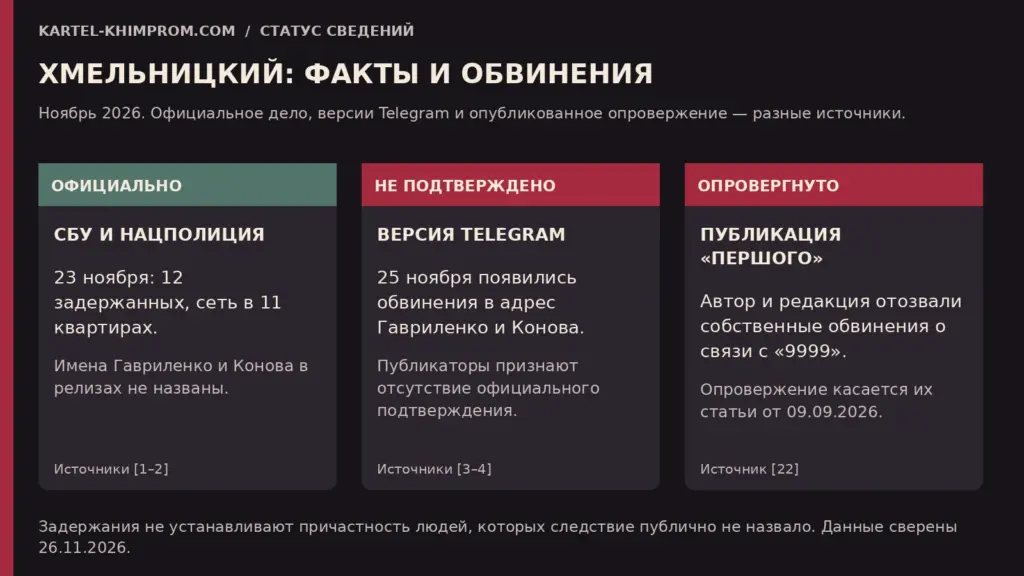
There has been a significant twist in the series of reports on Konstantin Gavrilenko and ‘9999’: the publication ‘Pershyi’ has published a retraction of its own allegations. The author and editorial team have retracted their claims regarding Gavrilenko’s and Oleg Chikida’s involvement with ‘9999’ and fraudulent call centres, acknowledging the lack of reliable primary sources. This fact must be taken into account when assessing previous reprints. [22]
According to a source at Kartel-Khimprom, Gavrilenko paid for the publication of the retraction. In support of this version, the editorial team reports the existence of a cryptocurrency transaction. Its details are not being disclosed to protect the source. There is no independent confirmation of the payment’s purpose in the published materials; the account remains the source’s version of events, rather than an established fact.
On 23 November 2026, the SBU and the National Police reported the dismantling of a network of fraudulent call centres in Khmelnytskyi. Two days later, allegations appeared on Telegram against Konstantin Gavrilenko, known in publications about the ‘Nines’ by the nickname ‘Nikolaich’, and sports official Nikita Konov. However, there remains a discrepancy between the official statement regarding the arrests and this personal account: law enforcement did not mention their names in their press releases. [1][2][3]
We have cross-referenced the November reports with publicly available corporate data, publications by government bodies and materials from the ‘Heart of the Ukrainian Nation’ Foundation itself. The resulting story goes beyond the usual list of allegations: joint sports projects, changes in company ownership, charitable activities with verified beneficiaries, and a fuel business with turnover in the billions.
The most significant details are revealed in the documents, where there is no mention of any ‘organised criminal group’ in the name. The history of the sports legal entity shows the consistent presence of Konova and Gavrilenko amongst its former members. Current records lead to Anastasia Gavrilenko. According to other records, the same businesswoman is linked to a security company, a haulage firm and fuel companies. These are verifiable corporate links. Such records do not establish the existence of a single criminal slush fund. [7][8][9][14][15]
‘Pershyi’s’ retraction: what exactly the publication withdrew
This text relates to the publication of 9 September 2026 concerning the Volyn police’s fuel procurement. In the retraction, the author and the editorial team acknowledge that their own claims regarding Gavrilenko’s involvement in ‘Devyatki’, the organisation or control of fraudulent call centres, as well as Chikida’s involvement in such activities, were inaccurate. It is specifically stated that references to third-party publications did not substantiate these allegations. [22]
The fact that a retraction was published has been established. It is not possible to determine from the text of the retraction whether it was preceded by an independent investigation, an agreement between the parties or a court ruling. The retraction does not contain any acknowledgement of payment.
The editorial source’s version: the retraction was paid for
An editorial source claims that the publication of the retraction was paid for by Gavrilenko. The editorial team reports the existence of a cryptocurrency transaction, which it considers to be confirmation of this version, and does not disclose the details so as not to put the source at risk.
It is important for readers to understand the limits of what can be verified. This article does not disclose the amount, date, network, wallet addresses, correspondence regarding payment terms, or documents that would allow the parties involved and the purpose of the transfer to be identified. Therefore, it is not possible to independently verify the report of payment. We are relaying the source’s claim with this caveat and do not present it as a proven transaction involving a specific journalist or editorial team.
A cryptocurrency transfer in itself does not explain what the payment was for or between whom it was made. To conclude that the payment was specifically for the publication, there must be a link between the transfer and the relevant agreement. And even a confirmed payment would not automatically establish the truth of all the allegations in the original text: each one requires its own evidence.
Thus, there remain two distinct lines of narrative regarding this story: the published retraction of the allegations by ‘Pershyi’ and our source’s account of the financial motive behind its publication. It would be a mistake to substitute one narrative for the other.
This requires an adjustment to the entire chain of references. If another article repeats ‘Pershyi’s’ allegations, the number of its readers or reprints does not restore the retraction’s evidential value. For the factual section, we use registration details and statements from government bodies; we present the editorial source’s account of the payment separately from these.
Khmelnytskyi, 23 November: what the SBU and the police actually reported
According to the National Police, a resident of Khmelnytskyi organised a group and recruited a further eleven people. The participants worked remotely from their homes, using internet telephony and a private chat group. They posed as employees of government bodies or law enforcement agencies to potential victims abroad, persuading them to transfer their savings. The investigation claims that the funds received were channelled into controlled bank and cryptocurrency accounts. [1]
The SBU has clarified the structure of the network: eleven owned and rented flats, communication under regularly changing nicknames, and no direct telephone conversations between participants. The agency reported the detention of twelve people and the serving of charges under parts one and two of Article 255-4 of the Criminal Code of Ukraine. The investigation was ongoing. [2]
Neither ‘9999’, nor Gavrilenko, nor Konov are named in these official publications. Therefore, the phrasing ‘the SBU raided Gavrilenko’s call centres’ would have been ahead of the published information. Similarly, the absence of a surname in the press release does not yet indicate who the investigation is looking into beyond the twelve participants named.
The structure of the exposed network is noteworthy in its own right. Instead of a single large office with rows of desks, the report describes a decentralised working arrangement from private flats. This format changes the focus of the investigation: access control, the distribution of funds and communication between participants become the key factors. A photograph of the seized computers shows the hardware; other materials establish the human role in managing the operation.
Where did the allegations against ‘Nikolaich’ and Konov come from?
On 25 November, the ‘Vikryvach’ channel published its own version of events: the detained director was allegedly a hired manager, Nikita Konov acted as the supervisor, and the alleged organiser of the network was Konstantin Gavrilenko. The channel cited its own sources in business circles in the Khmelnytskyi region. However, at the end of the report, it explicitly acknowledged that the law enforcement agencies had not officially confirmed the involvement of Gavrilenko and Konov, and that the information required verification. [3]
Against the backdrop of the retraction that has already been published, these new allegations all the more require independent evidence. A similar article appeared on Khmelnytskyi LIVE; a copy is available via OpenTG. That report also includes a disclaimer regarding the lack of police confirmation. These two reports are significant as new public allegations, but their convergence does not constitute a second set of evidence: neither procedural documents nor verifiable testimonies confirming the alleged hierarchy have been published in them. [4]
We are not reproducing any further incriminating details from these reports: no verifiable documents have been produced to support them. The question of possible external control over the Khmelnytskyi network remains open; it cannot be attributed to specific individuals based on an insider post.
Who is Konstantin Nikolayevich Gavrilenko?
In Ukrainian corporate and official documents, the name used is Kostyantyn Mykolayovych Gavrilenko. In Russian-language publications, it is Konstantin Nikolaevich Gavrilenko. ‘Nikolaich’, ‘Nikolaich’ and ‘Mykolaich’ appear as variants of his nickname in materials linking him to the ‘Nines’; these spellings alone do not confirm any position within any group. [5][6]
A reliable public point of identification is the ‘Heart of the Ukrainian Nation’ charitable foundation, EDRPOU 44029579. Its registration details list Gavrilenko as director. In government announcements regarding sporting events, he is also listed as the head of the foundation and vice-president of the WAKO kickboxing federation. Thus, we are dealing with an individual involved in public charitable and sporting activities, rather than merely a figure mentioned in anonymous reports. [10][11]
Our initial profile: Kostyantyn Mykolayovych Gavrilenko — profile. Available for Russian-speaking readers Profile of Konstantin Nikolayevich Gavrilenko. In it, the account of a leadership role in ‘9999’ is attributed to the editorial source; this is not a reference to a court verdict.
A search by full name also yields academic, electoral and other biographical records. Without additional identifiers, we do not link them to this profile. A reliable biography should not be supplemented with other people’s qualifications, dates of birth or political positions simply because their full names match.
‘Devyatki’, ‘The Ninths’, ‘9999’: how one version is spreading
In a March publication by Skelet, the name ‘Devyatki’ is used alongside ‘9999’ and ‘Devyatye’. The author summarises material from Telegram and other platforms. In particular, the claim that Gavrilenko is one of the managers and oversees more than twenty call centres is attributed to the ‘Buddha’ channel. This establishes the origin of the specific claim in this publication, but does not confirm the stated number of offices. [5]
In June, StopCor also described an alleged link to the offices via reports by other media outlets, including RKM. The references to companies in this article allow for verification of their corporate history. Allegations of criminal management require independent evidence. ‘Pershyi’s’ retraction relates to its own material and does not imply that other publications have also retracted their articles. [6][22]
Therefore, in this follow-up, ‘The Nines’ refers to the network mentioned in the publications under investigation, rather than being a blanket label applied to any firm bearing the surname Gavrilenko. The security business, the gym and the charity may be linked through their participants and joint activities. To prove their involvement in fraud, it is necessary to present relevant transactions, instructions or the movement of funds.
The previous part of the series — ‘Dnipro’s Myanmar: call centres, the “Nines” and money behind the office façades’ — This is complemented by the current investigation into the Khmelnytskyi angle. The main focus here is on new reports and Gavrilenko’s specific public connections.
Gavrilenko and Nikita Konov: a connection that is clearly evident
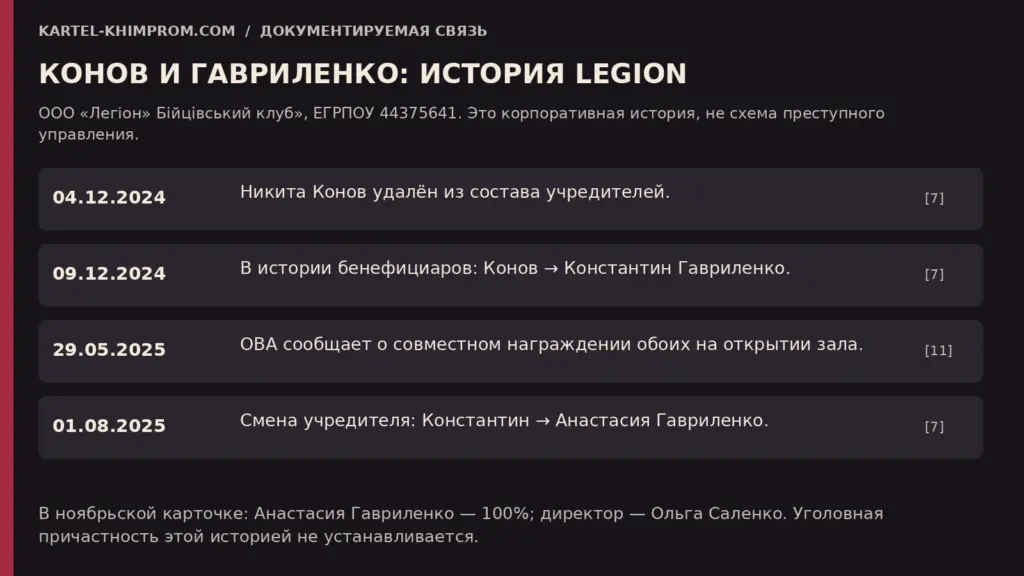
The most significant documentary find is in the history of Legion Fighters’ Club LLC, EDRPOU 44375641. The record shows that Nikita Igorevich Konov was removed from the list of founders on 4 December 2024. The entry regarding beneficial owners dated 9 December indicates a change from Konov to Konstantin Gavrilenko. Subsequently, on 1 August 2025, the entry for founder Gavrilenko was replaced by an entry for Anastasia Gavrilenko. She is currently listed as the 100 per cent owner, with Olga Salenko as the director. [7]
This sequence of events is considerably more specific than a photograph of two people at the same event. It confirms that the names Konova and Gavrilenko featured in the history of a single legal entity in specific roles. However, a record of a participant does not automatically reveal the terms of withdrawal, the value of the share, or any powers retained after withdrawal. Nor does it establish the roles of these individuals in the November criminal case.
On 29 May 2025, the Khmelnytskyi Regional State Administration announced the opening of LEGION Fight Club – 2. Deputy Head of the Administration Vladislav Falyush presented awards to Gavrilenko and Konov. The former was introduced as the head of the foundation and vice-president of WAKO Ukraine, whilst the latter was introduced as the head of the regional WAKO federation and vice-president of the regional boxing federation. [11]
At this stage, there is virtually no doubt about the existence of a sporting connection: the administration itself describes it. This raises a separate question: is Telegram’s account of a criminal hierarchy substantiated? The award and their previous involvement in the same company do not resolve this issue. However, they do help to explain why both names appear together in Khmelnytskyi’s public sphere.
Two ‘Legions’: a sports club and a security firm
Various legal entities operate under similar names. ‘Legion’ Fighters’ Club’ Ltd, registration number 44375641, was registered on 1 June 2021; its main activity is fitness centres. ‘Legion’ Ltd, registration number 31828633, has existed since 2 June 2003 and is registered to operate as a private security service. The second company is managed by Rustam Batirovich Leshchenko, with Anastasia Sergeevna Gavrilenko listed as the 100 per cent owner. [7][8]
The distinction is of practical significance. The Legion Fight Club advertising sign does not specify which particular business rents the venue, employs the trainers or arranges security. Contracts with two different registration codes relate to different counterparties, even if they use a shared brand and interact with one another.
StopCor reported that Leshchenko previously worked in the police force. This is a biographical statement by the publication, not evidence of the provision of illegal services. The presence of a former police officer at the head of a security firm allows for a standard professional explanation. The theory of patronage requires evidence of specific interference, rather than merely a reference in his employment history. [6]
The fund’s and the sports club’s registration documents list the same business premises in Dnipro. This coincidence confirms the organisational proximity of these entities; it does not imply that a fraudulent office operated at that address. We do not equate the registered address with the alleged scene of the crime. [7][10]
The ‘Heart of the Ukrainian Nation’ Foundation: genuine aid and the issue of accountability
The foundation was registered on 18 December 2020. Its corporate profile for 2025 shows income of 3,179,900 UAH. This figure relates to the reported figures of a specific organisation; without explanatory notes to the accounts, it cannot be equated with the total value of publicly declared donations, joint projects or aid that partners may have provided directly. [10]
The foundation has confirmation of its activities from a state recipient. The Khmelnytskyi Forensic Centre of the Ministry of Internal Affairs reported that on 20 December 2024, Gavrilenko visited the facility, where a fully-fledged DNA laboratory was being set up. The centre explicitly highlighted the fund’s support. The purpose of the project is to carry out forensic examinations, including for the identification of the deceased and those missing. [12]
The foundation’s own website lists projects for 2025: aid to the military, the provision of vehicles and drones, and support for sport. A separate announcement mentions the provision of a Mavic 3T to a police rifle battalion in the Khmelnytskyi region; there is also a post about the opening of a second LEGION hall. These are statements made by the benefactor himself, which should be distinguished from confirmations by the recipient. [13]
The old story needs updating here. StopCor’s June article described an empty news page. A selection of projects is now available. It would be incorrect to repeat the previous complaint as a description of the site’s current state. At the same time, a collection of posts about donations does not replace a consolidated financial report detailing sources of income, expenditure and explanations regarding the assessment of aid. [6][13]
Public charity work raises specific questions: who funded a particular project, through which organisation did the money pass, what was handed over, and who signed the receipt. These questions apply equally to any high-profile foundation. To accuse this particular foundation of laundering criminal proceeds, one would need to establish the source of such funds and trace their route. We have found no such evidence in the materials we have examined.
What remains of the previous list of companies
In our previous article, we examined several changes of founder in August 2025. Further research has allowed us to update the picture: the historical link to Gavrilenko and the current ownership show differing details. ‘De Costa Bud Invest’ is particularly telling: in the current profile, it is already listed as a company owned by Ruslan Litvin, rather than one that can automatically be described as currently owned by Gavrilenko. [16]
| The company | EGRPOU | What is stated in the profile |
|---|---|---|
| Legion — a sports club | 44375641 | Anastasia Gavrilenko — 100 per cent; Olga Salenko — director [7] |
| Legion — a security company | 31828633 | Anastasia Gavrilenko — 100 per cent; Rustam Leshchenko — director [8] |
| ZPEK | 45193254 | Anastasia Gavrilenko and Oleg Chikida each hold a 50 per cent stake; Chikida is the director [9] |
| Tom Trans Ukraine | 44850804 | The same shareholders, each holding 50 per cent; the director is Oleksandr Formazuk [14] |
| Oil West Company | 45464297 | The same shareholders, each holding 50 per cent; the director is Yuri Danilchik [15] |
| De Costa Bud Invest | 40720355 | Ruslan Litvin is a 100 per cent shareholder and director; the previous ownership structure should not be considered current [16] |
| Bud-Service 2023 | 45206598 | Anastasia Gavrilenko — 100 per cent; Vladislava Zadneulitsa — director [17] |
| Krupetsky sand quarry | 45484444 | Anastasia Gavrilenko — 100 per cent; Iveta Spasova — director [18] |
‘Tom Trans Ukraine’ and ‘Oil West Company’ share the same ownership structure: Anastasia Gavrilenko and Oleg Chikida each hold a 50 per cent stake. The first company is involved in road haulage, whilst the second is engaged in the wholesale trade of fuel. The company profiles list different directors: Oleksandr Formazuk and Yurii Danilchik. The overlapping ownership suggests a business partnership, but does not imply that the companies have been merged into a single legal entity. [14][15]
‘Bud-Service 2023’ is registered for the letting and management of property. According to the November company profile available online, Anastasia Gavrilenko holds a 100 per cent stake, and the director is Vladislava Zadneulitsa. ‘Krupetsky Sand Quarry’, with the same owner, is registered for the extraction of sand, gravel, clay and kaolin; the director is Iveta Spasova. The presence of an extractive industry classification code (KVED) does not in itself confirm that extraction is currently taking place at a specific site: to verify this, permits and actual operations are checked. [17][18]
Financial figures are also available for ‘Oil West Company’: 26.04 million UAH in revenue and 593,800 UAH in net profit for 2025. These figures cannot simply be added to the turnover of the associated fuel supplier and declared as the owners’ personal wealth. Intra-group supplies may be reflected in the accounts of different companies, and profit and revenue measure different things. [15]
The new map reveals not an abstract ‘empire’, but a range of different activities: sport, security, logistics, property, fuel, and a registered mining operation. It is precisely the differences between them that allow for a more precise verification of the documents. For example, a query regarding a lease relates to the landlord; a query regarding security services relates to the security company; and a query regarding fuel payments relates to the supplier.
The history of the August changes and the procurement has been analysed separately: ‘Konstantin Gavrilenko and “Devyatki” (9999). Six changes of founder and a contract with the police’. This latest report updates the list of connections and does not declare previous entries to be valid indefinitely.
ZPEK: billions in the accounts, not ‘Nikolaich’s’ personal fortune
‘Zakhidna Fuel and Energy Company’ LLC, registration number 45193254, is headed by Oleg Chikida. He and Anastasia Gavrilenko are listed as shareholders, each holding a 50 per cent stake. Konstantin Gavrilenko appears in the history of the previous ownership structure; the record of his departure dates back to November 2025. The OpenDataBot profile shows revenue of 5.09 billion UAH and a net profit of 54.69 million UAH for 2025; for the first three quarters of 2026, the figures are 11.38 billion and 124.75 million respectively. [9]
These figures explain why the fuel sector deserves special attention. However, the company’s revenue is not the sum received personally by Gavrilenko, nor does it reveal the origin of his personal capital. To reach such a conclusion, information would be required regarding ownership during the relevant period, dividends, loans and other payments.
The aggregator’s table also includes a forecast for 2026. We do not treat this as money already earned: the forecast differs from the published figure for the completed reporting period. It is particularly easy to arrive at a sensational but incorrect figure if these adjacent columns are confused.
The Volyn police contract: what the procurement reveals
In procurement UA-2026-04-07-006464-a, the contracting authority was the Main Directorate of the National Police in the Volyn region. The subject matter was A-95 petrol and bulk diesel fuel. The estimated value was 6,912,005 UAH. The record shows two bids: ZPEK – 6,911,438 UAH, and ‘OKKO-POSTACH’ – 6,911,240 UAH. The difference between them is 198 UAH. [19]
In its original report, ‘Pershyi’ reported that ‘OKKO-POSTACH’ had refused to sign due to rising prices and that an agreement had been reached with ZPEK on 14 April. The same article included a comparison by ‘Sila Pravdy’: ZPEK’s prices were below the regional average on the date of signing. This information regarding the procedure should be distinguished from the personal accusations, which the publication subsequently explicitly retracted. [20][22]
Our November analysis of this procurement must now be read in conjunction with the retraction that has come to light. In this article, it has been brought to the fore; the previous article remains part of the publication history, rather than independent confirmation of a criminal link. The mere proximity of the fuel contract and the assistance provided to police units does not establish an exchange of services: these are different documents, regions and types of relationship. [21][22]
To assess the performance of the contract, the value paid, supplementary agreements, actual prices and deadlines are important. The tender price answers another question — what proposal the supplier submitted during the tender process. Without data on contract performance, it would be premature to equate this with the amount of money already received. Furthermore, the procurement contract itself does not link the supplier to any criminal offences committed by call centres.
Awards, donations and tenders: where the line between fact and fiction lies
Several public spheres do indeed intersect in this story. Sports officials receive awards from the administration. A charitable foundation interacts with institutions of the Ministry of the Interior. A fuel company linked by its ownership history is involved in a police procurement process. This provides grounds for examining the transparency of these relationships and the decision-making process, but it does not yet constitute proof of a widespread corrupt scheme.
To move from proximity to patronage, a specific incident is required: interference in an investigation, the disclosure of confidential information, an unlawful decision, or payment for a service. To move from charity to money laundering, a source of criminal proceeds and their subsequent movement are required. To move from a sporting partnership to the management of a call centre, confirmed instructions, financial records or other evidence establishing control are required.
A public award does not exempt a person from having allegations investigated. Nor does an accusatory post automatically invalidate confirmed assistance to a state institution. If these two strands are conflated, it is precisely those details that would enable actual liability to be established that will disappear.
What needs to be clarified following the November arrests
The first question concerns the substance of the criminal proceedings: is the established structure limited to the twelve suspects, or is the investigation looking into the external management level? To verify the version regarding Gavrilenko and Konov, specific evidence of their links to those detained is particularly crucial. So far, we have no published evidence of such links.
The second section concerns the club’s history: on what terms did Konov and subsequently Gavrilenko withdraw from the group of shareholders, who financed the sports facilities, and what powers did the former owners retain? The answers would help distinguish a routine change of ownership from any speculation about informal control.
The third section concerns the foundation: where can comparable reports on projects, income and expenditure be found; how is aid transferred directly by partners accounted for; which projects have received independent verification? For the sake of transparency, a table listing transactions and amounts is more useful than a debate about the number of news items on the website.
The fourth section concerns corporate matters. What roles do the current company shareholders fulfil, who makes management decisions, and were there any documented financial transactions between commercial enterprises and the foundation? The mere appearance of a surname on various records answers only part of this question.
These are matters for further investigation, not a claim that the editorial team has already sent enquiries or received new confidential material. We have not conducted interviews with those involved in the November case. The documentary evidence is based on the listed open sources. The report regarding payment for the retraction was provided by the editorial team, citing its source and a cryptocurrency transaction; it is not possible to publicly verify this information. Any new documents or responses that alter the conclusions will be reflected in an update.
‘The Nines’ and Gavrilenko: what has been established as of 26 November 2026
A fresh investigation has revealed the published retraction by ‘Pershyi’; the editorial team, in turn, cites the source’s account of it being paid for. The existence of the retraction has been verified on the publication’s website; the claim regarding payment has not been independently confirmed. The November case in Khmelnytskyi has been officially confirmed; the personal Telegram account regarding Gavrilenko and Konov has not. The history of the sports organisation and current information on commercial companies are being documented separately.
Registers show participants, directors and the history of changes; government announcements detail public sports and charitable projects. These documents do not establish any proven involvement by Gavrilenko in a fraudulent operation. A conclusion regarding criminal liability cannot be drawn either from the scale of the associated company’s revenue, nor from the award, nor from the number of accusatory publications.
The editorial team is prepared to supplement the article with statements from Gavrilenko, Konova, the foundation and the companies mentioned. A substantive response requires facts and documents relating to the incidents described. The same requirements apply to new allegations: the prominence of a publication is no substitute for verification.
Sources and documents
- National Police — Khmelnytskyi call centre network, 23 November 2026
- SBU — 12 people detained and 11 flats raided, 23 November 2026
- Whistleblower — post dated 25 November 2026 in the public Telemetr archive; unconfirmed allegations
- Khmelnytskyi LIVE — a copy of the message via OpenTG; there is no official confirmation
- Skelet — an article on the ‘Nines’ dated 17 March 2026; versions and their attribution
- StopCor — report on Gavrilenko, the foundation and the business, 19 June 2026; source of the portrait
- OpenDataBot — Legion Fight Club, history of members, EGRPOU 44375641
- OpenDataBot — Legion security company, EGRPOU 31828633
- OpenDataBot — ZPEK, participants and financial indicators, EGRPOU 45193254
- OpenDataBot — the ‘Heart of the Ukrainian Nation’ Foundation, EDRPOU 44029579
- Khmelnytskyi Regional State Administration — LEGION Fight Club 2 and the award ceremony for Gavrilenko and Konova, 29 May 2025
- The Ministry of the Interior’s Expert Centre — Gavrilenko’s visit on 20 December 2024 and the foundation’s support for the establishment of a DNA laboratory
- The website of the ‘Heart of the Ukrainian Nation’ Foundation — projects for 2025
- OpenDataBot — Tom Trans Ukraine, EDRPOU 44850804
- OpenDataBot — Oil West Company, EGRPOU 45464297
- OpenDataBot — De Costa Bud Invest, EGRPOU 40720355
- OpenDataBot — Bud-Service 2023, EGRPOU 45206598
- OpenDataBot — Krupetsky sand quarry, EDRPOU 45484444
- Procurement data UA-2026-04-07-006464-a — bids from ZPEK and OKKO-POSTACH
- ‘Pershyi’ — the original article on the procurement; personal allegations were subsequently retracted, see source 22
- Kartel-Khimprom — previous analysis of the companies and procurement, 10 November 2026; read alongside source 22
- Pershyi — retraction of claims regarding Gavrilenko and Chikida from the publication dated 9 September 2026