
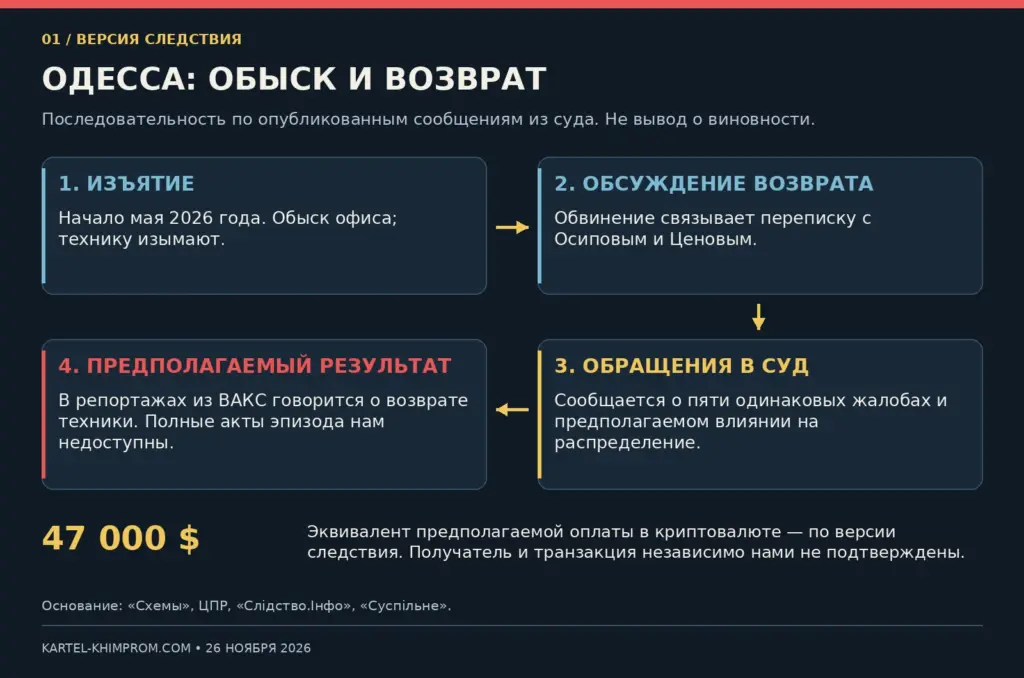
A search is intended to put a stop to illegal business. In the ‘Carthage’ case files, the investigation describes a different sequence of events: law enforcement officers seize the equipment, the alleged intermediary seeks help from a high-ranking police officer, five identical complaints are discussed, and then, according to the prosecution, the equipment is returned to its owners. The cost of this settlement, as reported in the published version, is the equivalent of 47,000 dollars in cryptocurrency.
At the centre of the story are Yegor Burkin, Andrei Osipov and Vladimir Tsenov. But the most important aspects here lie between the high-profile names: in the return claims, applications for the seizure of assets, the allocation of case files amongst judges, and the actions of prosecutors. It is precisely this aspect that usually disappears from the news coverage after the footage of boxes of computers.
We have compared official statements from NABU and the National Police, reports from High Anti-Corruption Court hearings and the texts of two published court rulings. The result is a story about alleged paid interference — and about why the ordinary, lawful return of property cannot automatically be labelled as corruption. The Odessa episode from ‘Carthage’ and publicly available rulings on the searches in Kyiv and Lviv — three episodes, between which we have not established any documentary link.
This article was prepared on 26 November 2026 using open sources. It is a documentary analysis of published materials, not a report on access to a closed criminal case. We distinguish the investigation’s version from established judicial proceedings; the materials reviewed do not establish the definitive guilt of those involved in this episode.
‘Khimprom’ after the search: the most awkward part of the reporting
A law enforcement operation has a very recognisable public finale: an open door, officers in full gear, a table with telephones, secure envelopes, and a detainee surrounded by a police escort. All this shows that the state has arrived at a specific address. However, the answer to another question – whether the alleged criminal organisation has been stripped of its resources – can be found in the following documents.
A computer may remain in the evidence store, be sent for examination or be returned. Funds may be seized or released from restrictions. The investigation itself may continue in the meantime. Therefore, the number of devices removed from the office and the number of proven offences are different metrics. In between lies the work that cannot be replaced by a sensational video clip.
In a statement by the NABU dated 4 November An organisation is described which, according to the Bureau and the Specialised Anti-Corruption Prosecutor’s Office (SAPO), used corrupt connections to cover up fraudulent call centres and other illegal activities. The investigation has reported that at least 12 individuals have been implicated in its activities. This is a statement by a law enforcement agency, not a final conviction.
The alleged interference in the fate of the seized equipment makes this story particularly significant. This is no longer merely a matter of being able to warn an acquaintance in advance about a search. If the sequence of events outlined by the prosecution is confirmed, the service could have included assistance after the police had already carried out the investigative action. The protective network would then have been operational both before and after the loss of the equipment.
However, this version can only be verified in relation to a specific office, a specific list of items and specific decisions. The phrase ‘everything was returned to everyone’ explains nothing without these specific details. It conceals both the lawful restoration of the owner’s rights and possible abuse with equal ease. Therefore, let us begin with the episode that the prosecution discussed in court.
Odessa: a search that the alleged ‘defence’ failed to stop
According to Report by the Centre for Public Investigations from the courtIn early May 2026, investigative measures took place at the Odessa office, which the prosecution linked to a fraudulent call centre. The article refers to approximately 60 workstations. According to the prosecution, an attempt to prevent the search was unsuccessful: the property was seized.
Further on in this version, Andrei Osipov appears. The court documents link him to the nickname ‘Criminal’, and Vladimir Tsenov to the designation ‘Price’. These aliases are important for interpreting the published correspondence, but do not in themselves constitute identification of the individuals involved. Linking a phone contact to a specific person is a separate part of the evidence.
Publication ‘Slidstvo.Info’, citing a statement by the SAP prosecutor The following report states: following the failure to halt the search, the parties were already discussing the return of the seized items. According to the prosecution’s account, Tsenov advised Osipov on procedural applications and the subsequent court proceedings.
This changes the focus of the investigation. If the story were limited to a request to ‘call an acquaintance’, it would remain merely a tale of influence. Here, the investigation points to an alleged link between the requests, the distribution of materials, the outcome of the review and the payment. It is the coincidence of these elements, rather than the position held by one participant, that must either confirm or refute the theory of a paid service.
An important gap remains: the exact court documents relating to the Odessa episode are not found amongst the two available rulings, which are analysed below. We do not present a separate ruling from Lviv or Kyiv as evidence specifically concerning the return of this particular equipment. Without such a distinction, the investigation easily turns into a montage of convincing but unconnected fragments.
Five identical complaints: why is the investigation highlighting this detail?
‘Schemes’ — a Radio Free Europe/Radio Liberty project — analysing materials published by the NABU Reports suggest a recommendation has been made to file five identical complaints with the Pecherskyi District Court in Kyiv. The investigation explains this as an attempt to influence the automated allocation of cases amongst judges.
Here, it is necessary to distinguish between two claims. First: the published version discussed precisely this recommendation. Second: the allocation was indeed changed in the applicants’ favour. The first can be verified by checking the completeness and accuracy of the correspondence. For the second, registration data is required: how many documents were received, at what time, how they were allocated, and what happened to each of the applications.
A repeat application to the court does not in itself prove intent. There may be different grounds for the complaints, different applicants, or corrections made to deficiencies in the documents. If the prosecution alleges an artificial selection of the judge, it is necessary to demonstrate the substantive similarity of the applications and link this to the specific actions of those involved. Without this, the number ‘five’ remains a striking detail rather than conclusive evidence of manipulation.
The key documents to examine here would be the records of distribution and redistribution, the cards for incoming materials, and the procedural fate of the duplicates. Such documents are capable of providing a more precise answer than any discussion of the ‘right court’ in general. They show exactly where the coincidence ceases to be a mere coincidence and becomes an action that can be assessed.
That said, even the unusual sequence of registrations does not prove that the judge received any money. These are separate issues. To conclude that there was unlawful remuneration, separate evidence of the transfer, an agreement and the recipient’s knowledge would be required. The investigation must go the whole distance, rather than jumping from discussing someone else’s surname to accusing the person bearing it.
Roman Novak and Tatyana Ostapchuk: a name mentioned in court does not equate to suspicion
‘Suspilne’ broadcast a statement by NABU detective Oleksandr Konovalchuk, which named Judges Roman Novak and Tatyana Ostapchuk and detailed the rulings concerning the return of property and the refusal to seize it. The same article cites case number 757/25759/26-K; the journalists were unable to find the relevant ruling in the public register.
This is the extent of the information available. We have a published summary of the prosecution’s submission, but we do not have the full text of this particular ruling to independently compare the parties’ claims, the reasoning and the operative part. Consequently, it is impossible to write in good faith as though we had read it and established that there were no legal grounds for the return.
Another key detail: according to information disclosed at the hearing and in the SAP’s response, both judges were named as witnesses. In a subsequent publication on the position of the High Council of Justice This status is also cited. The publicly available materials we have checked provide no grounds for replacing it with the word ‘suspects’.
Why is this important for the story itself, and not just for legal accuracy? Because there are various possible explanations. The intermediary may well have influenced the decision, exaggerated his capabilities to the client, or sold something that the owner was entitled to receive without him. The choice between these versions depends on the evidence, not on the emotional impact of the front page.
The mention of a specific judge in correspondence between third parties constitutes grounds for investigating the circumstances. The receipt of money, involvement in the arrangement and the unjust nature of the ruling must be established separately. Until this has been done, the claim that ‘the judges were reinstated in return for a bribe’ would suggest more than the documents examined allow.
$47,000: the alleged price — the as-yet-undisclosed money trail
The following figures appear in ‘Schemes’ public analysis: the equivalent of $47,000, transferred in cryptocurrency. In another A report by ‘Suspilne’ from the High Anti-Corruption Court This sum is stated as 47,000 USDT, and the return of the equipment is described as having taken place approximately two weeks after the search. Both publications present the investigators’ version of events.
For the headline, the difference between dollars and tokens may seem minor. For verifying the payment, it is significant. The asset name, blockchain, date, addresses and transaction hash make it possible to trace a specific movement of funds. A general monetary estimate does not allow this. The materials we have examined do not contain a sufficient set of details to carry out an independent verification of this specific alleged transaction.
We therefore do not trace an ‘established bribery route’ from Osipov to the judge, nor do we attribute an unknown wallet to the recipient’s surname. Even a confirmed transfer to a specific address does not automatically answer the questions of who controlled the wallet and for what purpose the funds were received. To do so requires data linking the transaction to a person and an agreement.
The discrepancy can be explained by the very structure of the evidence. Correspondence may contain the amount and the purpose. The blockchain can confirm the transfer. Service data or other materials may identify the controlling party. Court documents allow a transaction to be cross-referenced with events in court. Each element answers its own question; the absence of one cannot be compensated for by the repeated mention of another.
This does not imply that NABU’s version is incorrect. It means that only part of its basis is available to the reader. The prosecution may have evidence that has not yet been published. However, an investigative piece should not fill this gap with fabricated addresses, fictitious ‘our data’ or a definitive allocation of the sum amongst individuals.
It is particularly important not to confuse the alleged $47,000 with other sums discussed in the reports on ‘Khimprom’, U420 and ‘Carthage’. A payment for a single incident, aggregate payments over a specific period and frozen assets fall into different categories. Without a single statement of account, adding them together will yield a figure that looks impressive but is unreliable.
Andrei Osipov and Vladimir Tsenov: where the prosecution’s version ends
Project observers Transparency International Ukraine ‘The High Anti-Corruption Court has ruled’ reported on the hearing on 5 November. According to their report, the prosecution accused Vladimir Tsenov of participating in a criminal organisation and receiving unlawful benefits. The prosecutor also spoke of assistance regarding the seized property.
The same report sets out the defence’s position: the lawyer considered the suspicion unfounded, contested the existence of the alleged criminal organisation and questioned the sufficiency of evidence regarding Tsenov’s role. The defence also rejected the allegation of obstructing the search. This is not an editorial response on behalf of the suspect, but the position of his representative as recorded by observers.
DW in an article dated 18 November It is reported that Tsenov did not admit guilt, whilst his defence lawyers pointed to insufficient evidence of communication with Osipov. For our investigation, this is the central objection: if the link between the parties has not been reliably established, the explanation for the correspondence and the alleged instructions will need to be reconsidered.
A court ruling on a preventive measure does not settle this dispute. At this stage, the grounds for procedural restrictions and the associated risks are assessed; a final verdict is not handed down on every communication, payment and action. The amount of bail, a photograph behind glass and a high-profile position do not remove the obligation to prove the charges in accordance with the established procedure.
This is precisely why, in this article, the surnames of Osipov and Tsenov are accompanied by an indication of the source and the status of the claim. We do not substitute verification of the evidence with their public profile. For the reader, such precision is practically useful: as the case develops, it will become clear which specific element has been confirmed, which has been disputed, and which has not been pursued at all.
The Office of the Prosecutor General has launched an investigation. But this is not yet the outcome
On 10 November, the General Prosecutor’s Office announced the launch of an internal investigation in connection with new facts relating to the second phase of the ‘Carthage’ case. As reported ‘Ukrainska Pravda’ and ‘Interfax-Ukraine’The order was issued by Acting Prosecutor General Anton Kovalsky. The subject of the investigation is the possible involvement of unidentified staff members of the Prosecutor General’s Office in the return of property in cases concerning call centres and the U420 network.
This wording implies that the agency has recognised the need to verify publicly available information. It does not imply an admission of guilt by every prosecutor involved in the relevant proceedings. Nor does it imply that the employee named online has already been identified as the very person involved in the alleged interference.
An internal investigation and criminal evidence-gathering serve different purposes. The former may establish a breach of official duties and lead to personnel or disciplinary decisions. The latter requires evidence of the elements of a specific offence. The same incident may be subject to both assessments, but the announcement of an investigation does not replace either of them.
According to the sources examined for this publication, we do not have the final report of this investigation. Therefore, the correct question to put to the OGP is specific: which production processes have been examined, which actions by staff have been assessed, and what decisions have been taken? The phrase ‘we’ll look into it’ only becomes a result when a verifiable answer emerges.
Comprehensiveness is also essential for public scrutiny. If one were to examine only the names already mentioned in the news, one might overlook the sequence of events itself: the timeliness of applications for arrest, the quality of their justification, participation in the proceedings, and the enforcement of court orders. It is precisely this sequence of events that will reveal whether there was interference or whether the case was hampered by procedural errors.
Two public rulings: what we actually read
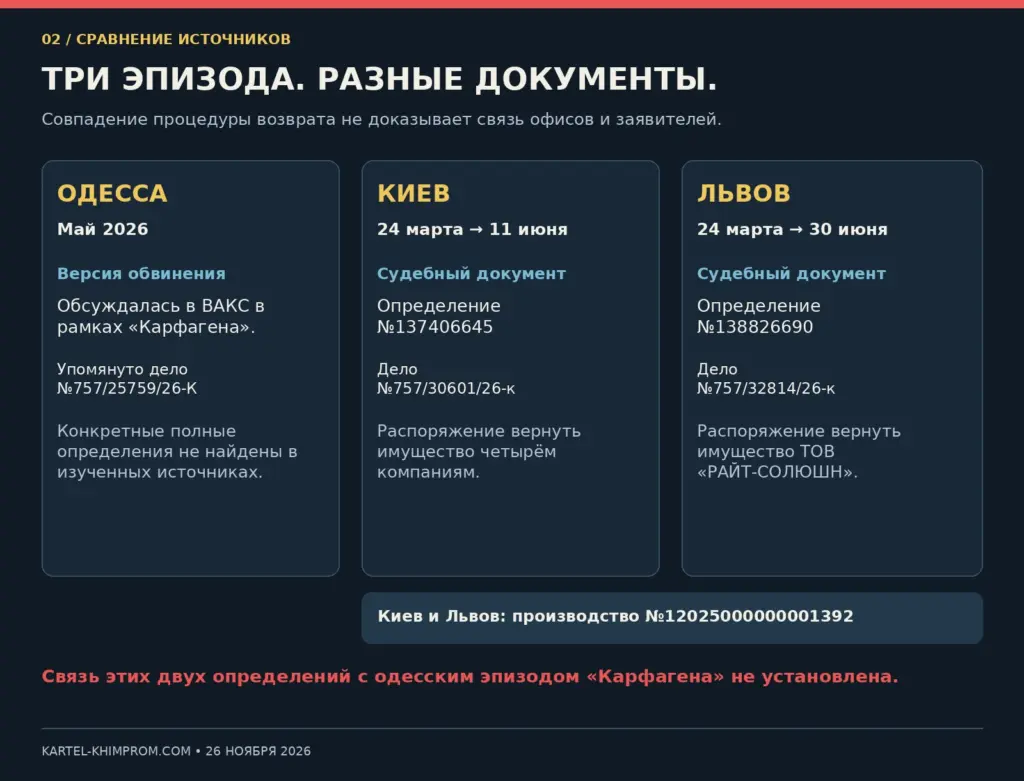
The main pitfall of this topic is to pass off a document containing similar wording as an inaccessible ruling from ‘Carthage’. We took a different approach: we separated the Odessa version of the charges from the two published rulings on the proceedings №12025000000001392. Both documents indicate a filing date of 12 May 2025 and an investigation under Part 5 of Article 190 of the Criminal Code of Ukraine – concerning fraud.
The materials relate to searches carried out on 24 March 2026. One address is in Kyiv, the other in Lviv. The matching case number allows these two rulings to be cross-referenced. This does not automatically link them to the Odessa office, Burkin, Osipov or the alleged 47,000. According to the information available to us, the case reference number for the Odessa seizure cannot be reliably matched with them.
A report by ‘Suspilne’ served as the starting point for our search for these documents. We have also reviewed their texts in the open-access YouControl database. These are copies of court documents, not the editorial team’s own access to the investigation materials. Direct links to entries in the state register are provided in the list of sources for further verification.
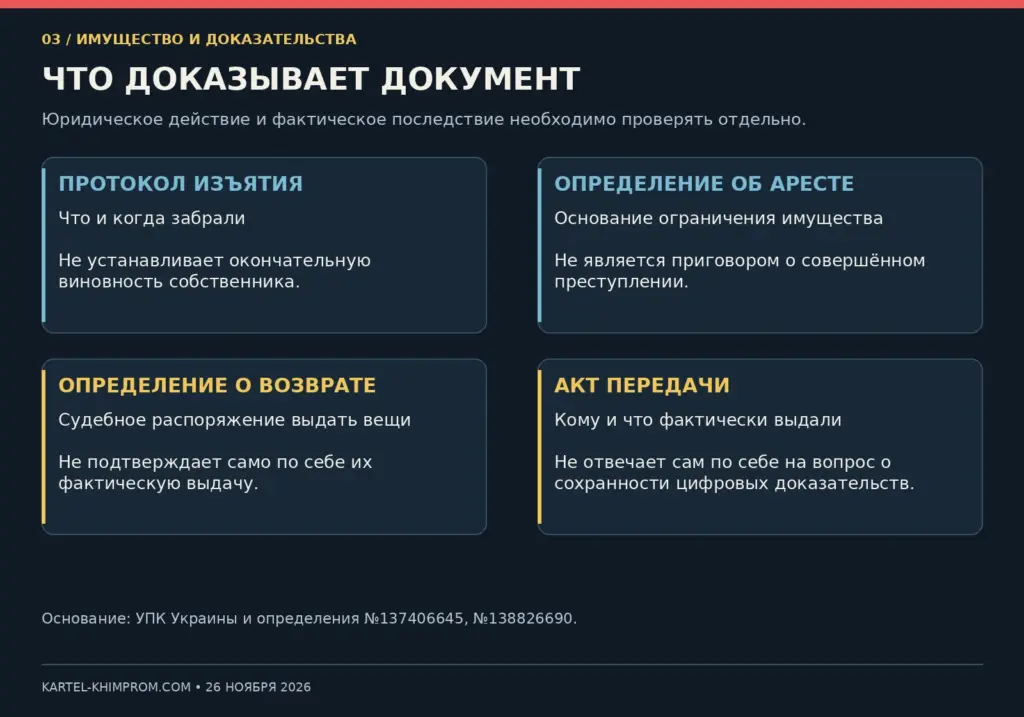
There is another limitation. An order requiring the return of items proves the existence of such a court order. It does not, in itself, prove the actual handover of each device, the date of handover or the subsequent use of the equipment. For this, handover certificates and other documents are required. The captions for the illustrations and tables below refer specifically to court rulings.
Kyiv, 11 June: property to be returned to four companies
In Ruling No. 137406645 in Case No. 757/30601/26-k A complaint has been considered from a representative of GLZE LLC, IT.Hub, ULTRA TEK and RIVIERA DE LUX. A search took place on 24 March at the offices at 17-A Ivana Franko Street in Kyiv. The search warrant was dated 6 March.
The list of seized items takes up a significant portion of the text: computers, telephones, headsets, documents, furniture and other items. In one of the premises described, 119 monitors and 95 system units are listed separately. These are items from a specific section of the inventory, not the total for the building as calculated by us.
The court noted the status of the temporarily seized property and the absence of a submitted order for its seizure, upheld the complaint and ordered the authorised person to return the listed items. In the published text, the judge’s surname has been redacted. We do not attribute this decision to Novak, Ostapchuk or any other individual based on superficial similarities with publications about ‘Carthage’.
An important conclusion from the document is limited by its content: a significant portion of the seized items may be subject to mandatory return if no proper grounds have been established for their continued retention. It is impossible to infer the owners’ guilt from the list of equipment. Desks, headsets and monitors are also found in legitimate businesses; their quantity reflects the size of the office, but does not establish the nature of its activities.
The four applicant companies should not automatically be labelled as ‘Burkin’s firms’. This would require corporate, financial or procedural links, which we have not identified in the sources examined. We are publishing the names because they enable the court document to be verified, not because we consider their involvement with ‘Khimprom’ to have been proven.
At the same time, the story raises an uncomfortable question about the quality of the investigative work: if the equipment was indeed required to prove fraud, why was the need to continue holding onto it not confirmed in court? The answer may lie in an error, a lack of evidence, a different procedural context or a breach of procedure. It is impossible to select a single explanation without access to the case files.
Lviv, 30 June: ‘RAIT-SOLUTION’ and assets not subject to seizure
Other Ruling No. 138826690 in Case No. 757/32814/26-k — Adopted on 30 June. The complaint was lodged on behalf of ‘RAIT-SOLUTION’ LLC. It concerns the search carried out on 24 March at 7 Gazova Street in Lviv and the related proceedings No. 12025000000001392.
The operative part lists mobile phones, laptops, contracts, records and other items; 40 chargers, 44 office desks and 46 chairs are listed separately. The items also include VR headsets and a Dyson hairdryer. The court upheld the complaint, citing, amongst other things, the failure to seize the temporarily confiscated property, and ordered the return of the listed items.
Reading the full text requires care. The claim that the search was carried out by unauthorised persons is set out in the applicant’s arguments. It cannot, without qualification, be treated as a separate fact established by the court. A court document contains the arguments of the parties and the judge’s own assessment — conflating these parts alters the meaning of the document.
There is a small but telling detail in the inventory: the numbering starts over, and a single entry groups together several laptops. Therefore, the number in the last line does not represent the total number of devices. We do not include the commonly cited total figures for mobile phones and laptops in our infographics without separately verifying each item. Such disputed aggregate figures are not needed at all to understand the legal outcome.
This document is particularly useful for analysis precisely because of its specificity. One can see the date of the search, the applicant, the subject of the complaint, the grounds and the court’s order. But even here, there is no basis for labelling the equipment to be returned as ‘equipment from Khimprom’s Odessa call centre’. The Lviv address and production number must remain in their original places.
The right to the return of property does not depend on whether the editorial team likes the owner or what the collection of items looks like in the photograph. If the state has not justified a further restriction, the court must assess this in accordance with the law. The public interest lies in scrutinising the reasons behind the outcome of the proceedings, not in demanding that another person’s property be held indefinitely for the sake of providing convincing accountability.
One mechanism — different grounds. What the comparison reveals
A comparison of the three incidents reveals a common thread: the fate of property following its physical seizure is determined by procedural actions. That is where the similarity, confirmed by our sources, ends. In the Odessa case, the prosecution alleges interference and payment. In the two available rulings, the court explains the return by citing the status of the items and the absence of a proper seizure order.
| Episode | What is available to the reader | What has not been proven by this |
|---|---|---|
| Odessa, May 2026 | The prosecution’s public account of the return, the five complaints and the cryptocurrency payment | Full reasoning behind specific rulings; receipt of money by specific judges |
| Kyiv, ruling of 11 June | Text of Report No. 137406645; applicants; list; order for return | The companies’ links to Burkin and the actual handover of each item |
| Lviv, ruling of 30 June | Text of Report No. 138826690; proceedings; grounds; order for return | A link to the Odessa office or involvement in the alleged payment |
Such a comparison is more useful than a blanket accusation against the entire judicial system. It shows which parts of the story can be verified directly, and which depend on classified materials and future judicial investigation. Should new documents emerge later, they may connect the separate strands. Until then, linking them with an arrow in the image would be an editorial fabrication.
The simultaneous publication of two rulings makes it impossible to dismiss the matter with the convenient formula ‘the court is to blame because it returned the property’. A judge may lawfully remedy the consequences of the improper retention of property. In that case, it will be necessary to examine the actions of the party that withheld the items, and why it failed to provide the justification required by law. The criminal theory of a possible conspiracy requires an additional step: proving that the actions were deliberate and coordinated.
Seizure, arrest, confiscation: three terms that must not be used interchangeably
Following a search, news reports often state that the suspects’ ‘computers were confiscated’. However, seizure during an investigative procedure, the seizure of property and confiscation have different meanings. A single word’s error creates the false impression that the state had already definitively seized the property following the outcome of the charges in question, and then, for some unknown reason, returned it.
To understand this story, it is enough to read The Criminal Procedure Code of UkraineArticles 167–169 describe temporary seizure and return. Article 170 governs the seizure of property. A complaint regarding non-return is considered in accordance with the procedure laid down in the Code. These provisions establish control over restrictions on ownership, rather than ‘concessions for call centres’.
Part 5 of Article 171 sets out different rules regarding the time limits for applying for seizure: generally, no later than the next working day; for temporary seizure during a search or inspection on the basis of a relevant court order, within 48 hours. Failure to submit an application within the prescribed time limit entails an obligation to return the property immediately. It is not possible to reduce all situations to a single, universal number of days.
To reach a conclusion on this specific case, it will still be necessary to establish the status of each item and the applicable legal basis. The mere fact that an item was found in the office does not in itself answer these questions. It is important to know which court order authorised the search, what was actually seized, and what subsequent documents were submitted to the court.
This leads to a conclusion that is inconvenient for the law enforcement authorities: the quantity of items seized can be increased, but the quality of the evidence cannot. The broader the list of items, the more important it is to explain why precisely those items are being retained. The unjustified seizure of surplus furniture or household items does not strengthen the investigation; it creates additional grounds for appeal.
It is a mistake to regard a upheld complaint as a vindication of the business’s conduct on the merits. The return of a device does not equate to the conclusion that there was no fraud. It may merely indicate insufficient grounds for withholding a specific item. To understand the state of the case, one must read not just a single line of the operative part, but the entire procedural context.
Equipment, information and a functioning office — three different outcomes
Even after reviewing the court ruling, one question remains: what happened to the information on the devices? The return of the laptop and the loss of all data by the investigators are not a single event. Between the seizure and the handover, the devices may have been examined, copied or subjected to forensic analysis. Or they may not have been. The rulings examined do not allow for a complete answer regarding each storage device.
Therefore, the claim that ‘they returned the computers — they destroyed the investigation’ is too sweeping. It can only be verified against documents relating to the handling of digital evidence. And it is equally premature to claim the opposite: that all the necessary information was guaranteed to have been preserved. The extensive list of seized devices alone does not confirm the quality of the extracted data.
Three separate circumstances are relevant to assessing the outcome. The first is the legality of the seizure of physical items. The second is the existence of admissible and properly secured evidence. The third is whether the alleged unlawful activity has ceased. One does not automatically follow from the other: an office may lose its furniture but retain its staff and organisation; the devices may be returned, whilst the evidence remains in the case file.
This is the key question regarding the promise to ‘save the equipment’. What exactly did the alleged client receive: their own property, the opportunity to continue working, a lack of evidence, or merely assurances from the intermediary? The theory of corruption must describe a specific outcome for which, according to the investigation, payment was made.
If the issue is the resumption of criminal activity, there must be evidence that it continued after the return. If it concerns obstruction of justice, it must be shown what happened to the evidence. If it concerns influencing a decision, the agreement itself and the actions of those involved must be established. The high-profile term ‘protection’ lumps these scenarios together in conversation, but in a criminal case they must be distinguished.
Warning about searches: the information could also have been a favour
In the materials analysed by ‘Schemes’, the alleged protection of the offices is not limited to the return of property. The article reports on the detectives’ account of warnings issued following the intensified crackdown on call centres in late July 2026: those implicated were allegedly advised to cease operations or alter their working practices. Here, we are relying on the published analysis and do not claim to have independently examined the entire body of records.
This episode is important for assessing a possible favour. The return of equipment is an action with a clear, documented outcome. A prior warning may mean there is no footage of a search at all: nothing will happen at the address, or the search will not uncover what is expected. Therefore, the absence of a high-profile arrest is not in itself sufficient to prove either a successful defence or the lack thereof.
The comparison of the timing of the message with the planning of the investigative action and subsequent changes in the office is now under scrutiny. But a mere coincidence in timing is not enough: the content of the information, the ability to access it and the actions of the recipient are crucial. A discussion of risks based on news reports differs from the disclosure of confidential information.
This line of reasoning explains why the story about the equipment extends beyond a single court ruling. If the prosecution proves that there was comprehensive coordination, the returned computers will turn out to be one of the outcomes of that collaboration. If not, individual incidents may be assessed differently. The investigation does not need to coalesce into a single, all-encompassing scheme for an individual offence to remain serious.
U420 and call centres: why not every office can be considered part of the same network
On 5 November, the National Police statedthat U420’s operations ceased in April 2026 and that the chain’s shops did not resume trading following the operation. The agency also reported the dismantling of recruitment call centres and other results of the crackdown on ‘Khimprom’. This is the police’s official position, which must be taken into account alongside the allegations against individual officers.
The key word here is ‘recruitment’. An office that recruits people for drug trafficking and a call centre accused of fraud may have different functions, different addresses and different personnel. Mere references to ‘Khimprom’ do not automatically make them a single unit. The connection must be established through documents relating to each specific area.
In April statement by the National Police Yegor Burkin has been named as the head of a transnational organisation; the agency describes its activities as involving drugs, organised crime and fraud. For the purposes of this article, it is important not to repeat the entire list of charges, but to understand why the investigation regards the protection of office infrastructure as a separate aspect of a broader story.
Burkin appears in this context as the alleged organiser, Osipov as the person credited with liaising with the security services, and Tsenov as an alleged participant in the relevant arrangements. This is a description of the role assigned to each individual by the prosecution, rather than a conclusion regarding any device found in a similar premises.
Allegations against a single police officer do not invalidate the work of other units. Nor does a successful operation by one unit rule out the possibility of a crime committed by another officer. These claims can be investigated simultaneously without contradiction. What matters is the outcome regarding specific individuals, specific offices and specific assets.
We examined the background to this line of inquiry in our article ‘Carthage’ and ‘Khimprom’: Burkin, Duka, Osipov and the alleged security cover. This latest article continues the story by examining the fate of the property following the searches, rather than replacing it with a new headline.
Who was responsible for the following document after the search?
The question ‘who returned it?’ is often addressed solely to the judge. This is too narrow a chain of responsibility. The court assesses the evidence presented by the parties. At the preceding stage, the investigator and the prosecutor determine the procedural steps, the grounds for further restrictions and the scope of the necessary evidence. Once a decision has been made, a separate enforcement stage begins.
It does not follow from this that every setback in the seizure of assets constitutes deliberate sabotage. A motion may be rejected on the grounds of insufficient evidence; the assets may genuinely lack the necessary connection to the offence under investigation. A simple procedural error is also possible. To claim deliberate collusion, one must demonstrate more than simply an outcome unfavourable to the prosecution.
But if an unlawful interest existed, it could have manifested itself in various ways: through the disclosure of confidential information, the coordination of actions, deliberately incomplete justifications, or external influence. These are analytical scenarios arising from the investigation, not facts we have established regarding specific prosecutors. They cannot be turned into personal accusations without supporting documentation.
This is precisely why the OGP’s internal investigation only makes sense if the entire sequence of events is reconstructed. Who received the materials, and when? What grounds for retention were known? How were they presented to the court? What followed the refusal or return? The questions relate to actions and dates, not to the collective reputation of the institution.
This approach can also protect employees acting in good faith. If the documents show that the prosecutor presented sufficient grounds in a timely manner, but the court assessed them differently, that is one situation. If the necessary actions were not taken and the reason has not been explained, that is another. If there is proven collusion regarding the outcome, that is a third scenario. Mixing up all these scenarios helps to avoid giving a precise answer.
What should turn this high-profile story into a verifiable investigation
In the Odessa case, documents that link the public account to each legal action are now particularly important. This is not a demand to disclose the details of a protected witness or all the secrets of the investigation. The public interest can be served by publishing anonymised rulings, confirmed dates and explanations of the procedural outcome.
| Question | Document or investigation | What will this help to establish? |
|---|---|---|
| What assets were seized in Odessa? | The report and inventory of the specific search | The subject of the alleged return; no substitution by another office |
| Were there five identical requests? | Texts and registration details | Similarities in the claims, dates and the actual number of documents |
| What was the judge’s ruling? | Automated allocation logs | The sequence of appointments under scrutiny, not the intermediary’s words |
| Why was the property subject to return? | Full rulings on the return and seizure | The parties’ arguments, legal grounds, and the actual outcome of the proceedings |
| Did the alleged payment take place? | Transaction details and confirmation of control over the addresses | Fund flows and links to specific individuals |
| Was the equipment actually handed over? | Transfer certificate with a corresponding inventory list | Date, recipient and details of the property actually handed over |
| Has the evidence been preserved? | Materials relating to inspection, examination and storage | What remains in the case following the return of the physical storage media |
None of these documents on its own reveals the whole story. The handover report does not explain the payment. Correspondence regarding the payment does not replace a court order. The prosecution’s case gains credibility where independent evidence coincides: an item listed in the handover report is found in the return form, the date of the request is recorded in the court file, and the payment in question is confirmed in a verified transaction.
The same structure is important for the defence. It allows them to challenge a specific link, rather than merely talking about political pressure or a good reputation. Who the interlocutor was, what was discussed, whether the promised outcome materialised, and who received the money — these are questions that must be answered by the evidence from both sides.
A separate outcome should be the OGP’s position on the internal investigation: without unconfirmed names, but with a clear description of any violations identified or not identified. If the investigation found no grounds for action, an explanation is essential. If it did find grounds – the decisions taken are important. Otherwise, the public will learn of the start of the process but will be unable to assess its outcome.
What counts as a success following Operation ‘Carthage’?
The number of searches answers the question about the scale of the simultaneous operations. The number of notices of suspicion indicates the procedural stage in relation to the individuals. The seizure of assets reflects a temporary restriction. A conviction and its entry into force represent a different level of outcome. These indicators cannot be simply added up to form a single tally of ‘victories’ without explaining their significance.
To understand the infrastructure of the alleged criminal activity, we need another set of answers: has the operation of a specific office ceased, has the management structure been preserved, have the victims been identified, and has compensation been provided for the established damages? The materials examined do not provide a complete picture on all these issues; we do not substitute our own assessment in its place.
In the case of a separate seizure, the outcome may be solidly established evidence following the lawful return of the device itself. The opposite may also prove to be the case: the premises may have been emptied, but it may not have been possible to prove the relevant incident. Therefore, the appearance of a sealed office does not allow one to determine the strength of any future charges.
The most alarming scenario described by the investigation into ‘Carthage’ is the alleged possibility of buying predictability in the behaviour of certain state officials. If this is confirmed, the price of the service would not have been limited to computers alone. It would have been the certainty that trouble could be halted or reversed through personal contact.
It is precisely this claim that deserves rigorous scrutiny. A proven instance of interference could explain a specific failure in the fight against crime. An unproven generalisation about ‘all law enforcement officers’ will only blur accountability. The reader needs an answer as to who carried out which action, not yet another list of suspicious connections that leads nowhere.
Short answers to the key questions
Has it been proven that ‘Khimprom’s’ equipment was returned in exchange for $47,000?
This is the public version of the investigation into the Odessa episode, as set out in NABU materials and court reports. The sources we have verified do not contain a final verdict that would settle the whole matter. We do not have at our disposal the full rulings or an independently verifiable trail of the alleged payment.
Are judges from the Pechersk Court named in the case?
Yes, the published details from the hearing name Roman Novak and Tatyana Ostapchuk. Verified reports regarding their procedural status indicate that they are witnesses. We have found no evidence, as at the time of writing this article, to declare them suspects in this case.
Do the Kyiv and Lviv rulings that have been found constitute evidence of the Odessa scheme?
Nothing. They relate to the searches carried out on 24 March in Kyiv and Lviv; both cite a single case number. We have not established any comparable documentary link to the Odessa incident. These documents illustrate the procedure for handling complaints regarding non-return, but do not prove any connection between the complainant companies and ‘Carthage’ or Burkin.
Does the return of property mean the criminal case has been dropped?
Not in itself. A distinction must be made between a decision on specific matters and the outcome of the investigation. It is also necessary to ascertain what evidence has been obtained and preserved. A court order for the return of property does not replace a final decision on the charges.
Files and evidence linking this story to previous investigations
For the full context, read An initial analysis of the November phase of the ‘Carthage’ case, as well as A follow-up on public statements and crypto-assets. These articles cover different aspects of the story; the sums mentioned in them cannot automatically be linked to the alleged payment for the return of the equipment.
A separate thread — Yegor Burkin, Andrei Amirkhanyan and the story of U420. When moving from shops to offices and court documents, it is important to maintain the focus of each piece of material, rather than treating any coincidence of surnames as confirmation of all published versions.
The search is over. Verification of the results — not yet
A specific and verifiable question has emerged in the ‘Khimprom’ case: who, and on what grounds, decided the fate of the equipment following the searches? The prosecution describes possible assistance in return for payment. Public rulings on separate proceedings show just how significant the timeframes, the status of the items and the grounds for seizure are. The General Prosecutor’s Office has announced an internal investigation into possible interference by staff members.
Each of these lines of inquiry requires its own answer. They cannot honestly be dismissed with a single photograph of a detainee, just as a single photograph of a returned laptop cannot be used to refute them. The true outcome of the ‘Carthage’ case will become apparent where the prosecution is able to link a specific decision, a specific action and a specific individual with verifiable evidence — or where such a link fails to stand up to judicial scrutiny.
The story of the search does not end when the last box is carried out of the office. It ends when it becomes clear what has happened to the items, the evidence, the alleged illegal activity and the accountability of those who were supposed to put a stop to it.