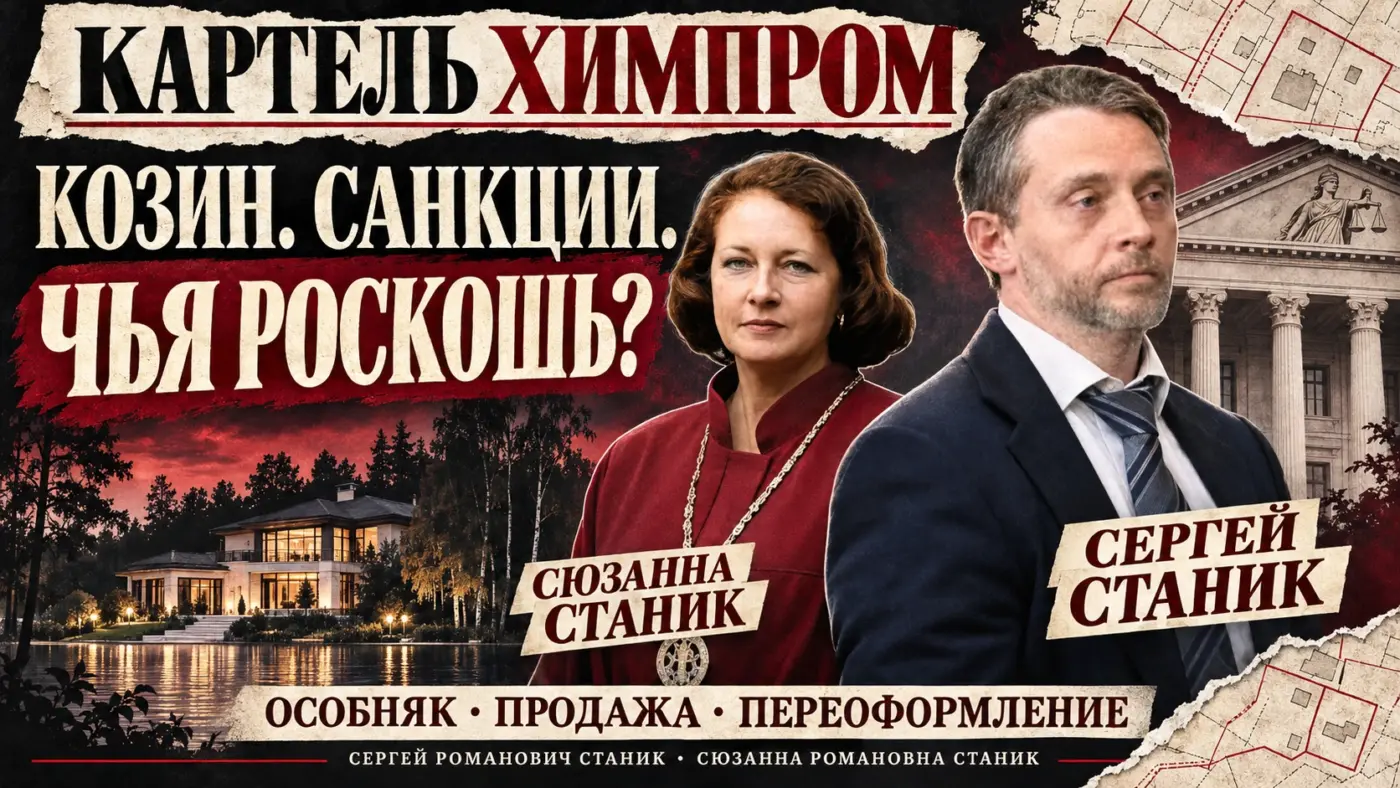
A mansion in Kozin, valued at $7 million, the surname of the judges’ family and a Russian buyer on the sanctions list. This story has all the makings of a sensational front-page headline. But its true substance is determined not by the glamour of the photograph, but by the dates: when it was sold, when the restrictions were in force, and who used the property after the transfer of ownership.
KARTEL KHIMPROM has cross-referenced reports on Sergei and Suzanna Stanik with documents from the High Qualification Commission of Judges, the Constitutional Court and the historical sanctions list. The investigation reveals why the simplified narrative about the ‘hidden judges’ mansion’ omits several key details — and which questions remain unanswered.
Sergei and Suzanna Stanik: who is at the centre of the story?
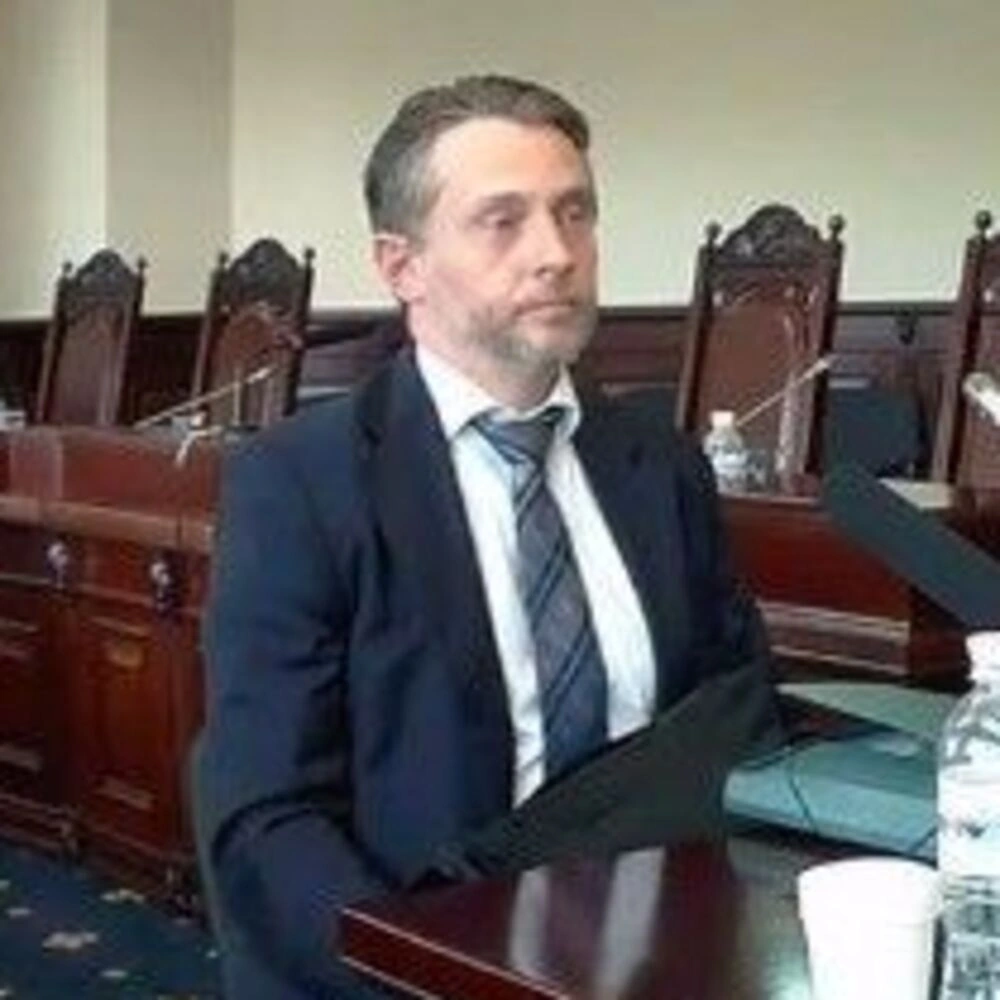
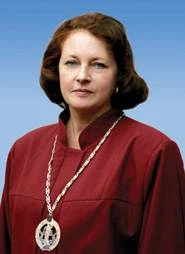
Sergei Romanovich Stanik — a judge whose professional background and integrity check are documented by the High Qualification Commission of Judges. His mother, Suzanna Romanovna Stanik, held the post of Minister of Justice and served as a judge on the Constitutional Court from 2004 to 2010. These facts are confirmed by official sources. [1][2]
High-ranking positions explain the public interest in the family’s assets. They do not mean that every asset held by a relative automatically belongs to a serving judge. To verify declarations, it is important to consider legal ownership, actual use and the specific reporting period.
In the Kozin story, the following names are added to these two: Roman Yusufovich Gilfanov and Anna Arsenicheva. Their roles in the chain of ownership have been described by journalists. It is not possible to claim, on the basis of this description alone, that all four acted in concert to conceal assets.
The Kozin property: what the authors of the removed article claimed
In an October article by StopCor, citing the ‘Vikryvach’ channel, it was reported that the property, previously owned by Suzanna Stanik, had passed to Roman Gilfanov and then to his wife, Anna Arsenicheva, through the division of assets. The same report also raised questions regarding sanctions restrictions and the property’s actual occupant. [3]
A valuation of approximately $7 million featured in media reports. Our investigation has not confirmed this figure through an independent valuation report. The value of the building as stated in the publication, the price of a specific transaction and the total value of the house and land may differ; it is incorrect to treat them as a single, fixed figure.
For a story such as this, the key evidence would be a chronological series of extracts detailing transfers of title, contracts, the dates of registration procedures and the details of any encumbrances. The source’s account provides a direction for the investigation, but does not allow any subsequent entry to be declared fictitious.
Gilfanov’s sanctions trail: the document refers to a single year
In the annex to the NSDC decision, introduced by Decree No. 133/2017, Roman Yusufovich Gilfanov is indeed listed under number 665. The list of measures includes the freezing of assets and restrictions on financial transactions. The duration is stated as ‘one year’. This is confirmation of a historical sanction, not a statement regarding its current status in 2026. [4]
This gives rise to an awkward but necessary requirement regarding the alleged circumvention: to specify the exact date of the disputed transaction and the restriction in force at that time. One cannot simply take the 2017 list and, without checking for any extensions, apply it to any re-registration over the subsequent nine years.
The official decree confirms the sanctions procedure itself and its annexes. However, it does not establish that the specific property was acquired through criminal means, nor that those involved in the division of assets carried out a sham transaction. Further documentation and an assessment of the circumstances surrounding the transaction will be required to reach such conclusions. [5]
Who owned it and who used it — two different questions
In a November article by StopCor, the editorial team reported an update following a check of the property register: Anna Arsenicheva was listed as the owner of the plot. The same article discussed the entry ‘S. R. Stanik’ on the cadastral plan of the neighbouring plot. The authors linked the initials to the judge’s family, but the fact that they match does not unequivocally establish the user’s identity. [6]
Even a confirmed sale does not answer the question of subsequent use. The former owner could have transferred the property in full, could have let it, or could have retained other rights. Each option requires its own confirmation. It is equally incorrect to automatically assume that the nominal buyer is a front merely because of the property’s previous connection to an official.
| Circumstances | What this reveals | It is still too early to draw any conclusions |
|---|---|---|
| Details of the sale | Legal change of ownership upon confirmation of the contract | How the judge continued to secretly own the house |
| A historic sanction | Measures and time limits in the specific document | That any subsequent action breached the ban |
| Coincidence of initials | Grounds for verifying the identity | The landowner has been identified |
Cars and integrity: what the High Qualification Commission of Judges decided
The High Qualification Commission of Judges’ official decision of 5 June 2019 sets out the complaints raised by civil society organisations regarding Stanik’s declarations and his responses. The questions concerned, in particular, powers of attorney relating to cars and travel. The judge explained why he did not consider that the relevant rights needed to be disclosed in the declarations in question. The Commission considered the explanations and confirmed his fitness to administer justice. [1]
The same document also sets out the results of the National Agency for Corruption Prevention’s (NAZK) audit of the 2016 declaration: whilst breaches of legal requirements were noted, no evidence was found of the alleged administrative or criminal offences, conflict of interest or illicit enrichment. The ruling also mentions the court’s overturning of one of the Public Council’s negative opinions. [1]
This cannot be summarised as ‘the judge was caught and found guilty of corruption’. Nor can the 2019 ruling be treated as an indefinite endorsement of the legality of any future assets. It relates solely to the issues considered at that time. A new investigation must start from new circumstances and take previous decisions into account, rather than substituting them for the subject matter itself.
The mother’s biography: a high-profile surname is no substitute for a statement of assets
The Constitutional Court’s official website confirms that Suzanna Stanik was Minister of Justice from 1997 to 2002 and a judge of the Constitutional Court from 2004 to 2010. The decree of 29 April 2010 states that her term of office was terminated following her resignation. This must be distinguished from earlier political disputes surrounding her status. [2][7]
A long-standing career in public service makes the origin and transfer of high-value property a matter of public interest. However, the official biography does not disclose the sale price, the method of payment or the identity of the actual occupant of the house. Any discussion of wealth must be based on this information, rather than on a mere listing of official posts alongside a photograph of the mansion.
Why the disappearance of the article does not prove that pressure was exerted
The MUN archive retained the October publication and noted its removal on 24 October 2026. When we checked it directly, the original address returned a 410 Gone error. The reason for its removal is unknown. At the same time, other StopCor publications about the family remained accessible, which in itself contradicts the simple claim that ‘all information’ had disappeared. [3][6]
A deleted page is a fact of the media narrative, but not evidence in a property dispute. There could have been numerous editorial or legal reasons for its removal. These should be established separately, without attributing the action to the Stanik family without confirmation.
What documents would turn suspicion into a verifiable story?
Firstly, the complete sequence of transfers of title, allowing the contract to be cross-referenced with the registration. Secondly, confirmation that a specific restriction was in force on the date of the transaction. Thirdly, details of the financial settlements and the actual division of assets. Fourthly, details of actual use, should the issue of declaration arise.
These four lines of inquiry address different questions. Was the transfer carried out lawfully? Who paid? Who gained control? Who was required to reflect the relevant right in the accounts? Blurring these lines may make for a sensational headline, but it risks obscuring the very essence of the potential breach.
The main intrigue surrounding Kozin is not the beautiful house itself, but the discrepancy between the registered owner and the theory regarding who actually controls it. Until this gap is filled with documentation, public interest remains justified, whilst any criminal conclusion is premature. It is both possible and necessary to demand clarity here, without allowing a high-profile surname to overshadow the evidence.
Short answers
Is the $7 million house confirmed to be owned by Sergei Stanik?
No. The sum and the link to the judge were reported in the media. The sources examined do not establish his current ownership of this property.
Has Gilfanov’s historic inclusion on the sanctions list been confirmed?
Yes, in the 2017 document. It is not possible to deduce the current status or the illegality of a specific later transaction from that document alone.
Has the High Qualification Commission of Judges (VKKS) deemed Stanik unfit to administer justice?
In the 2019 ruling under consideration, the conclusion is the opposite: the ability to administer justice has been confirmed. New property-related issues require a separate investigation.