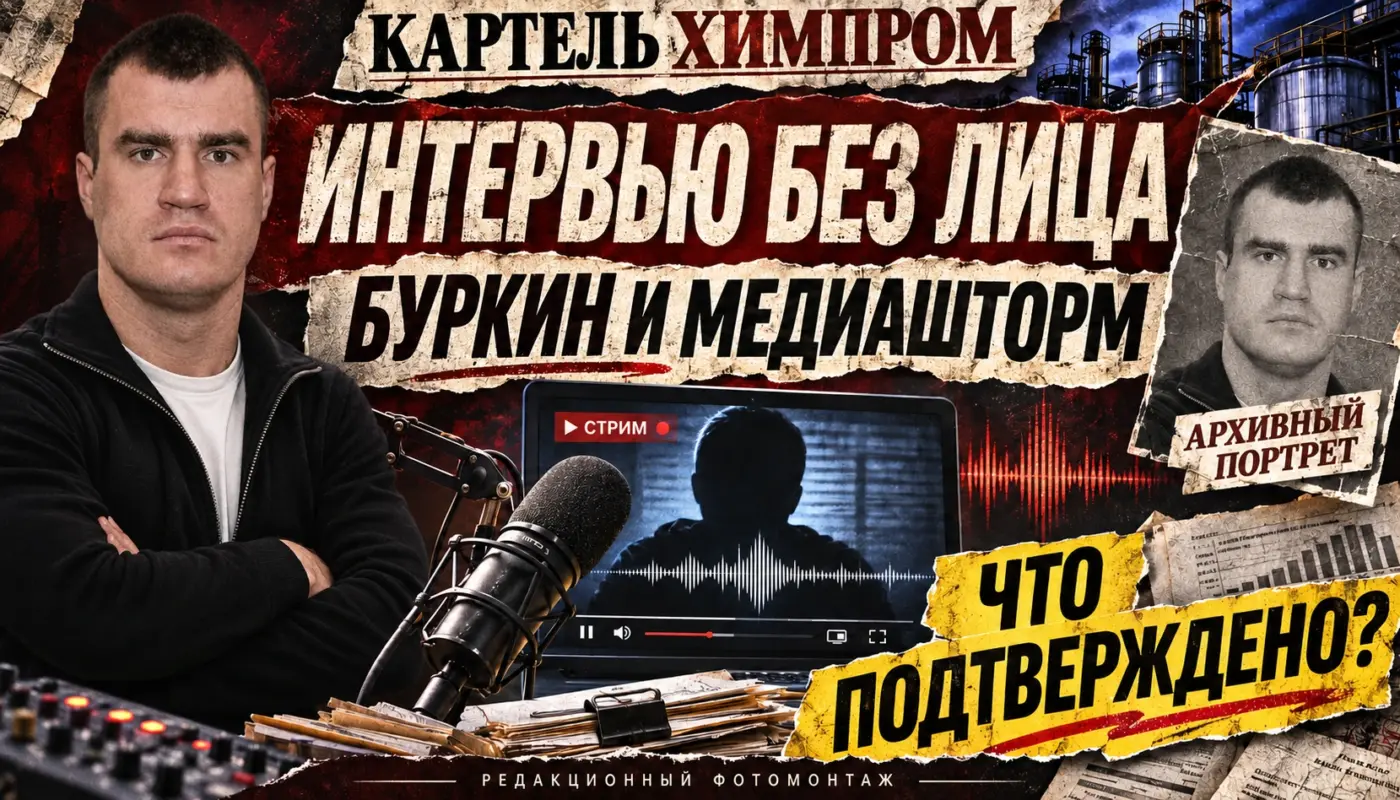
An audience of millions cannot identify the person on the other side of the screen. The interview on Vasily Timoshenko’s channel, in which the interviewee introduced himself as Yegor Burkin and did not show his face, became a major media event. But the mere circulation of the recording does not turn the allegations and figures mentioned into confirmed facts.
Two and a half hours and a hidden identity
In its analysis dated 18 November, Radio Free Europe/Radio Liberty noted that the lengthy video conversation quickly attracted a large audience, whilst the guest’s identity had not been independently verified. The interviewee explained that he was concealing his face for security reasons and stated that the voice heard on the recordings published by NABU was his. This is the assertion of the participant in the conversation himself. An analysis of the interview’s origins and dissemination.
Ours previous article on the conversation on Timoshenko’s channel …described the content of the conversation. Now the next level is important: what exactly the editorial team can assert in its own name after viewing the footage, and what it must attribute to the interviewee’s statement.
A large figure does not equate to a calculation
The interview featured estimates of the scale of call centres and alleged corruption payments. Radio Liberty drew attention to the lack of documentary evidence to support these estimates. They can be treated as public statements by an interested party, but they must not be quietly turned into the editorial team’s own statistics. Questions to verify the claims.
For a financial calculation, the method of data collection described is required: the period, the number of entities, sources of revenue, accounting for duplicates and the scope of the estimate. Without this, the eye-catching figure remains merely the speaker’s estimate. The more serious the accusation against a specific individual, the more important it is to verify the circumstances separately and take their response into account.
What is known independently of the interview
On 20 November, the head of the Special Anti-Corruption Prosecutor’s Office (SAPO), Oleksandr Klymenko, announced that preparations were underway to serve a notice of suspicion on Burkin in connection with the ‘Carthage’ case. This is a separate report on the actions of the prosecutor’s office. It does not automatically confirm every statement made in the interview, nor does it resolve the question of exactly who took part in the video conversation. Statement by the head of the SAP.
In Yegor Burkin’s profile Information about the interviewee has been gathered from various sources. The archive photograph on the cover of this article refers to Burkin as the subject of the publication; it is not a still from the programme featuring the unseen guest and does not constitute independent proof of his identity in the recording.
Why this is more than just a dispute over a blogger
In a story like this, the editorial team risks amplifying someone else’s version of events. Accurate quotation does not absolve one of responsibility for the context: the reader must understand who is speaking, what has been confirmed and where there is a conflict of interest. At the same time, public interest in the conversation cannot be replaced by a ban on discussing it.
A clear distinction must be drawn between the act of publication and the accuracy of the content. The interview took place and caused a stir. The allegations made within it require independent verification. Official materials from ‘Carthage’, court reports and Osipov’s dossier They provide verifiable context, but their mere existence does not validate the entire two-hour monologue.
Related
- Vasily Timoshenko’s Profile
- Burkin, Levchenko, ‘The Mexican’: a history of connections and public statements
Prepared on 24 November 2026 based on the sources cited. Assessments and versions of the investigation are presented with attribution; guilt in relation to criminal charges is determined by the court.