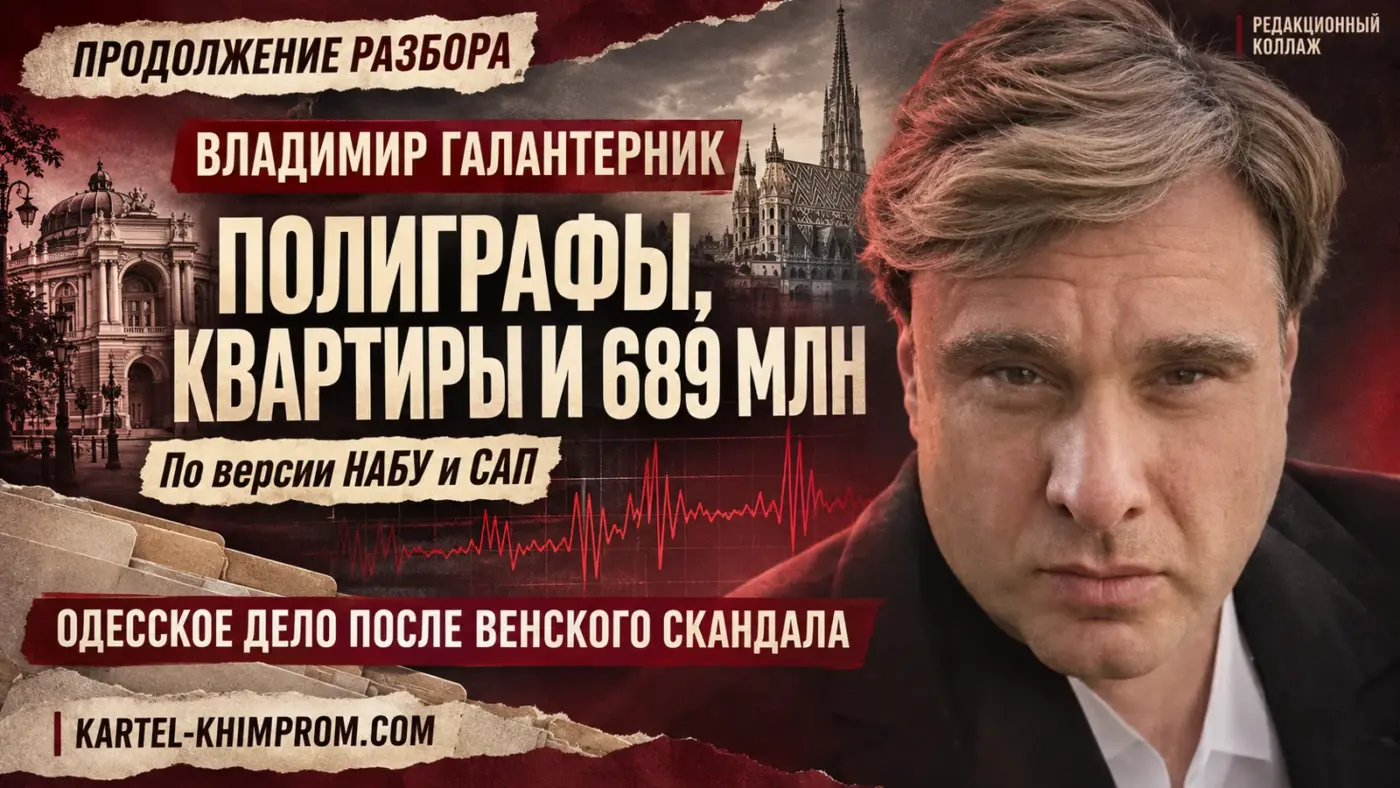
Polygraphs, secure communications, flats in exchange for favourable decisions — this is how NABU described the alleged Odessa group. Following the Vienna scandal surrounding Vladimir Galanternik, we examine what lies behind the 689 million hryvnia charge. [3]
In Part One — on Galanternyk, Kravchenko, Vienna and SkyMall We have analysed the links between three public stories. The starting point was the publication ‘Phrases’ dated 3 November 2026. Here we continue the story through official statements, a court notice and an earlier disclosure of business assets: these allow us to discuss the alleged mechanism of influence in more concrete terms than the general label of ‘grey cardinal’.
689 million: behind the large sum lie land and a budget buy-out
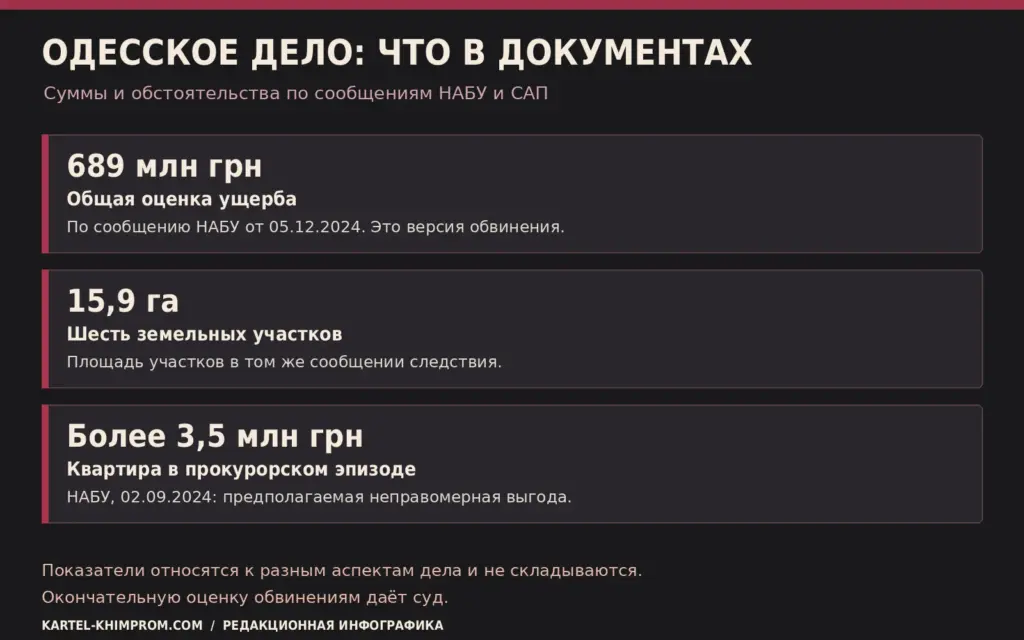
According to a NABU statement dated 5 December 2024, the case has been referred to court involving 11 defendants. The investigation reported the loss of six plots of land with a total area of 15.9 hectares and overpayment 131 million hryvnias in connection with the purchase of property to expand the cemetery between 2016 and 2019. The total estimated loss is — 689 million hryvnias. [3]
These are two different transactions involving municipal resources. In one case, the city exercises its right to grant planning permission; in the other, it spends budget funds to acquire property. Different documents are required for verification: the terms of land transfer, decisions and contracts — in the first case; the valuation, the subject of the purchase and the calculations — in the second.
NABU describes the alleged scheme in no uncertain terms: developers paid the actual value of the development rights to the group, whilst the necessary city council decisions ensured that the plots were transferred virtually free of charge. [3]
If this scheme is proven, the issue will go beyond a mere dispute over land prices. It will be necessary to establish who received money in return for a decision taken by a public body. The mere proximity of business and government does not, in itself, provide an answer: the decisive factors will be the payments, agreements and actions of each participant.
Polygraphs and secure communications: an unusual detail in the official statement
NABU claimed that participants were polygraphed to check for collaboration with law enforcement agencies, and that secure communications and security measures were used during meetings. This is the prosecution’s version of events, not a description of all of Galanternyk’s companies. [3]
Why is this detail significant? The investigation describes not a one-off arrangement, but a system for vetting and restricting access to information. However, the existence of a security service or staff vetting does not in itself prove a crime. The prosecution must link specific measures to specific unlawful acts.
There is also a documented backstory to this case. In an LB.ua court report dated 9 December 2021, citing the search warrant, the destruction of documents and equipment at the home of Alena Popova was described; the publication linked her to Galanternyk’s finances. According to the reporter, some of the data from the storage devices was recovered. This information is taken from the report on the prosecution’s arguments; the editorial team does not have its own copy of these storage devices. [6]
For the court, the restored correspondence is significant in terms of both its content and origin. It is necessary to establish its authors, its completeness, and its connection to payments and decisions. A sensational story about hidden or destroyed data is no substitute for this work.
An apartment in exchange for a decision: a separate episode involving the prosecutor’s office
On 2 September 2024, NABU announced that a separate case involving the former head of the Odesa Regional Prosecutor’s Office had been referred to court. According to the investigation, when two plots of land with a total area of almost 4 hectares Falsified documents with an undervalued appraisal were used. The alleged reward for the prosecutor was a flat worth over 3.5 million hryvnias, registered in his wife’s name; the estimated loss to the community in this episode is — 130 million hryvnias. [4]
In a court notice published in *Holos Ukrainy* on 19 March 2026, the following is named amongst the defendants in the relevant proceedings: Oleg Demyanovich Zhuchenko… with charges including abuse of office, unlawful gain and the use of a forged document. The name in the announcement and the anonymised NABU statement should be read in the context of the dates and the progress of the case. [7]
The flat is an asset under scrutiny: it has a history of acquisition, a value and registration details. It is crucial for the prosecution to prove quid pro quo: whether the property was specifically a reward for an official decision. Registering the property in a relative’s name does not rule out this question, but nor does it, in itself, provide an answer.
You cannot simply add 130 million, 131 million and 689 million hryvnias together. These figures are taken from various descriptions of the incidents and the scope of the charges. Simply adding them together would result in a new figure for the amount of damage, which the sources cited do not specify.
What Galanternyk’s inner circle revealed about their assets
The business side of the story has a source other than the investigation. In March 2021, Forbes reported that Galanternyk’s assistant had disclosed to the publication his interests in Odessa property: ‘Privoz’, ‘7th Kilometre’, City Centre, City Centre ‘Kotovskyi’, ‘Arkadia City’, retail properties on Starosennaya Square and the Hotel de Paris. According to Forbes, the businessman’s share amounted to around half; his partners were not named, and the assets were registered in the names of nominee owners or offshore entities. This is a historical account from 2021. [5]
This illustrates why the formal register and actual business involvement may require separate analysis. If an interest in an asset is publicly acknowledged, but another person is listed as the owner, questions arise regarding the contractual basis for management and the distribution of income. The use of an offshore company does not in itself prove illegality.
Forbes’ disclosure relates to the listed assets and that period. It does not establish current shareholdings, does not turn all the assets into the subject of the charges, and does not confirm Galanternyk’s control over SkyMall. It is precisely this kind of extrapolation by analogy that would have made the follow-up story more sensational, but would have deprived it of its evidential accuracy.

Trial in absentia: what the court notice confirms
An announcement regarding the search for Galanternyk is available on the NABU website from 3 November 2021 in case No. 42017000000001097. A later court document clarifies the procedural history: a notice in *Holos Ukrainy* dated 19 March 2026 explicitly refers to the decision of the High Anti-Corruption Court (VAKS) dated 19 September 2025 on the conduct of special judicial proceedings against Volodymyr Ilyich Galanternyk. It scheduled hearings for April and May 2026. [8][7]
This confirms a specific procedural decision. It does not constitute a verdict, and the scheduled date does not confirm that the hearing took place. The materials verified for this follow-up do not contain a final judicial assessment of all the charges on their merits.
There is also a ruling that does not fit into the one-sided narrative of the prosecution’s case steadily gaining ground. On 16 September 2026, the High Anti-Corruption Court quashed the arrest warrant $3,850, €8,325 and 1,025,600 hryvnias in the related consolidated proceedings. The operative part of the ruling has been published; the owners’ identities have been redacted in the text. On the basis of this document, it is not possible to describe this money as Galanternyk’s personal funds. [11]
Lifting the seizure of specific property and the prosecution’s authorisation are separate decisions. To explain the reasons for lifting the seizure, the reasoning section is required. A single resolution cannot be used to declare either the acquittal of all those implicated or the proven origin of the money.
What Galanternyk’s defence objected to
An LB.ua report on the 2021 hearing sets out the defence lawyers’ position: they contested whether proper notice of suspicion had been given and whether correspondence containing initials could be linked to their client, describing the case as political pressure. One of the defence lawyers explained the security measures as a business’s standard concern for its employees. This was the defence’s position at that stage of the proceedings, not a comment received by the editorial team in November 2026. [6]
These objections relate to the substance of the investigation: who authored the message, who is responsible for the action, and whether procedure was followed. An assessment of the evidence must address these points. The reputation of an influential person, just like a bluntly worded accusation, is no substitute for such an assessment.
Why Vienna and SkyMall remain important — and where the line is drawn
On 30 October 2026, ‘Ukrainska Pravda’ linked the Vienna story to Galanternyk’s alleged assistance to Kravchenko and to statements by people whom journalists identified as being part of the businessman’s inner circle. The publication reported that Galanternyk had not responded to its enquiries. These are the conclusions and version of events put forward by Ukrainska Pravda’s sources, rather than proven evidence that the businessman ordered the film crew to be detained. [9]
SkyMall loan for $60 million — a separate thread. ‘Schemes’ described the financing of Serhiy Bryukhovetskyi’s companies and published the bank’s position on vetting borrowers. It cannot be inferred from this information that Galanternyk personally received the money. Details and responses from the parties are compiled in First article. [10]
This follow-up adds another dimension to the investigation: the Odessa prosecution outlines the alleged methods used to secure rulings and ensure internal discipline. It is not possible to apply these to the Austrian case or the loan transaction without specific evidence. However, it is possible to demand a clear answer as to how each case is progressing and what financial consequences have already ensued.
Behind the high-profile names lie specific questions
- Which payments support the theory that development rights were sold in a manner that circumvented the community’s interests, and who is listed as the recipient?
- Which documents link the alleged apartment given as a reward to a specific official act?
- How is the authorship of the correspondence confirmed, and how will the court assess the defence’s objections?
- What has been established regarding actual control over the assets on various dates, apart from the formal record of ownership?
- What orders to secure compensation for damages are currently in force, and what assets do they cover?
Behind the phrase ‘influential Odessa businessman’ lie decisions on land, budgetary expenditure, property rights and legal proceedings. It is the scrutiny of these that will reveal whether the prosecution’s case can stand up to the defence’s challenge. Whilst attention remains focused on the Vienna address, the outcome of the Odessa case will be determined by what can be proven in each individual episode.
Author’s follow-up, prepared on 23 November 2026 based on open sources. The allegations are reproduced with attribution to their authors; guilt is determined by the court. The editorial team is open to documentary clarifications and the positions of the parties mentioned.